Nutrition and Training Habits Engaged Couples Should Build Together Before the Wedding
Shared fitness and eating habits now predict relationship satisfaction and health for decades.

Most couples treat the engagement as a countdown to a single day: the dress fitting, the diet, the "wedding body." The real opportunity is different and lasts much longer than a wedding day. Engagement is the window when a couple's daily habits, the ones that will run the household for decades, are still soft and moldable. Research on 227 couples found that happier couples shared more joint health behaviors than unhappier ones, and newer research suggests the arrow runs both directions: shared habits build relationship satisfaction, not just the reverse. A study out of UAB, published in Brain, Behavior, and Immunity and led by Stephanie Wilson, found that a happy marriage can slow or speed up biological aging depending on whether couples share healthy habits. The moderating factor was joint health behavior, making the real goal a marriage with shared habits built into its foundation before the ceremony even happens.
What shared habits do for a couple's relationship
Training and eating together rewires more than muscle and metabolism. Physical activity releases endorphins (linked to pain relief, euphoria, and better mood) and oxytocin (linked to bonding, trust, and emotional closeness), so a shared workout functions as a bonding event first and a training session second. Research cited by ACSM-CPT trainer Denise Cervantes notes that social interaction during physical activity boosts enjoyment and satisfaction, and that varying the routine improves long-term adherence. Partner workouts teach two people to read each other's physical and emotional cues, ask for help without embarrassment, and value effort over perfection, skills that get used at the dinner table and in the car during an argument about seating charts just as much as in the gym. Shared meals carry the same weight. A study published in Appetite by Herwig et al., drawing on data from 12,686 participants, found that couples who shared more meals reported higher relationship satisfaction, higher life satisfaction, fewer depressive symptoms, and better subjective health. Behavioral convergence drives all of it: partners monitor and influence each other's choices, and when one person improves a habit, the other tends to follow. Apps like Sweatmates, which help couples track workouts and check in together, are built on exactly this principle. Shared accountability turns good intentions into routines that can carry a couple through the engagement and straight into the marriage.
Training together when fitness levels and preferences differ
Mismatched fitness levels, the single biggest reason couples skip working out together, are a solvable problem. The first phase of engagement, roughly months 12 through 9 out from the wedding, should be about finding activities both people actually enjoy, not optimizing anyone's performance. The job right now is just showing up together, repeatedly, until it becomes automatic.
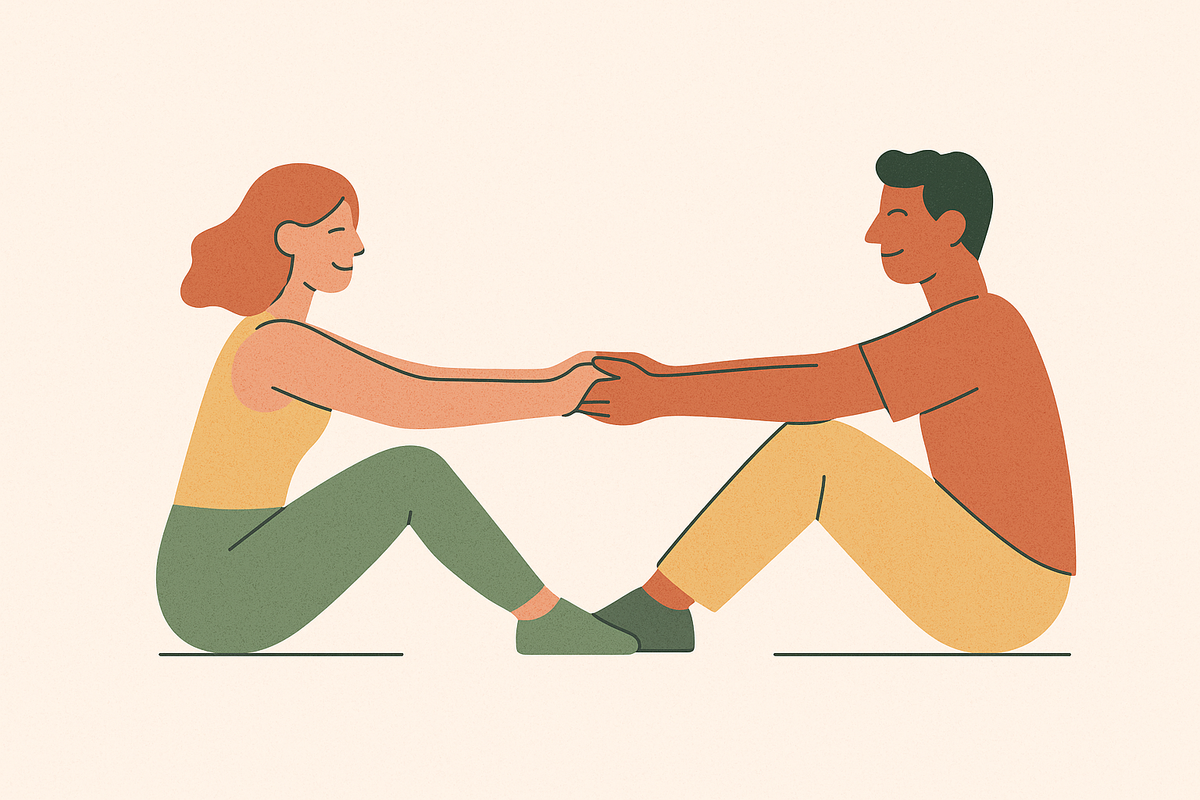
A few formats handle mixed fitness levels particularly well. Couples yoga (sometimes called buddy yoga) builds flexibility, balance, and mindfulness, and because many poses require one partner to physically support the other, it builds trust along the way. A back-to-back chair pose or a double tree pose demands communication no matter how fit either person is, and Cervantes calls it perfect for winding down together. Partner bodyweight exercises, like partner squats done hand-in-hand, partner plank high-fives, wheelbarrow push-ups, and medicine ball passes, require coordination more than raw strength, and they scale to any fitness level with small modifications. HIIT or bootcamp classes work too: sessions of 20 to 30 minutes deliver real cardiovascular and metabolic benefit without requiring matched endurance, and the group setting adds accountability from outside the relationship.
None of these formats is "the winner." Alternating who picks the activity each week keeps one partner's preferences from quietly taking over the couple's entire routine. A simple weekly goal, built around one partner's pace and the other's challenge, paired with a quick mutual check-in, helps couples find a rhythm without either person holding the other back or dragging the other along.
Best weekly workout plan for engaged couples (and how to pace it)
A phased approach across the engagement gives these habits a shape instead of leaving them as a loose pile of activities. Think of it less as a training program and more as a sensible shape for the year.
Months 12 through 9 out are the habit-building phase. The job is finding activities that fit both partners' schedules and sticking with consistency over intensity. Soreness after every session isn't the goal; showing up consistently is what counts.
Months 8 through 5 out are the strength phase, and this is where the most meaningful changes in body composition and metabolic health actually happen. Compound movements, squats, deadlifts, overhead presses, build the metabolic engine that carries a person through the rest of the engagement and beyond. Experts generally recommend three to six months for sustainable, visibly noticeable changes in muscle tone, so starting early matters more than training hard late.
The final eight weeks are a stress-management phase, not a transformation phase. Cortisol rises naturally as the wedding gets closer, and when stress climbs it causes bloating and skin sensitivity, the opposite of the glow most couples are chasing. So back off intensity here in favor of mobility work, Pilates, and Zone 2 cardio like steady-state walking. This stretch is about maintenance and recovery, full stop on intensity.
What matters across all three phases is consistency. A couple that shows up together three times a week for a full year will outperform a couple that trains hard for six weeks right before the wedding, both in how they look and in how the habit survives afterward.
Why crash dieting before the wedding undermines what couples care about
The impulse to want to look a certain way walking down the aisle is understandable. The evidence points somewhere else. When people crash diet, a large share of the weight lost comes from lean muscle rather than fat, which slows metabolism and moves body composition in the wrong direction. Dr. Nandini Dadu, a hair transplant surgeon and cosmetologist at Dadu Medical Centre, warned in July 2026 that extreme dieting disrupts metabolic, stress, and reproductive hormones, bringing on sleep disturbances, mood swings, low energy, and hormonal imbalance, particularly in women. Abrupt nutrient deprivation also interferes with collagen production and skin repair, leading to dryness, dullness, and heightened sensitivity, which is the exact opposite of the bridal glow the diet was supposed to deliver.
There's a psychological cost too. Food restriction layered on top of wedding planning stress compounds anxiety, and plenty of people report becoming obsessive about food in ways that linger well past the honeymoon. Practitioners across the field converge on the same 80/20 logic: most of the visible glow on a wedding day comes from nutrition and hydration quality sustained over months, not from cutting calories hard in the final weeks. Months of decent eating build what a short-term diet can't.
The nutrition habits couples should build together instead
Shared planning beats individual restriction, and the research backs this up. Herwig et al., in a study published in Appetite, found that couples who shared more meals reported better subjective health along with higher relationship and life satisfaction. So eating together is a health behavior worth building on its own.
Batch cooking on the weekend is a practical place to start. Wedding planning eats into weekday time fast, so preparing a week's worth of balanced meals together, built around protein, fiber, and healthy fats, cuts down the daily decision load and makes the healthy choice the easy choice. EveryDay Fitness notes that shared meal prep builds mutual accountability and turns nutrition into a supportive routine shared by both partners.
The 90/10 framework fits naturally here: eat whole, nutrient-dense food the large majority of the time, and leave room for cake tastings and celebratory dinners without guilt. That balance is sustainable through a full engagement in a way that crash dieting never is.
A joint consultation with a registered dietitian is worth building, rather than one partner simply adopting the other's plan. The Appetite research found that in heterosexual couples, shared meals were associated with higher meat consumption for women but not for men, suggesting women more often compromise their own preferences when eating jointly. When one partner has specific goals, plant-forward eating, managing a condition like PCOS, or a food intolerance, a joint consultation keeps that person from quietly abandoning their own needs. Herwig et al. call out the importance of including romantic partners in interventions targeting eating behavior, since couples make food choices as shared decisions far more often than as individual ones.
How accountability between partners stays supportive rather than controlling
Accountability that strengthens a relationship and accountability that strains it come down to one question: is the couple tracking compliance, or celebrating effort? Research consistently shows social accountability, built on support, drives exercise adherence. A partner who makes sure leg day happens works because that person feels invested in you, not because you're afraid of disappointing them.
Picture the exchange after a missed workout. One version sounds like a scoreboard: "You said you'd go three times this week and you went twice." The other sounds like a conversation: "What got in the way today?" The version built on curiosity instead of score-keeping is the one that keeps a couple on track long-term.
Simple weekly goals hold up better than detailed tracking systems for this reason. And when one partner trains alone some days while the couple still shares a broader goal, the system still holds. EveryDay Fitness points out that personal training works as a solid alternative when a workout partner isn't available, giving someone professional accountability and structured sessions on the days a partner can't make it.
Tools that help couples stay connected to their shared goals without adding complexity
The best tools for engaged couples make shared progress visible and make it feel encouraging. They don't just pile on more data.
Sweatmates is built specifically around fitness accountability between partners, friends, and couples, and it leans into the principles already covered here: simple weekly goals, a shared view of progress, friendly wagers, a separate streak-based reward feature, and workout photos that carry more motivational weight than another chart ever could. Partners can train separately on a given day and still feel connected through that ambient awareness and encouragement, and that matters during an engagement when schedules rarely line up perfectly. The platform is built around mutual support rather than head-to-head competition, and that fits a season already carrying enough pressure from vendors, guest lists, and seating charts.
A shared calendar works too, and it costs nothing. Blocking out workout times and batch-cooking sessions as calendar events treats those commitments with the same seriousness as a venue tour or a vendor call. Denise Cervantes points to the SunnyFit app as a resource for following dance workouts together at home, and it suits couples who'd rather follow a guided session than build their own program from scratch. On the gym side, EveryDay Fitness offers a partner add-on for existing memberships, a low-friction way to formalize shared gym access without committing to much, and the same low-cost, shared-access logic applies at most gyms generally.
The real test for any tool is simple: does it make showing up easier and make the couple feel more connected, or does it just become one more obligation? A tool that adds complexity or generates shame around a missed session is working against the exact habits a couple is trying to build.
What happens to the habits after the wedding
A couple that builds these habits during the engagement walks into marriage with something sturdier than a good wedding-day photo: a working system for supporting each other's health over the long run. Behavioral convergence compounds once it's established. A couple that batch-cooks before the wedding is far more likely to keep batch-cooking during the first year of marriage, right when time pressure actually gets worse.
The UAB research led by Wilson found that the biological aging benefit of a happy marriage depends on joint health behaviors, not on emotional satisfaction alone, and happiness paired with unhealthy shared habits can actually speed up biological aging. The habits are doing the work, not the feeling. Other research on gender asymmetry has found that wives are more likely to look out for their husbands' health behaviors than husbands are to return the favor. Couples who build explicitly shared habits during the engagement are less likely to fall into that imbalance, because mutuality gets established as the default from the start.
The habits that actually survive the honeymoon and the first year are simple: a weekly cooking session, a regular walk, a shared monthly goal. Starting before the wedding matters because engagement is when both partners are the most aligned in motivation and the most open to building something new side by side. That window doesn't slam shut after the ceremony, but it gets narrower. The best time to start is now, while the invitations are still going out and the habit is still cheap to build.