At-Home Workout Plan Without Equipment for Brides
Build strength and posture that actually show in photos, not just on a scale.
A bride stands in front of a fitting-room mirror, arms raised while a seamstress pins fabric at her back, and her shoulders start shaking after about ninety seconds. Not from nerves. From holding a position her body has never had to hold for that long. She trained for a long-distance race last spring. Nobody told her to train for standing still in eight pounds of beading for six hours straight. That gap, between the body she built for a race and the body her wedding day actually asks for, is the real starting point here. What actually stands in the way isn't motivation or picking the right workout, it's time. By 2026, most couples planning a wedding are juggling two full-time jobs, vendor calls, venue walkthroughs, and cake tastings, often in the same week, sometimes the same evening. A calendar with no open seats left on it isn't a willpower shortage. A workout plan that assumes a bride has a free hour, a gym membership, and the mental bandwidth to drive somewhere after a ten-hour day is a wish list, not a fitness plan. The workout that actually gets done is the one already sitting in the corner of the bedroom when she walks in the door at 7pm, tired and still holding her phone open to three unanswered florist emails. Every piece of advice that follows in this plan gets built around that one fact.
What bodyweight training can and cannot honestly deliver
Bodyweight training, done at home with no equipment, will not turn a body into something unrecognizable in eight to twelve weeks. Say that up front, because a plan that overpromises loses trust the first time a bride checks a mirror expecting a transformation and doesn't see one. Without a calorie deficit layered on top, dramatic changes in body composition in that short a window aren't realistic from bodyweight work alone, though studies do show real, measurable gains in muscle mass and drops in body fat over an eight-week stretch of consistent training. What bodyweight training delivers reliably: better posture, more endurance, a steadier nervous system, and visibly improved muscle tone and control, even without a single dumbbell in the house.
That's not a consolation prize. Those are the things that actually show up on the wedding day. Nobody studies a photo wondering if the bride dropped two percent body fat. They notice how she stands, how she carries her shoulders, whether she can dance for three hours straight without needing to sit down and fan herself. Eight weeks is enough time to feel a real, noticeable shift in strength, energy, and posture, and that shift is the entire point of this plan: not looking different, but feeling strong walking down the aisle and having the stamina to dance until the band packs up.
Setting a weekly goal structure that survives a chaotic planning schedule
A rigid, day-by-day workout schedule is the first casualty of wedding planning season, because the schedule itself is the thing under attack. A better structure sets a weekly target instead of a daily mandate, one flexible enough to absorb a canceled Tuesday without the whole plan collapsing. Start with how the bride wants to feel, not a number on a scale. Strong. Confident. Able to survive a twelve-hour planning weekend without running on fumes. A scale number swings around with water retention and muscle gain anyway, and chasing it just adds stress to a season already full of it.
Aim for two strength sessions and one active-recovery walk per week, for the next four weeks. Specific, measurable, doable, tied to the actual goal, with a deadline. Compare that to something vague like "get fit before the wedding," which isn't a goal so much as a mood. Sessions can swap around depending on energy that day, and they don't need to eat up a full hour. What matters more is the total number of minutes moved across the week, not whether any single session hit sixty minutes on the dot.
A sample week might run: one rest day, one full-body strength session, one active-recovery day (yoga works well here), one cardio day (dancing, cycling, or a short HIIT burst), another rest day, one fun movement day with friends or a second strength session, then a final day of rest or light recovery. Treat that as a loose rhythm to bend around a seating-chart deadline, not a locked-in order. The real move that keeps this from falling apart: put the workouts on the same checklist as the florist meeting and the cake tasting. Once it's a scheduled commitment next to the vendor calls instead of something to squeeze in if time allows, it actually survives the season.
The three-phase progression that takes a bride from first workout to wedding week
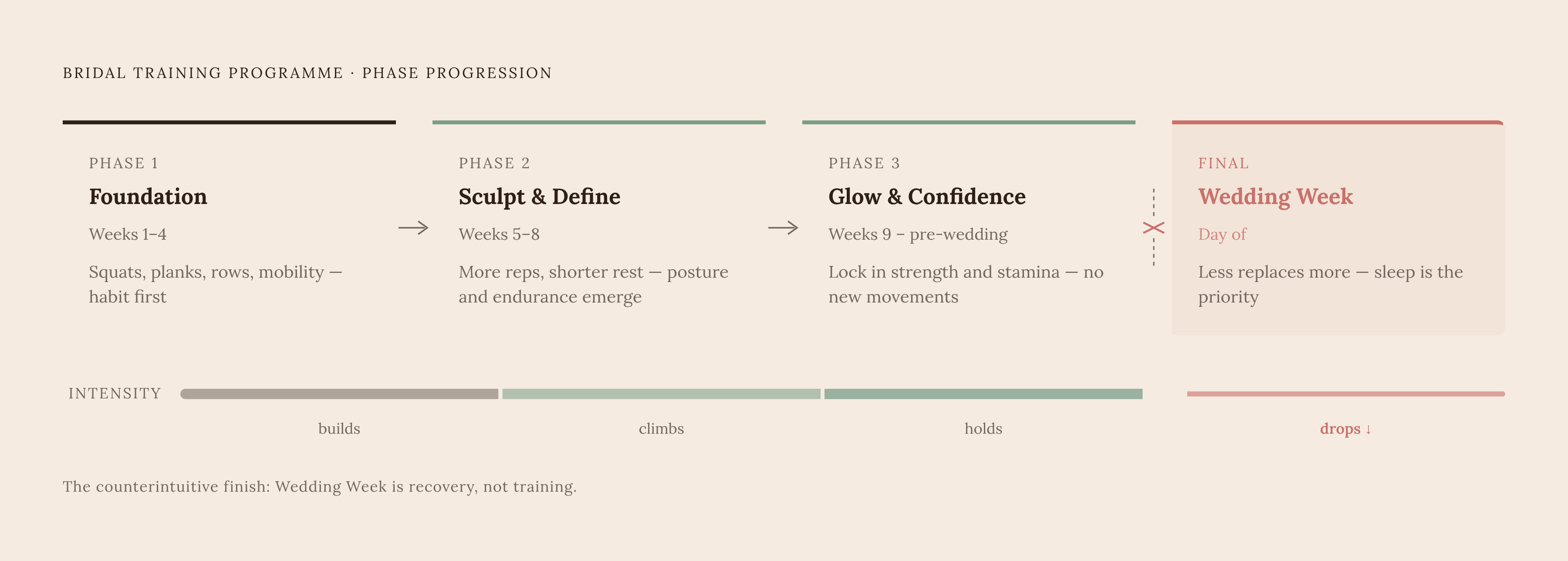
A long engagement needs a sense of direction, something that tells a bride where she stands and what to focus on next so the plan doesn't stall out around week five, which is exactly when most routines quietly die. Three phases carry a bride from day one to the week of the wedding itself.
Phase one: Foundation (roughly weeks 1 to 4). The focus here sits on building the habit and relearning basic movement patterns, squats, planks, rows, and simple mobility work. The goal in phase one isn't intensity, it's showing up consistently enough that the habit sticks before anything harder gets added.
Phase two: Sculpt and define (roughly weeks 5 to 8). Once the habit holds, repetitions go up, rest periods shrink, and exercise variations get a bit harder. This is where the posture and endurance gains from bodyweight training become noticeable day to day, not just in a workout log.
Phase three: Glow and confidence (roughly weeks 9 through wedding week, minus the final week itself). Training here locks in strength and stamina while confidence builds alongside it. Sessions stay challenging but shouldn't introduce brand-new movements this late in the game.
Wedding week itself breaks away from all three phases. Sessions shrink down, intensity drops, nothing new gets introduced, and sleep becomes the priority. Pushing hard the week of the wedding doesn't add fitness. It adds risk, soreness, and exhaustion right when neither is welcome.
Which exercises to prioritize based on the dress silhouette
The dress itself tells a bride which muscles matter most, which is what turns a generic workout plan into one built specifically for her wedding day.
A basque waist, with its V-shaped seaming that elongates the torso and carves out an hourglass shape, shows up across Spring 2026 collections from Ouma, Alyssa Kristin, Cinq, Nadja Manjarrez, Claire Pettibone, and Wona Concept. That silhouette rewards a strong, stable core. Planks, dead bugs, and functional moves like squats build the posture and stability that make the seaming sit the way it's supposed to.
Backless and low-back gowns remain a dominant choice for 2026, and they put the entire upper back and shoulder blades on full display with nowhere to hide. That calls for rows, reverse flys, overhead presses, lateral raises, wall angels, and band pull-aparts, moves that build visible definition across the exact real estate an open back shows off. Rows and band pull-aparts deserve a spot in every single week of the plan, since posture improves visibly in photos after those two moves.
Strapless and fitted bodices pull every eye toward the arms and shoulders, and the instinct is to chase arm isolation exercises. Spot reduction doesn't work that way. Visible arm tone comes from training the whole body consistently, not from a hundred tricep kickbacks in isolation.
Ballgowns and heavier fabrics demand plain functional strength, since carrying that much material through a full day and night of standing, walking, and dancing is its own kind of workout. Goblet squats, dead bugs, and rows cover the legs, core, and back needed to wear a heavy gown without exhaustion setting in by hour four.
One rule cuts across every silhouette on this list: posture. Strengthening the upper back and shoulders, then practicing standing tall, ears stacked over shoulders, shoulders down and back, ribs stacked over hips, changes how a bride carries herself in every single photo taken that day, no matter what dress she's wearing.
A bodyweight-only session that requires nothing but floor space
This is one full session, built entirely from the priorities above, that needs nothing but a stretch of open floor.
Start with a short warm-up, two to three minutes of light mobility work: standing cat-cow, arm circles, and hip circles to get the joints moving before anything harder starts.
The main circuit runs three rounds total. For the upper back and posture, hold a face-down back extension for time to work the posterior chain and upper back, then move into a reverse fly, lying face-down with arms extended and lifting them off the floor, followed by wall angels to train shoulder and postural alignment. For the core, hold a plank (progressing to plank shoulder taps as it gets easier), add a dead bug for core stability without putting strain on the spine, then a side plank to hit the obliques, which matters most for anyone wearing a basque waist. For the lower body, run through a bodyweight squat (progressing to a squat jump or a slow, controlled eccentric squat), a reverse lunge for balance and single-leg strength, and a glute bridge for the posterior chain (progressing to a single-leg version once the two-leg version feels easy).
Finish with a two-to-three-minute cool-down: gentle stretching and one posture drill to close the session the same way it started, paying attention to alignment.
Across the twelve weeks, progress comes from three simple levers: more repetitions, shorter rest between sets, or a harder version of the same move. No equipment needed to keep making the body work harder over time. Just a willingness to push the dial up gradually, week over week.
Using movement as a stress-management tool during the planning season
The biggest win from this plan might not even be physical. Regular movement lowers stress, improves sleep, and lifts mood, which makes fitness a two-for-one deal during engagement season: it shapes how the body looks and feels on the wedding day, and it helps a bride actually survive the months of planning that come before it.
On a day where a full session feels impossible, movement in smaller doses still counts for something. A fifteen-minute bodyweight circuit, a walk taken on the phone during a vendor call, a few minutes of stretching between venue research tabs, none of that needs to be a full workout to matter. A scheduled session and ten minutes grabbed between tasks register the same to the body. It just registers movement.
A partner, a friend, or even a simple daily check-in text turns a solo habit into a shared one, and a shared habit is a lot harder to skip than a private promise made to no one but yourself. On the days when energy is genuinely gone, a short walk or ten minutes of easy yoga keeps the habit alive in its smallest possible form, which matters more over twelve weeks than any single session's intensity ever will.
Getting back on track after a sideways week, without shame
A missed week is going to happen. Somewhere between the seating chart meltdown and the caterer who suddenly can't do the Saturday date anymore, a week of planned workouts is going to disappear, and that's not a reason to panic or scrap the whole plan.
Treat a missed week as information, not failure. Ask not "how do I make up for this," but "what made this week so hard, and does the plan need to flex around it. Punishing a missed week with a crash diet or a sudden spike in workout intensity backfires badly, and eating too little in an attempt to "catch up" can actually cause hair thinning and dull skin, the exact opposite of what any bride wants heading into wedding photos.
Getting back on track doesn't require heroics. Return to the last phase that was fully completed, do one session at a moderate, comfortable intensity, and pick the weekly rhythm back up from there. No bonus sessions, no doubling up to make up for lost time. A partner or friend checking in on progress makes that return a lot easier too, since a habit with someone else attached to it carries weight that a private goal alone often doesn't.
How to handle the final week before the wedding
The final seven days call for less, not more. That's the one piece of advice brides tend to get backward, reaching for one last hard push when the smarter move is pulling back. Shorter sessions, lighter loads, nothing new added to the routine, and sleep prioritized above almost everything else. No new exercises. No new diets. No new supplements showing up for the first time days before the ceremony. The body has had eight to twelve weeks to adapt. It doesn't need a surprise in week thirteen.
Light walks and easy stretching keep the body moving and the stress hormones in check without creating soreness that lingers into the ceremony. Sleep, water, and breaking in the wedding shoes beforehand matter more in this final stretch than any workout could. Those are fitness tools in their own right, not side notes to the plan.
On the morning itself, there's nothing left to chase. A few deep breaths, a light stretch, and a quiet recognition that the work is already done. The posture, the stamina, the steadiness built over eight to twelve consistent weeks is already there, standing in the mirror. This plan was never about reaching some perfect version of a body by a deadline. It was about showing up often enough that the wedding day feels like the payoff for all that consistency, not a finish line that was frantically chased down at the last minute.