Walking as a Wedding Planning Fitness Strategy for Busy Couples
Walking fits wedding planning chaos because it needs no gym bag, no booking, and no mood.
The right fit for a planning schedule that leaves no margin
Engaged couples typically face a planning window that stretches well over a year. Fifteen months, a long list of vendors, a fixed date that doesn't move, and no built-in rest. Most engaged couples try to bolt a gym routine onto that chaos and quit by month three: the workout most people pick for engagement season is the wrong one. A spin class needs a booking, a bag, a commute, and a mood. Walking needs shoes.
The best workout is the one that actually happens. Research into how couples actually manage their schedules finds that dual-income couples juggling vendor calls, venue walkthroughs, and full-time jobs finish workouts that need zero travel time far more often than ones requiring a gym bag, a class booking, and a parking spot. Walking clears that bar because it barely asks anything of you. No membership, no commute, no special outfit unless sneakers count (they don't, but nobody's checking).
It's also free, which matters more once the budget has a line item called "miscellaneous florals." The Everygirl's wellness editor, writing twelve months out from her own wedding in a piece published August 2025, called walking "truly a miracle exercise" that's "completely free and enjoyable," and said she'd trade a forty-five-minute gym session for a forty-five-minute walk without a second thought, because the walk would "often serve me more."
Walking scales down without losing the point, too. A fifteen-minute loop after dinner counts. A walking pad at a slow clip while answering vendor emails counts. Venue visits, florist consultations, and cake tastings are already on the calendar, so walking doesn't compete with wedding planning. It rides along inside it. That's the whole trick, and it's the reason it survives where every other workout gets quietly abandoned by spring.
What walking does to a stressed body during a high-cortisol period
Planning stress doesn't stay abstract for long. Bloating, breakouts, insomnia, and mood swings appear when cortisol stays elevated for months, and they tend to feel like they came out of nowhere. They didn't, because the cause sits in the bloodstream, not in anyone's head. The same cluster of complaints appears repeatedly in bridal stress surveys, and the cause sits in the bloodstream, not in anyone's head.
A 2025 mobile-based walking study in ScienceDirect found a walking group had a real drop in perceived stress (Cohen's D of 0.60) and negative mood (Cohen's D of 0.65), while a control group that didn't walk showed no change. Unlike a punishing spin class, walking lowers cortisol directly without spiking it first. It also supports post-meal blood sugar and circadian rhythm, especially when it happens outside in daylight.
Taking it outdoors makes the effect stronger, not just nicer. A 2025 randomized trial in Scientific Reports found a month of repeated forest walking produced a real drop in cumulative hair cortisol, with salivary cortisol falling only in the walking group. Nobody needs an actual forest. A neighborhood park pays a version of the same dividend.
The heart numbers argue against the way most people log their steps. Research has found that sustained walking bouts carry a greater cardiovascular benefit than steps scattered in small increments across the day. One deliberate evening walk beats steps scattered in small bursts across the day while on hold with a caterer. A peer-reviewed meta-analysis in PMC backs that up with hard numbers: walking groups saw systolic blood pressure drop 3.72 mm Hg, diastolic drop 3.14 mm Hg, resting heart rate drop 2.88 bpm, body fat drop 1.31 percent, BMI drop 0.71 kg/m², aerobic capacity gain 2.66 mL/kg/min, and a real drop in depression scores. None of that needs a gym membership.
How walking together changes the planning dynamic, not just the fitness outcome
A study in the journal Family Relations, drawing on data from nearly 1,700 married couples in the nationally representative CREATE study, found couples who exercise together report measurably better relationship outcomes than couples who don't. Walking was the most commonly reported shared exercise in that dataset.
Lead researcher Mildenhall said: "Out of all three outcomes, exercise had the biggest impact on communication. That's why it was interesting that walking was the number one reported exercise. It naturally provides opportunities to communicate." Couples in the study who exercised together reported better overall relationship quality, which happens to be the exact muscle that starts to atrophy around vendor deposit number seven.
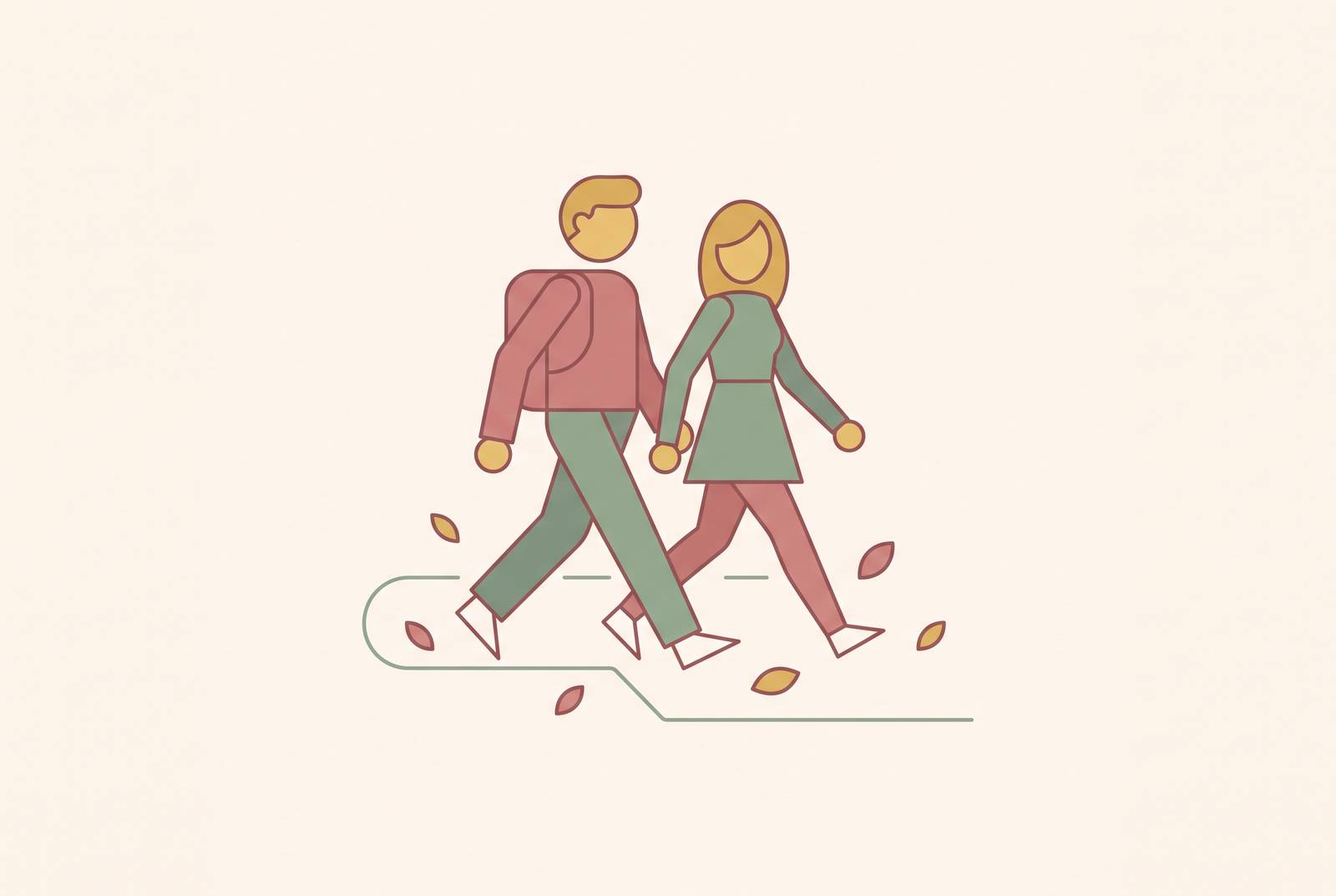
Side-by-side movement takes the pressure off in a way face-to-face conversation never does. No eye contact standoff, no gym mirror competing for attention. Matching stride for stride with another person builds trust and cooperation almost without either person noticing, and the pace itself matters less than the time spent moving together. Nobody's setting a personal best out here. Thirty minutes of unscheduled talking is worth more than the split time, and during an engagement, it's worth more than a faster mile too.
Ways to weave walks into the planning calendar without adding a new obligation
Don't carve out new time. Attach the walk to something already happening on the calendar, because a fifteen-month engagement has no spare hour sitting around waiting to be filled.
Plenty of venue walkthroughs and florist consultations sit in walkable neighborhoods, so turning the trip there or back into a walk changes the whole feel of the errand, from chore to something closer to a date. A simple and widely recommended protocol is a short walk after dinner on weeknights. It steadies digestion and blood sugar, and it swaps out scrolling wedding forums in bed for an actual conversation.
For the admin-heavy stretches, ourvows.app's guide flags a walking pad set to a gentle incline while clearing vendor emails or working through a budget spreadsheet as a real trend for 2025 and 2026. A treadmill desk adds daily distance without ever blocking off separate workout time, which matters when there's no separate workout time to block off.
For couples who want more structure, Bespoke-Bride's expert guide points to the 12-3-30 protocol (a moderate incline, 3 miles per hour, 30 minutes) as a low-impact way to work the glutes, hamstrings, and calves without running. Beginners should start at a gentler incline for fifteen to twenty minutes and build from there.
Save the longer walk for the weekend. The Annals of Internal Medicine research found bouts of fifteen minutes or more carry the bigger cardiovascular payoff, so a Saturday loop through the venue's neighborhood or a Sunday farmers market walk is both the most enjoyable option and the most productive one. Three to four brisk sessions a week is a reasonable baseline. In the final week before the wedding, drop the intensity entirely: light walks and stretching only. Nobody needs sore calves on the actual day.
Pacing the walking habit across the engagement timeline
Fifteen months is enough runway to build a real habit without rushing it. So don't rush it. Early on, roughly nine to twelve months out, the goal is just making the walk automatic: short loops after dinner, an occasional weekend outing, nothing that requires willpower to sustain.
By the middle stretch, five to eight months out, consistency has piled up enough that longer walks and the occasional incline session make sense. Ourvows.app's twelve-month timeline notes that sustained consistent movement is usually when couples start noticing real changes in energy and body composition.
At the two-month mark, the goal shifts again, toward cortisol management and mobility rather than pushing harder. Ourvows.app's final-phase guidance points toward Pilates, mobility work, and steady Zone 2 cardio (walking fits neatly here) over any kind of intensity increase, and the final week tapers to light walks and stretching only.
Couples starting later than the fifteen-month average haven't missed anything. Even three to six months of consistent walking delivers a real drop in stress and a real bump in cardiovascular health. The only actual mistake is waiting for some more convenient month that was never going to show up.
Making the walks feel like something you want to do rather than something you should do
Consistency doesn't come from discipline here. It comes from the walk being genuinely enjoyable, and the research consistently shows that enjoyable shared habits sustain themselves, no willpower required.
Naming the walk helps more than it sounds like it should. "Our Sunday venue walk" or "the post-dinner loop" belongs to the relationship, not to a fitness app's streak counter. Adding a small, silly stake (loser picks the next dinner spot, winner calls the Saturday plan) turns the whole thing into a game instead of one more task on a list.
A quick photo from the walk, the street, the sunset, the outside of a venue under consideration, proves showing up better than any chart or step count ever will, which is the logic behind Sweatmates, a shared fitness accountability app for couples built around photo check-ins, weekly goals each partner sets for themselves, and friendly wagers that make showing up feel like something the two of them are doing rather than something either one is tracking alone. The walks don't need to happen together every time, either: a solo lunchtime walk on a busy Tuesday and a shared evening walk on Thursday both count toward the same habit. Shared doesn't mean simultaneous.
Missing a week during a stressful venue-hunting stretch or a rough conversation with a parent about the guest list is information. It's information. A short "what got in the way this week?" conversation does more good than guilt ever has.
What walking during the engagement builds that survives into the marriage
The wedding date is a deadline. The walking habit doesn't have to be one. Couples who build this into the engagement have already cleared the hardest part, starting, and they walk away from the wedding with a ritual they already know they can keep.
The same Family Relations study that found communication and conflict-resolution benefits among married couples who exercise together points to where this habit actually goes: the patterns set during planning tend to stick. A walking habit doesn't need an app subscription, a membership renewal, or new gear every season. It bends around whatever life looks like next year, whether that's a move, a new job, or something bigger down the road.
None of this was ever about a number on a scale or fitting into a dress a certain way. It comes down to showing up together, over and over, until the planning stops feeling like something each partner carries alone and starts feeling like something they carry side by side. That's what a walking habit delivers, and it keeps delivering long after the wedding photos come back from the printer.