Stress Management Workouts During the Engagement Period
Couples who work out together lower stress and strengthen their relationship during engagement.
Wedding planning stress is not in your head, and it is not a sign you picked the wrong person to marry. It is a documented, near-universal experience, and it hits hard enough to strain the relationship it's supposed to celebrate. Working out together is one of the few tools that fixes both problems at once: it lowers the stress chemically, and it puts couples on the same team while it does it.
Why exercise works as a stress response, not just a wellness habit
Start with the numbers, because they're worse than most people expect. Zola survey data puts the share of couples who feel some form of wedding planning stress as high as 96%. That's not a subset. That's almost everyone standing at the altar having just crawled through some version of the same fire.
And it's not mild. Forty percent of couples rate the planning process as "very" or "extremely" stressful, and 71% say it beats out buying a house or landing a new job on the misery scale. A poll of 842 engaged and recently married couples found 70% reported negative mental health effects, with nearly 22% calling the impact "significant." Only 13% said planning did anything positive for their wellbeing. Rock n Roll Bride, citing a therapist, lists the physical toll: headaches, appetite changes, hair loss, skin breakouts, a drop in sex drive. None of that is metaphorical. It's cortisol doing what cortisol does when it doesn't get a release valve.
Alyssa Bowman, a marriage and family therapist at Banner Health who also plans weddings, names three usual suspects: unrealistic expectations, pressure from family, and starting too late to give yourself breathing room. Money doesn't help. The average one in the country wedding ran about $33,000 in 2024, per Zola, and planning involves over 150 individual decisions. That's not a to-do list, that's a part-time job with a deadline and a guest count.
The relationship absorbs the hit. Of 500 couples Zola surveyed, 43% said planning put real strain on the relationship itself. An important distinction is worth making here, though: short bursts of stress aren't the enemy. A tight deadline can sharpen focus and build resilience. It's the stress that never lets up, the kind that runs the full length of an engagement, that wears a couple down. That's the gap a workout routine is built to fill, not by removing the wedding, but by giving the nervous system somewhere to put the pressure.
Exercise works on stress through more than one channel at once. According to the Anxiety and Depression Association of America (ADAA), movement triggers endorphin release, improves sleep, releases muscle tension, and lifts mood, all in the same session. Research the ADAA cites found people who exercised vigorously on a regular basis were 25% less likely to develop depression or an anxiety disorder over the following five years. A systematic review and network meta-analysis by Li, Huang, and Zhu, published in the journal Sports, pooled 44 randomized controlled trials and found exercise produced moderate cortisol reductions overall, with yoga at the top of the list. A separate 2025 review of 38 studies from 2020 to 2025, covering more than 20,000 people, found the same pattern: more physical activity, less stress, less anxiety, less depression, and higher reported wellbeing.
The dose doesn't need to be big, which should feel like relief instead of another obligation. Psychologists cited by the ADAA note that a 10-minute walk can do as much for anxiety as a 45-minute workout. A widely cited baseline recommendation, 150 minutes of moderate aerobic activity a week (or 75 minutes of vigorous activity), lines up with another health authority's 2020 guidance of 150 to 300 moderate minutes or 75 to 150 vigorous minutes weekly. That's roughly 20 minutes a day. Nobody needs to train like they're chasing a marathon PR to get the hormonal benefit, and very long, intense sessions risk working against the goal rather than supporting it. More is not always better here. Timing and dose matter as much as the workout itself.
Which workout types lower cortisol during a high-stress period
Not all movement is equal when the goal is cortisol, specifically. Some workouts calm the system down. Others, done wrong, wind it back up.
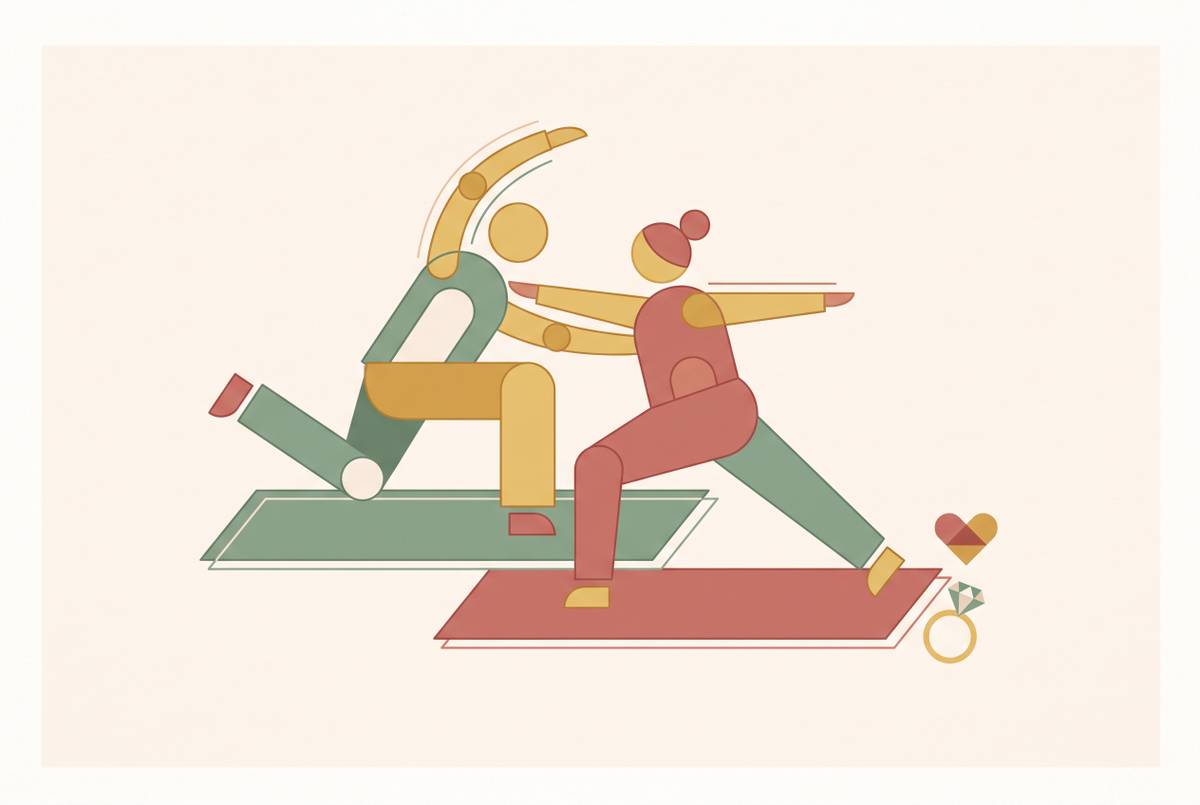
Yoga carries the strongest evidence of any single modality, with a SUCRA score of 93% in the 2025 meta-analysis, ranking above every other workout type tested for lowering cortisol. It works through several channels stacked together: slow, controlled breathing switches on the parasympathetic nervous system (the "rest and digest" counterpart to fight-or-flight), sustained focus helps interrupt anxious mental loops, and the movement itself loosens muscle tension built up from stress. A randomized controlled trial of 158 Brazilian medical and nursing students, run over eight weeks, found the yoga group saw drops in self-reported stress, serum cortisol, waist circumference, and systolic blood pressure, all statistically significant. Couples yoga adds a layer beyond the physiology: partner poses require balance, weight-sharing, and trust, which is a workout for the relationship as much as the body.
Moderate steady-state cardio, walking, running, cycling, or swimming at a conversational pace, is the safest default for anyone already running high on stress hormones, because it skips the cortisol spike risk that comes with harder efforts. A brisk walk can deliver hours of mood benefit, according to ADAA-cited research, described as roughly comparable to taking an aspirin for a headache. A moderate daily session is widely considered enough to bring cortisol down, which is a realistic daily target rather than an aspirational one. It also requires zero equipment and zero scheduling gymnastics, which matters a lot when the shared calendar is already full of vendor calls.
Strength and circuit training showed up in that same Brazilian RCT, too: the circuit training group also posted a significant drop in self-reported stress. The catch is intensity management. Keep sessions moderate and space them with rest days, since lifting does raise cortisol briefly, but the body adapts over repeated sessions. A practical combination of cardio, basic strength work, and flexibility training works regardless of how fit either partner currently is.
Dance and dance cardio deserve more credit than they usually get. Some research suggests dance may lower stress, anxiety, and depression in ways comparable to other mind-body practices. Dance stacks three separate cortisol suppressors at once: the aerobic effort, the social element, and the plain positive emotion of moving to music. Partner dance forms also involve physical closeness and shared positive emotion, giving engaged couples a relational payoff on top of the physiological one. The barrier to entry is close to zero: a Zumba class, an aerobic dance session, or just clearing the living room floor all count.
Outdoor exercise adds a layer indoor workouts can't replicate. Research has found that exercising outside can lower cortisol and lift mood beyond what the same workout done indoors delivers. Research has found that even a single walk in a natural setting can measurably reduce anxiety. Hiking fits naturally into a couple's week, too: no gym membership, no fixed schedule, and built-in time to actually talk without a screen in the middle of it.
What to watch for: HIIT done without adequate recovery can work against the stress-reduction goal instead of supporting it. And any session that stretches past 60 minutes at high intensity risks working against the goal. None of this means cutting HIIT out entirely, just scheduling it with some care instead of grabbing it because it's the fastest calorie burn on the app.
Why working out together does more than reduce stress on its own
Research on shared physical activity and romantic relationships suggests that people who exercise with a partner tend to report better mood and higher relationship satisfaction than those who work out alone. That's three separate wins stacked on top of the cortisol drop, and it's the reason a shared routine outperforms two people quietly working out alone in the same apartment.
Remember that Zola's survey found 43% of couples said planning strained their relationship. Planning has a documented tendency to put partners on opposite sides of a decision, whether it's the guest list, the budget, or whose cousin gets a plus-one. A shared workout runs in the opposite direction on purpose. Exercise triggers endorphin release regardless of who you're with, but doing it together means both people feel that lift at the same moment and, over time, start associating the good mood with each other instead of just with the treadmill.
Couples yoga is a clean example of the mechanism at work: partners holding and supporting each other through poses builds a kind of physical attentiveness that carries over off the mat, which echoes Bowman's advice to "work as a team" through the planning process itself. Partner dance does something similar through touch, releasing oxytocin at a point in the engagement when stress has a habit of quietly killing off intimacy, one of the physical symptoms tied directly to prolonged engagement stress.
The workout slot can also function as a boundary. Maggie Sottero's planning guide suggests a "no wedding talk" rule during exercise, and that one rule does a lot of work: it creates a protected 30 or 45 minutes where the seating chart cannot follow you. Planning conversations have a way of leaking into every part of the day. A workout with a no-wedding-chat rule is one of the few windows that stays sealed.
And the payoff outlasts the wedding itself. Couples who build a joint fitness habit during the engagement don't lose it the day after the reception, they walk into the marriage with an established shared practice already running, which is worth more than anything on the registry.
How to build a shared workout routine that survives the engagement calendar
Start small, and protect the slot like it's a vendor deposit. The ADAA's finding that a 10-minute walk can rival a 45-minute workout for anxiety relief is basically permission to stop overbuilding the plan before it starts. Consistency beats performance here, full stop.
Think in weekly totals rather than daily perfection. Hitting the WHO and Mayo Clinic range (150 moderate minutes or 75 vigorous minutes a week) only takes three sessions, which is realistic even during the busiest stretch of vendor calls and dress fittings.
Match the workout to how the week is actually going:
- A high-tension planning day calls for gentle yoga or a walk, something that leans on the parasympathetic system instead of adding another spike.
- A normal week can carry a moderate run, ride, or swim together.
- A lower-stress window is the time for a strength session or a dance class, when the body can handle a bit more intensity without it backfiring.
Stephanie Thomas's cardio-strength-flexibility combination maps cleanly onto a three-day weekly plan and needs no gym membership or coach to run.
Schedules don't have to match to keep the habit shared. Partners who can't train at the same time can still check in, a quick photo, a text after a solo run, even a small friendly bet on who finishes the week's sessions. The point is keeping the social thread alive, not syncing two calendars that were never going to align anyway.
Bowman's advice from the Banner Health piece applies directly here: schedule time for mental health the same way you'd schedule a task, with a defined start and end time. Treat the workout block the same way. Don't leave it as a vague "we'll figure it out later," because later during an engagement rarely arrives.
Keep the goal visible and simple. A shared calendar with one weekly target both people agreed on beats a spreadsheet tracking pace, reps, or calories. Showing up is the metric. Everything else is noise.
And hold the line on intensity as the wedding date closes in. Deadline pressure has a way of pushing people toward harder, longer workouts as a coping mechanism, exactly when sessions over 60 minutes at high intensity are most likely to raise cortisol instead of lowering it. Keep it moderate in the final stretch. The wedding will still happen at the same pace either way.
Making the workout habit feel like part of the relationship, not another item on the planning list
Bowman's point stands out here: engagement stress is temporary. What tends to stick is whatever habit a couple builds while dealing with it. A shared workout routine started for damage control during the planning chaos has a real shot at becoming a permanent fixture of the marriage, long after the seating chart is a distant memory.
Framing changes the outcome more than people expect. Southern Bride's list of stress-relief activities puts "dates with your partner" at the top, and the reasoning is straightforward: shared time reminds two people why they're doing any of this in the first place. A workout date checks that box and handles the cortisol at the same time, two birds, one sweaty stone.
Let it stay a little silly. A friendly wager over who logs more sessions this week, a small reward for hitting a shared goal, a coffee ritual after the Saturday run, these small bits of playfulness are what keep a routine feeling like part of the relationship instead of a wellness chore bolted onto an already packed calendar.
A workout photo sent between partners, not posted anywhere, just sent, works as a quiet signal that the sender showed up that day. Repeated over months, that small gesture builds the kind of low-pressure accountability that keeps a habit alive without turning it into another obligation on the list.
Success here is measured in whether both people kept coming back to it, week after week. It's measured in whether both people kept coming back to it, week after week, through dress fittings and seating charts and the 150-odd decisions nobody warns you about in advance. That's the only number this particular workout routine actually needs to hit.
For couples who want a lightweight way to track that consistency without overengineering it, apps built around shared fitness accountability, including Partner Fitness Review, let two people log sessions separately, set one simple weekly target, and stay connected without forcing identical schedules or a rigid program onto an already stretched calendar.