Active Date Ideas That Replace Sedentary Wedding Planning Sessions
Swap wedding planning spreadsheets for walks and hikes to save your relationship.
The average engaged couple burns 528 hours planning a wedding, according to a Minted survey of 2,000 Americans. Even skeptics who trust the lower estimate, 200 to 300 hours for couples skipping a planner, are still looking at eight to twelve full days gone. Most of that time happens on a screen, most of it happens after 9pm, and almost none of it involves standing up. The fix isn't complicated: trade a slice of those hours for something physical, before your engagement turns into a second job with a seating chart attached.
What wedding stress actually does to two people who used to like each other
Planning a wedding is stressful, and nobody's shocked by that sentence. What might catch you off guard is the scale: a Zola survey of 500 couples found 96% called planning stressful, and 40% went further, straight to "very" or "extremely." Seventy-one percent ranked it above buying a house or starting a new job, meaning a party beat a mortgage. Sit with that for a second, because somewhere a real estate agent is offended on your behalf.
The physical fallout is where it stops being funny. Eighty-six percent of couples reported real symptoms: anxiety, insomnia, mood swings, headaches, a dip in sex drive. Eight percent considered calling the whole thing off, while 16% floated postponing instead. Those numbers aren't noise; that's stress leaking out of the spreadsheet and into the relationship the spreadsheet was supposed to be celebrating.
Forty-nine percent named "making it perfect" as their top stressor, and later, 37% admitted they regretted how much of themselves they poured into that pursuit. You spend three months in a standoff over centerpiece height, and by the one-year mark you can't even remember which way the napkins folded.
Some of this comes down to sheer volume. Couples face over 150 distinct decisions during planning, and 71% say nobody warned them how many there'd be. Turns out "wedding planning" is a part-time logistics job you never applied for and definitely didn't interview well for. What starts as a shared project, picking a venue, splitting a budget, sours fast once in-laws start weighing in on the guest list. And this doesn't stay contained to engagement, either: newlywed research shows close to a fifth of couples see a real drop in satisfaction within the first four years of marriage. Whatever pattern you fall into while planning, reactive, screen-lit, always solving something, has a way of sticking around long after the invitations go out.
Why moving together beats another conversation about the guest list
Self-expansion theory has a simple premise: doing something new and slightly difficult with your partner keeps the relationship from calcifying. Couples who tried a new, challenging activity together reported higher satisfaction that same day, and researchers could still measure the effect three months later.
Compare that to another night hunched over florist quotes, familiar, screen-bound, entirely focused on solving a problem. Self-expansion theory says those three traits are precisely what drains the spark instead of feeding it.
A University of Oklahoma study found shared physical activity tracked more closely with relationship satisfaction than shared downtime like watching TV together. Intensity had nothing to do with it; time spent moving side by side did all the work, and a walk counted the same as a run. Couples who exercised together logged more good days and fewer bad ones, and for wives specifically, it meant fewer arguments and less disappointment in the relationship overall. A 2024 study in Frontiers found the mood boost from exercise was stronger on days people moved with a partner than on days they went it alone.
There's a chemical reason, too. Exercise releases endorphins, and both people get hit with them at the same time, which is more than can be said for a shared spreadsheet no matter how many tabs get color-coded. Research in PMC also links moderate activity to more cooperative behavior, and cooperation happens to be the one resource wedding planning spends fastest.
None of this requires a hard workout. It requires something new, some shared time, and a body that's upright instead of slumped in a desk chair.
Quick weeknight resets that fit inside a planning-heavy schedule
Weeknights during engagement are already booked solid: vendor emails, budget spreadsheets, a call with somebody's mother about the seating chart. Whatever you add here has to take under thirty minutes and require zero gear.
Science backs the short version. Twenty to thirty minutes outside produces the sharpest drop in stress hormones, and the payoff flattens out after that. You don't need an hour, just a door and a pair of shoes.
A few things that actually fit on a Tuesday:
- A walk around the block or through a nearby park. No gear, no planning, and it directly interrupts the late-night scrolling habit that's been eating your wind-down time.
- Twenty minutes of partner stretching or yoga at home. Low effort, easy on the nerves, and it can follow a planning session instead of replacing it.
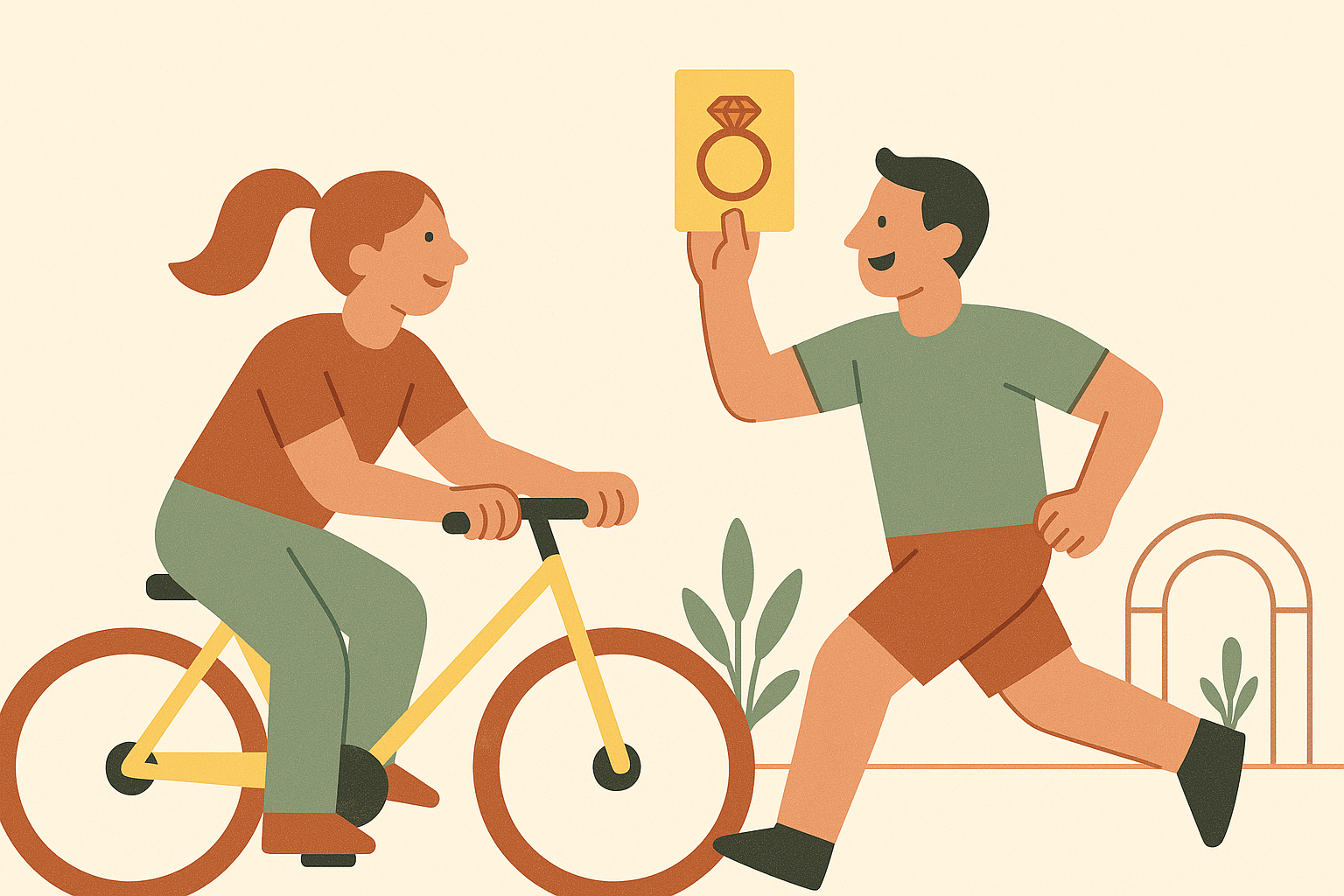
- A short bike ride through the neighborhood, for couples who find walking too slow to shake the day off.
- Kitchen dancing. Genuinely — it costs nothing, looks ridiculous, and nobody's grading your form.
None of this touches your VO2 max. It's about breaking the planning rhythm long enough that the wedding isn't the only topic at the table. Close the walk with one good thing from today and one thing you're looking forward to, and you've built a connection ritual without ever scheduling "a talk." Keep a loose photo roll of these outings if you want, not to measure anything, just so you notice they're happening.
Longer weekend outings that serve as genuine planning-period milestones
Weekends offer more room, but they're also more crowded: venue tours, family dinners, vendor calls all fighting for the same six hours. So the ask here is smaller than it sounds. Protect one weekend block a month, just one, and declare it off-limits to planning.
This is where real novelty earns its keep:
- A trail you've never hiked. New place plus moderate effort is the exact combination self-expansion theory says lifts satisfaction.
- A beginner climbing session. You'll both look ridiculous, you'll have to trust each other on the wall, and that's the whole point.
- Kayaking or paddleboarding. Cooperative by design, and your phones won't survive the water, so you're both fully present whether you like it or not.
- A cooking class in a cuisine you've never touched, where standing and chopping side by side beats sitting across a restaurant table for shared discovery.
- A local 5K, which gives you the same goal-oriented structure as planning, except pointed at something that isn't a spreadsheet.
A day trip to a state or national park works too. The National Park Service points to research showing time in green space lowers stress hormones and sharpens cognitive function. A full day outdoors does something a 20-minute walk can't touch.
Skip the fitness tracker. The goal is walking away with a story that has nothing to do with vendors or budgets. Add a small, friendly wager, first to the summit, best paddle stroke, and you've built in playfulness without a scoreboard. Drop a photo in the group chat afterward, and the good feeling outlasts the actual afternoon.
Errand-adjacent movement that slides into the planning process itself
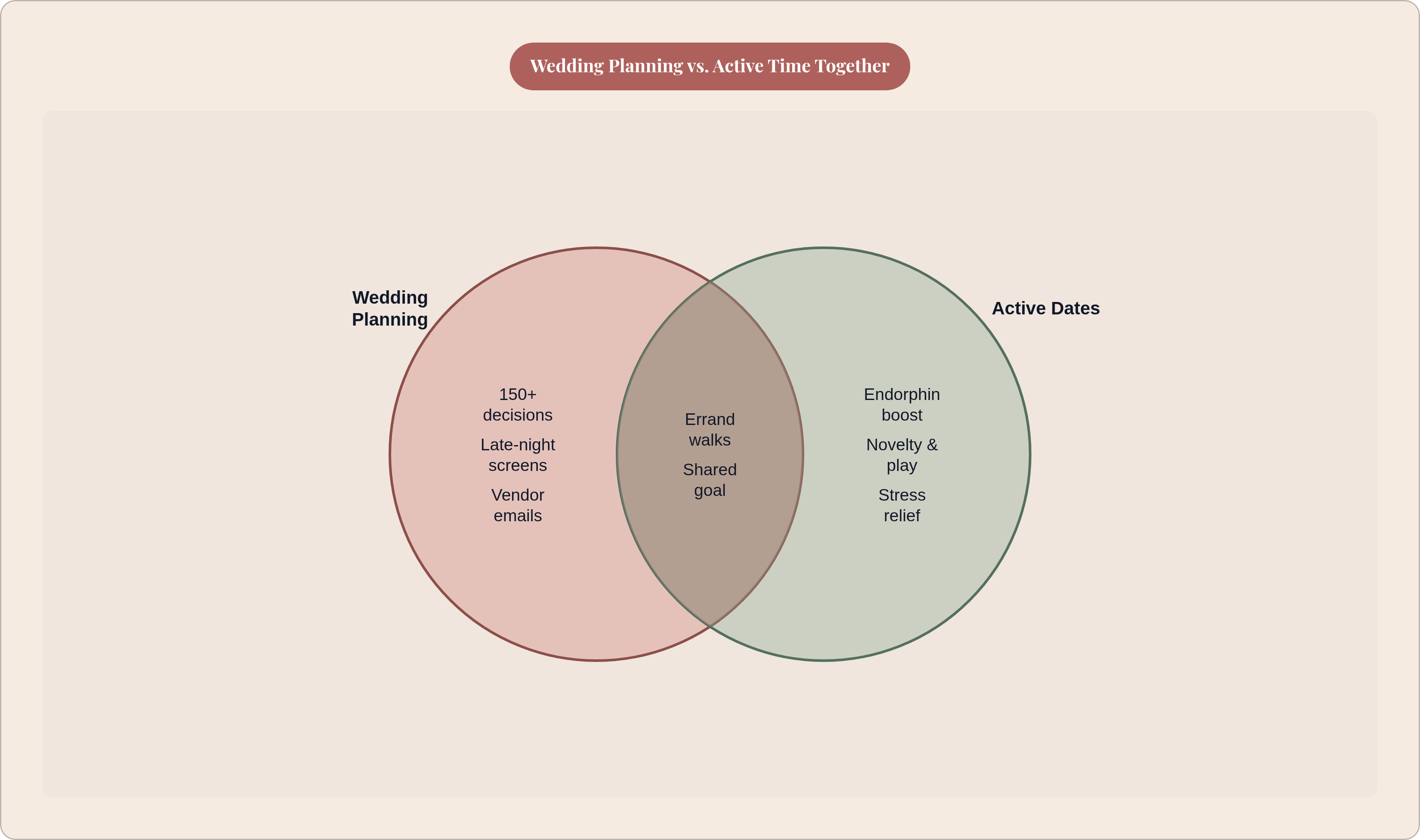
Not every wedding task needs a laptop open, since some of them simply work better on your feet.
Skip the cake reviews online and walk to the bakery to taste the thing yourself. Skip the florist's Instagram grid and bike over to have the conversation standing among the actual flowers. If you've narrowed venues down to two or three, walk or bike between them, then talk it out on the way home. Try a "mood board walk" through a neighborhood that matches your wedding's vibe; it pulls inspiration-gathering off the screen and puts it in front of your actual eyes. Even calls with vendors or parents can happen while you're walking instead of hunched over the couch.
This matters more than it sounds, especially for the sizable share of Gen Z couples who say social media made their planning worse. Standing in front of a real flower arrangement, or tasting an actual bite of cake, short-circuits the comparison spiral that endless scrolling feeds. A task that would've eaten 45 sedentary minutes still costs 45 minutes, except now it comes with a memory, some steps, and usually a clearer decision. Your senses cut through option overload faster than any spreadsheet.
Making active dates a habit instead of a one-time idea
The pattern holds up everywhere you look: total time spent moving together predicts satisfaction better than any single big outing. A small habit, repeated, beats one grand gesture done once and never mentioned again.
A standing "no-planning Sunday morning," a block where nobody so much as opens a vendor tab, works better than trying to schedule a formal workout together. Keep a running list of places you've gone, not calories or miles, just places, and the pattern becomes visible enough to protect on its own. A loose points system (whoever suggests the next active date picks dinner after) keeps it playful instead of turning into one more chore with a checkbox next to it. A shared photo folder from these outings becomes something you'll actually flip through at the wedding, proof the engagement wasn't only spreadsheets and seating charts.
Lightweight apps built for couples can hold this structure without demanding perfect tracking: a check-in, a photo, a small weekly goal you set together. The tool should bend around your life, not hand you a new obligation to babysit.
Couples who build a rhythm of moving together during engagement tend to keep it going once the wedding's over and everyday inertia creeps back in. Five hundred twenty-eight hours is an absurd amount of time to hand over to spreadsheets and vendor emails without a fight. Take back even a fraction of it for something active, together, and the whole stretch starts to feel like something other than a countdown to the invoice.