Fitness Apps That Connect Long Distance Partners
Research shows working out together boosts adherence and mood, even across distance.
Millions of Americans are in a long-distance relationship right now, the highest number on record, according to research on the long-distance relationship landscape. Millions more live it without the label: married couples split up by work, deployment, or grad school, plus the huge share of college students who cycle through an LDR at some point. This piece is about fitness apps as a fix for one specific problem those couples share: the absence of shared physical life. A workout app doesn't solve distance on its own, but it can rebuild a ritual that distance took away.
What research actually shows about exercising with a partner
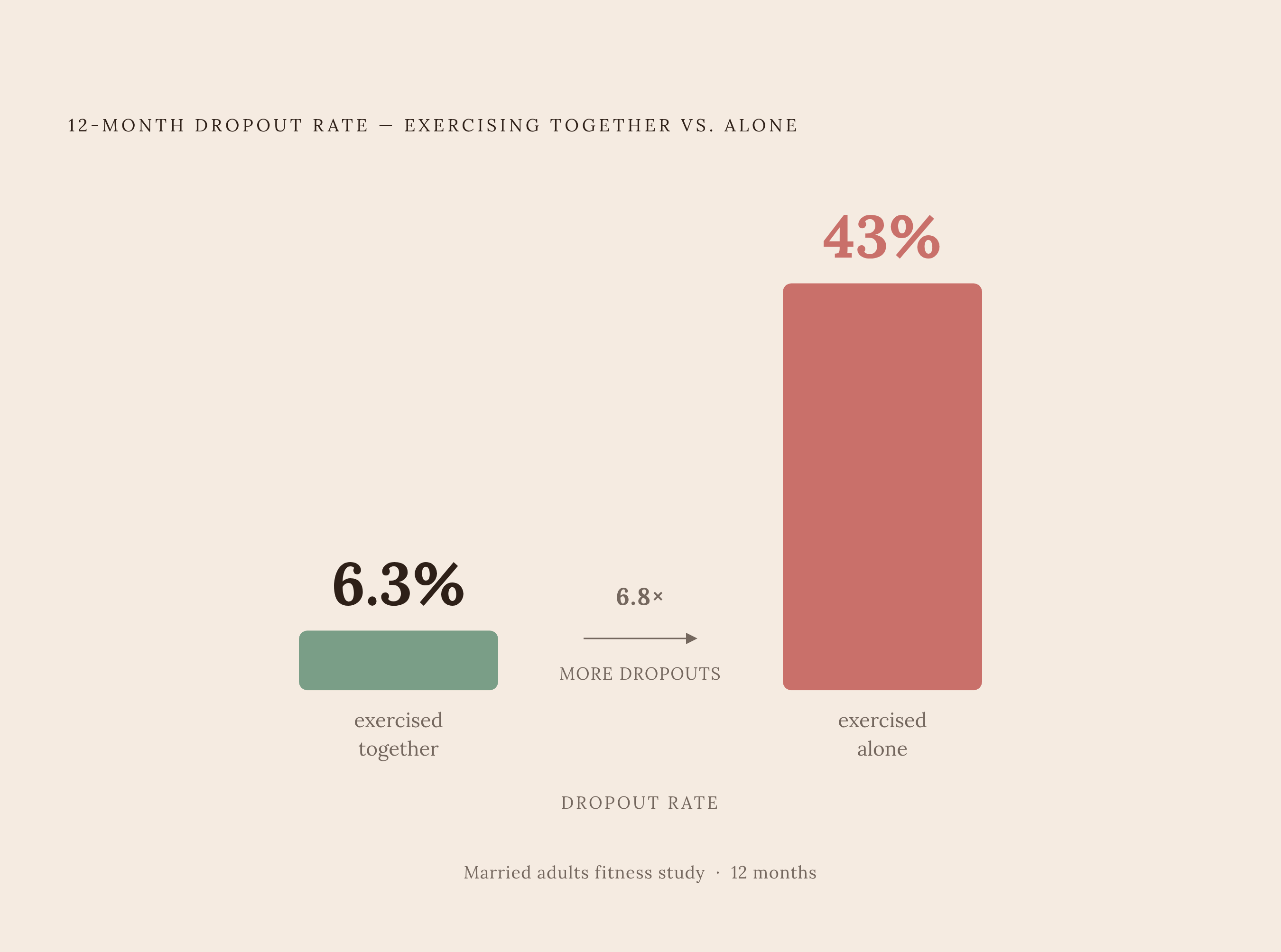
Start with a number that should embarrass every solo New Year's resolution ever made. In a 12-month study of married adults in a fitness program, couples who worked out together had a dropout rate of 6.3%. People who joined alone dropped out at a rate of 43%. That's the difference between a habit and a phase.
A 2021 study in the Journal of Social and Personal Relationships followed 95 adults in relationships over two weeks and found something couples already suspected: on days they exercised with their partner, they reported better mood and higher relationship satisfaction than on days they worked out solo. Fitness fed the relationship rather than competing with it for time.
There's also a strange, almost gym-locker-room piece of psychology at play called the Köhler effect. People push harder, sometimes up to 24% harder, when they're working alongside someone more capable than them. For decades, researchers assumed you needed to be in the same room for that to kick in. Turns out you don't. The effect shows up with virtually present partners too, which is basically the scientific permission slip for every long-distance fitness app that's ever existed. Visibility, more than proximity, seems to be the active ingredient.
One more piece worth knowing: research in Nature Digital Medicine found that people using fitness apps connected to wearables showed 35% higher adherence rates over six months than people using standalone apps. Passive tracking removes friction, and friction is the thing that kills habits at 6 a.m. when you'd rather just go back to sleep.
Put it together and the takeaway is almost insultingly simple. The benefit was never really the app itself. The other person is the benefit; the app's only job is to make that person visible.
Why most fitness apps quietly fail long-distance couples
Here's the part nobody puts in the App Store description: the fitness app market hit $12.1 billion in 2025 and is on track for $33.6 billion by 2033, according to Grand View Research. That's a lot of money chasing a problem most of these apps don't actually solve for couples living apart. About 42% of American adults use a health or fitness app regularly, and the overwhelming majority of those are solo products with a "share your workout" button bolted on as an afterthought.
The design mismatch is almost comedic once you see it. Most partner-focused fitness features assume you're in the same city, the same gym, the same time zone, sometimes even the same fitness level. Try applying that to a couple where one person has been lifting for six years and the other just downloaded a step counter last Tuesday. Identical plans fail both people at once: the veteran gets bored, the newcomer gets buried, and everybody quits within the week.
That quitting happens fast, too. Retention numbers across the fitness app category are famously brutal, with apps routinely shedding a large share of users in the early weeks. Social features change that math in a real way. Apps with challenges, friend connections, or shared accountability consistently hold onto users longer than apps that leave you alone with your own willpower.
So what does an LDR couple actually need to check for before downloading anything? A short list:
- Asynchronous visibility: can your partner see you worked out without both of you being online at the same moment?
- Shared, calendar-based tracking: a visible record of both people showing up, not just two sets of private stats
- Low-pressure accountability: nudges that feel like support, not a surveillance camera
- Independent plans: room for two different workouts under one shared habit
- Built-in reactions or messaging: a way to say "nice work" without picking up the phone
- Wearable syncing: because manually logging a workout at 11 p.m. is how habits die
Apps built specifically with partners in mind
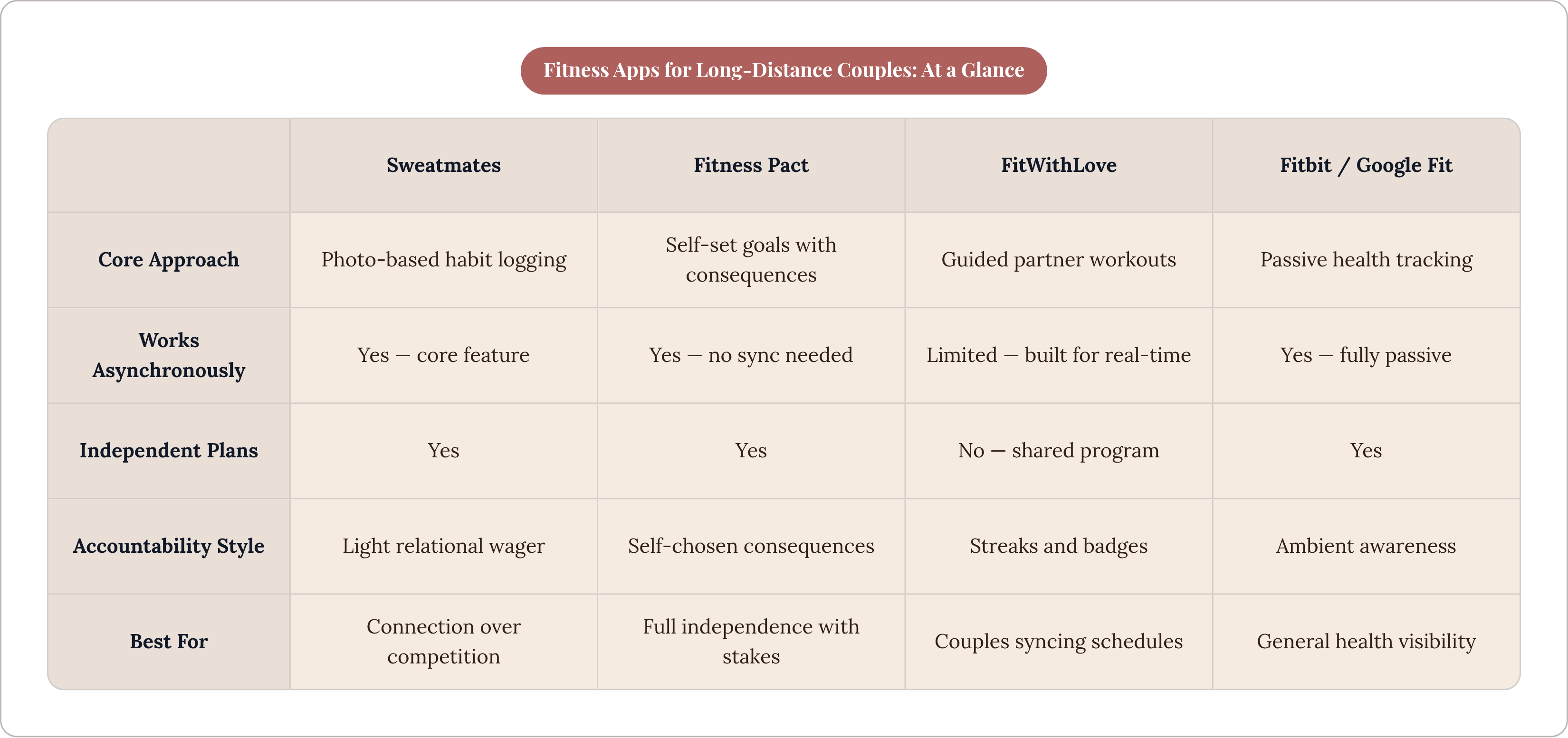
Sweatmates, launched in 2024, skips competitive stat tracking entirely. The whole idea is that showing up matters more than how fast or how heavy. You set a weekly goal, log it with a photo through a feature called SweatCam, and your partner sees it the moment you post it. Miss your goal and you owe something small, dinner, a chore, nothing that turns fitness into a courtroom. There's even a "Pinky Promise" mechanic for missed logs, where your partner decides whether it counts. Trust gets built into the software instead of enforced by a rigid rule.
Long-distance users describe it less like a fitness app and more like a non-verbal check-in between FaceTime calls. It becomes one more way the two of you stay in each other's day, more than a workout in itself. It fits couples chasing connection over data, though the logging feature does sit behind a subscription.
Fitness Pact: Better Together takes a more contractual approach. Neither person has to do the same workout, live in the same city, or even be online at the same time. You each pick your own routine, set your own consequence for missing it, and a shared feed tracks who did what. It's built for couples who like a little friendly stakes and want zero coordination overhead.
FitWithLove is free and leans into structure: guided partner workouts, more than 30 achievement badges, shared streaks, completion certificates. It has a deeper workout library than the other two, but it's built more for couples doing a session together in real time, maybe over video call, than for two people logging separately at 6 a.m. and 9 p.m. in different time zones.
General fitness platforms that couples adapt for long-distance use
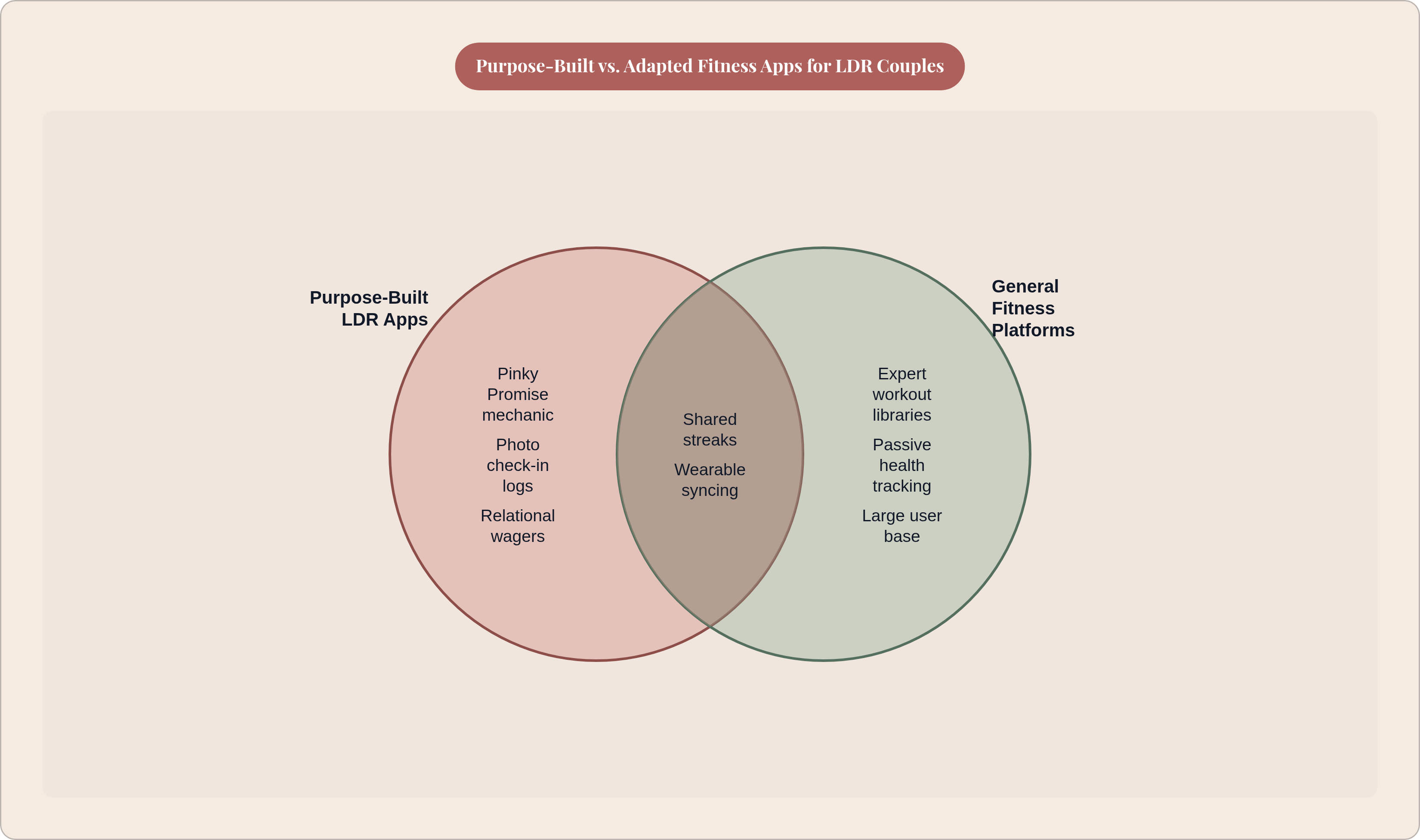
Not every couple needs a purpose-built app. Plenty adapt tools that were never designed for relationships in the first place.
Fitbit and Google Fit work well for couples whose shared interest is health broadly, not one specific sport. Step counts, sleep, heart rate, all visible passively, no manual logging required. According to Grand View Research, more than 73% of US health tracker users were on Fitbit as of 2023, so odds are decent your partner already has the hardware. The catch: Fitbit retired its open step challenges, so the social layer is thinner than it used to be. This fits couples who want ambient awareness of each other's health, not a training partner.
Nike Training Club and Aaptiv offer large libraries of expert-built workouts, HIIT, yoga, strength, cardio, that couples can run through independently. Milestone tracking exists, but the accountability is looser, more "we're doing the same program this month" than any built-in nudge system. This works best for couples who coordinate informally and don't need software to hold them to it.
How to choose based on what actually matters to your relationship
Forget the feature list for a second. The right app is the one you'll both actually open next Tuesday, not the one with the most impressive spec sheet. Before picking anything, answer two questions honestly.
Do you want to feel connected through the ritual of showing up, or through competing and comparing numbers? And do you need to be doing the same workout, or is it enough to just witness each other doing your own thing?
From there, it maps out fairly cleanly. Want low-pressure, asynchronous connection with a light relational wager attached? Sweatmates fits that best; the photo log and Pinky Promise are built for intimacy, not performance metrics. Want full independence with self-set consequences? Fitness Pact removes the coordination problem entirely. Want a structured shared program and you can actually sync your calendars? FitWithLove or a shared plan on Nike Training Club does the job. If your shared interest is general health rather than specific training, Fitbit's passive tracking covers it without asking either of you to log anything.
Worth noting: apps that let each partner run an independent plan sidestep the fitness-level mismatch entirely. Nobody has to slow down, nobody has to catch up. You're both just moving toward your own version of consistent, and the shared ritual ties it together more than the shared workout does.
And when someone misses a week, that should open a conversation, not trigger guilt. The best setups treat a missed goal as a "hey, you okay?" moment, not a strike against you. The app matters less than the agreement behind it. Couples who name a simple shared goal and actually stick to celebrating it will outlast couples who picked the fanciest app and never agreed on why they downloaded it.
Making shared fitness actually stick across the distance
The research bears repeating because it's the whole point: exercising with a partner doesn't just improve retention, it improves mood and relationship satisfaction on the days it happens. Moving through life alongside someone, even from six hundred miles away, matters more here than the fitness itself.
Three things matter more than which app you land on. First, keep the weekly goal simple enough to survive a bad week, "three workouts, any kind" beats a rigid four-gym-sessions-plus-a-long-run plan that collapses the second life gets messy. Second, build a tiny ritual around the log itself, a reaction, a voice note, one line of text, so the check-in feels like contact instead of a data point landing in a feed. Third, agree ahead of time on what happens when a week gets missed: talk about it, adjust the goal if it needs adjusting, and keep going. No shame, no silence, no disappearing for three days because you feel guilty about a missed leg day.
Working out separately but feeling connected works as an actual feature, not a workaround. Asynchronous visibility means both people keep their own schedule and still build something together, which is more than most co-located couples manage half the time anyway. Add a small wager, dinner on the next visit, a chosen activity, something with a little skin in the game, and the habit gets stakes that feel relational instead of punitive.
The couples who make this last aren't running the most optimized system on the market. They're the ones who kept it simple enough that showing up, even from opposite ends of the country, became its own quiet form of closeness.