Fitness Accountability Strategies for Long Distance Engaged Couples
Virtual workouts let long-distance couples stay accountable together without being in the same room.
Long-distance engaged couples make up a bigger chunk of the population than most people guess. Roughly 14 million couples in the US call themselves long-distance right now, which works out to about 28 million individuals figuring out how to build a life together while living in two different zip codes. As of 2026, that number has climbed to 15.5 million Americans in long-distance relationships, the highest count on record. And three out of four engaged couples go through at least some stretch of separation during their courtship, so if this is you, you're not the exception, but the rule wearing a slightly stressed-out ring.
The distance itself keeps growing too. Average separation is now around 180 miles, up from roughly 125 not long ago. Add an engagement timeline that's compressed to about a year to eighteen months (Zola surveyed close to 7,000 couples and found this shrinking window is now the norm), and you've got two people trying to plan a wedding, build a shared future, and stay in shape, all while FaceTiming through a workout instead of spotting each other on a bench press. The friction is obvious once you name it: no shared gym, no shared schedule, nobody physically there to notice if you skipped leg day. The social pressure that normally keeps people consistent just evaporates. This piece is about rebuilding that pressure on purpose, without turning your relationship into a fitness bootcamp.
What the research actually says about partners and fitness consistency
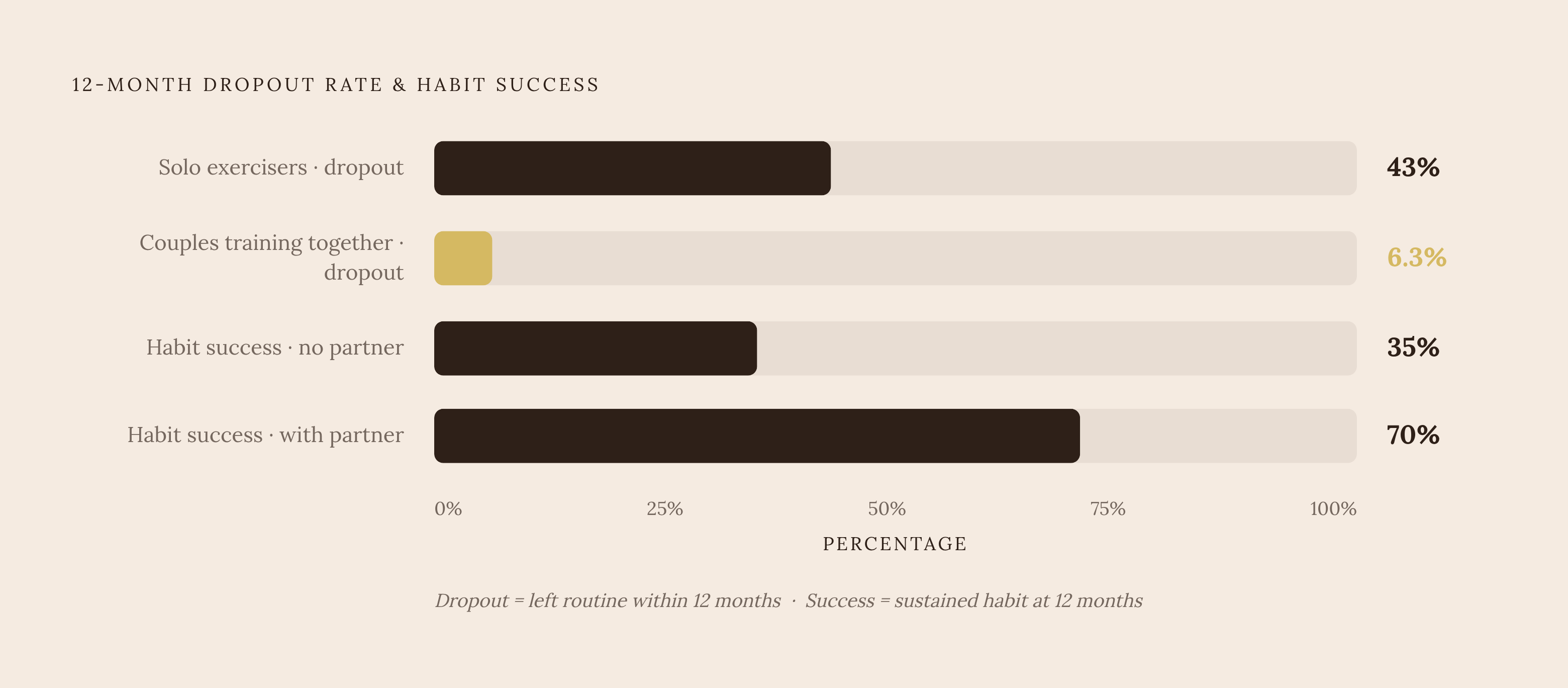
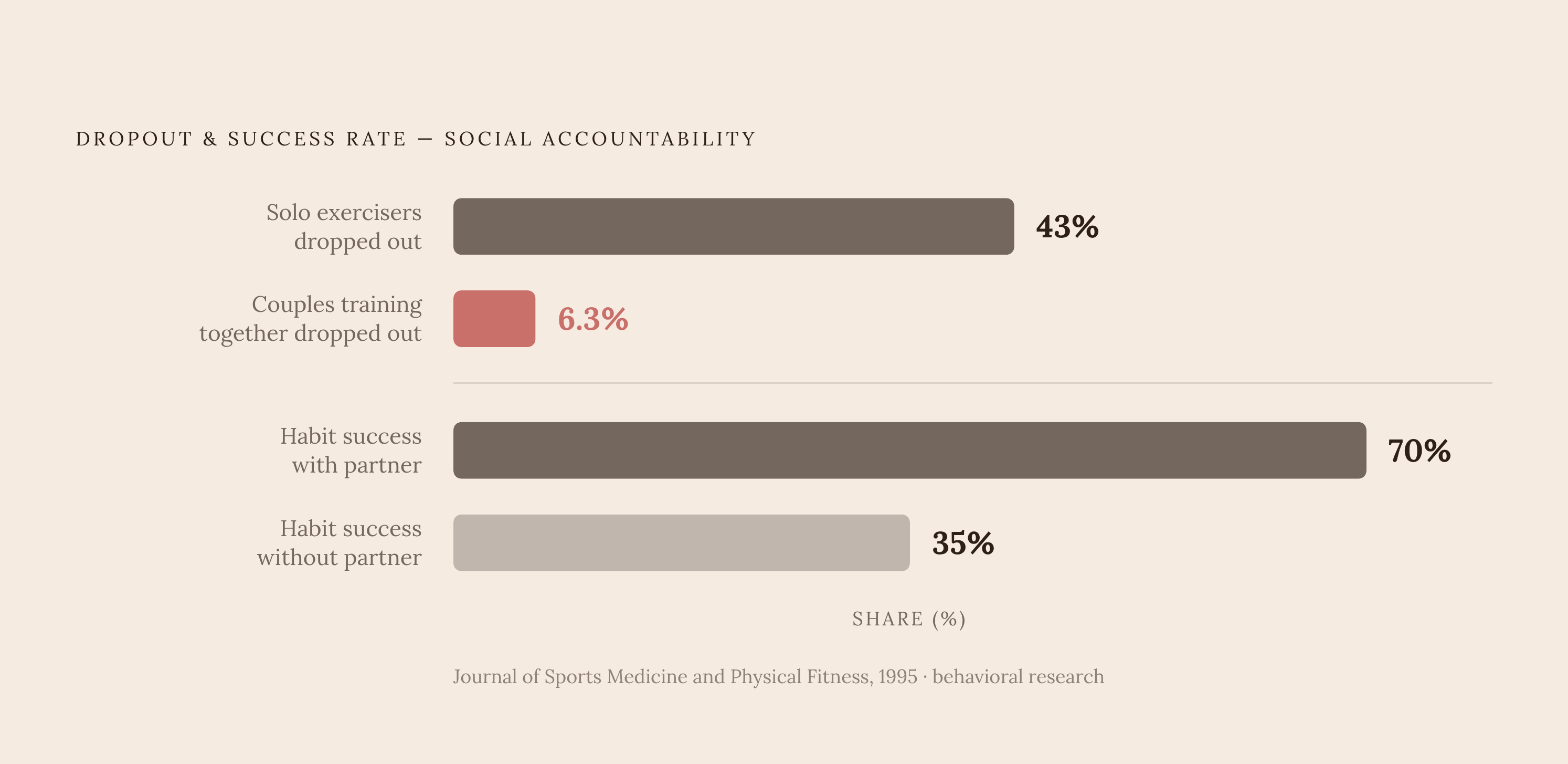
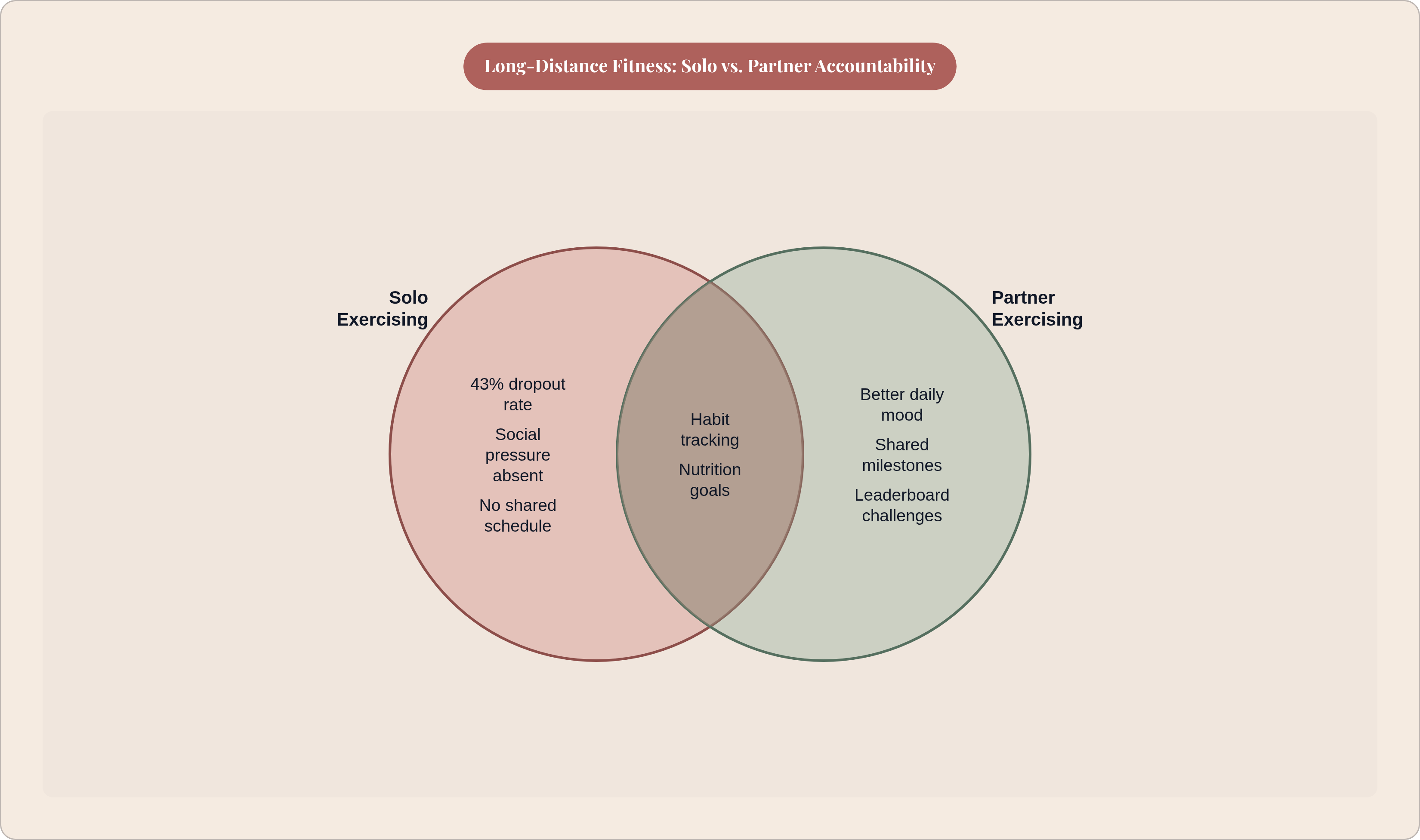
Here's a number that should stop you mid-scroll. A 1995 study in the Journal of Sports Medicine and Physical Fitness found that only 6.3% of couples who exercised together dropped out of a fitness program after 12 months, compared to 43% of solo-exercising married individuals in the same program. That's not a rounding error, but the difference between a habit that survives February and one that's dead by Valentine's Day.
Zoom out further and the pattern holds. Up to 80% of people who start a fitness routine abandon it within a few months, regardless of relationship status. But bring in an accountability partner and habit success rates jump from 35% to 70%, according to behavioral research on the subject. That's not willpower working harder. That's social commitment doing the heavy lifting while willpower takes a breather.
A 2021 study in the Journal of Social and Personal Relationships (researchers Sackett-Fox, Gere, and Updegraff) tracked 95 adults over two weeks and found something worth sitting with: on days people exercised with their partner, they reported better mood during the workout, better mood for the rest of the day, and higher relationship satisfaction. Here's the part that matters for anyone reading this from a different area code than their fiancé: those benefits didn't require being in the same room. They came from the shared act itself, not the shared square footage.
There's a chemical reason this works. Exercise releases endorphins and oxytocin, the same compounds tied to bonding and attachment, which leaves people more emotionally open to each other afterward. Psychologist Art Markman has a framing worth borrowing: exercise and relationships are both future-focused activities. You're investing now for a payoff later, whether that's a stronger heart or a stronger marriage. They reinforce each other naturally, which is a nicer way of saying your quad workout and your relationship are, somehow, on the same team.
Why the "shred for the wedding" mindset works against long-distance couples specifically
The "shred before the wedding" thing is still culturally loud, but the tide's turning. The wedding fitness conversation in 2025 and 2026 has shifted from "lose weight fast" to "feel good in your body," and for long-distance couples, that shift isn't just nicer, it's necessary.
Appearance-only goals fall apart faster across distance than they do in person. One partner starts progressing quicker than the other, and suddenly what should be teamwork turns into silent comparison. Miss a week, and instead of shrugging it off as a normal blip, it feels like failure, because the whole goal was a number on a scale or a fit in a dress. Shame creeps in, and shame is the natural enemy of the check-in text, because nobody wants to report bad news to someone they're trying to impress.
The research actually lets you off easier than Instagram does. A review of 16 studies found that just 30 to 60 minutes of strength training a week cuts risk for diabetes, heart disease, several cancers, and death from any cause. That's not a full split routine and a green juice cleanse, but two short sessions a week doing real, measurable work. Experts recommend starting six to nine months out for sustainable results, not a six-week panic sprint that leaves you injured and resentful three weeks before the vows.
For couples apart, the better frame is this: fitness is a shared ritual that makes the distance feel smaller, not a solo performance graded at the altar. Miss a goal, have a two-minute conversation about why, and move on, with no trial and no verdict, just Tuesday.
Synchronized virtual workouts as the closest substitute for training side by side
You can't spot each other from hundreds of miles away, but you can still sweat on the same timer. Schedule the same workout, same time, and hop on FaceTime or Zoom. If time zones make real-time impossible, Marco Polo style video messages work as a solid substitute, letting you send the workout and the encouragement asynchronously.
This isn't just a feel-good workaround, either. A 2015 University of Pennsylvania Annenberg School study found that people in online workout groups who got notifications when others exercised worked out 1.6 more times per week than people who only got motivational messages, and more than people who got no support at all. Knowing someone else is moving makes you move, simple as that.
A few things make this actually work day to day. Figure out your overlap window first, then build the workout around it, not the other way around. A 20-minute HIIT session might be more realistic than a 90-minute gym block if one of you is on a lunch break and the other's winding down after dinner. If real-time doesn't line up at all, record the session and send it over afterward, both for form feedback and for that "I did this thing and thought of you" feeling. Stick to low-equipment formats too, like bodyweight circuits, yoga, or running. Neither of you needs a gym membership to make this work, just floor space and mild willingness.
The social pressure here mimics the in-person kind almost exactly: you know they're watching, so you show up. Two synchronized sessions a week is enough to build real strength and real ritual, since consistency beats volume every time.
Following the same training program from different cities
Different setup, same payoff: both of you follow the same program on your own schedules, in your own time zones, and compare notes after. You don't need to be doing burpees at the same second to be doing the same burpees.
This creates its own momentum. You've suddenly got something to talk about besides wedding vendors, namely how the workout felt and what to adjust next week. You watch each other progress through the exact same plan, which builds a sense of shared journey even when your workouts happen twelve hours apart. And if one of you gets stuck on a movement, the other can help troubleshoot, because you're both intimately familiar with the exact same exercise. That's mutual investment, not solo struggle.
A handful of tools make this easy. Peloton lets couples coordinate class picks and challenge each other on the leaderboard no matter where they're logging in from. Running-specific apps like Runna give both partners identical week-by-week progressions to reference and compare.
One design rule matters more than the rest: build the plan around whichever partner has less gym access, not more. A program calibrated to the person with a full home gym and unlimited time will get done by exactly one of you, and it won't be the one texting from a hotel gym with two dumbbells and a prayer. Keep it simple enough that both people can realistically finish it, and celebrate finishing, even separately. A quick "done" text or a sweaty selfie does more relational work than it looks like on paper.
Shared tracking apps and wearables that make progress visible to both partners
When your partner's workout shows up in your feed, their fitness stops being something you hear about later and becomes something you're part of in real time. That shift, from episodic to continuous, is the whole point of shared tracking.
MyFitnessPal's Friends feature lets couples share nutrition logs alongside activity, which matters if you're trying to build accountability around eating, not just movement. Fitbit and Apple Watch both offer built-in competition features, like Activity Rings challenges, that require zero extra apps and give you a low-friction way to needle each other about who closed their rings first.
One caution worth repeating: tracking should build connection, not run surveillance. The goal is visibility and encouragement, not a scoreboard that quietly turns into comparison anxiety. A photo from a workout, or a ten-second voice note about how it went, carries more weight than any dashboard ever will. The number confirms the effort happened, while the voice note confirms someone cared that it did.
Friendly challenges and monthly goals that give the week a shared shape
Give the month a shape and the week takes care of itself. Most workouts completed, total miles logged, a consistency streak, or a shared milestone like both of you hitting a first 5K, it doesn't matter what the container is, just that there is one.
The psychology behind this is well established. Psychologist Gail Matthews at Dominican University found that sharing goals with someone and giving them regular updates increases your odds of success by more than 70%. A friendly wager is just that principle wearing a costume.
Design the wager carefully, though. Keep stakes low and specifics high: loser cooks dinner at the next visit, picks the reunion activity, writes a letter. The point is playfulness and commitment, not punishment dressed up as motivation. Make sure both of you have a real shot at winning, because a challenge tilted toward the fitter partner just demoralizes the other one into quitting early. And reset monthly, so one rough week doesn't poison the whole structure going forward.
The payoff shows up in the data on relationships generally: 94% of couples who exercise as a team report improved relationship satisfaction, compared to 67% who work out solo. Shared challenges, even fully remote ones, plug into that same dynamic. They also give you something to look forward to beyond just closing the distance; you're not only counting down days apart, you're counting toward a bet you might actually win.
Purpose-built apps designed for partners exercising apart
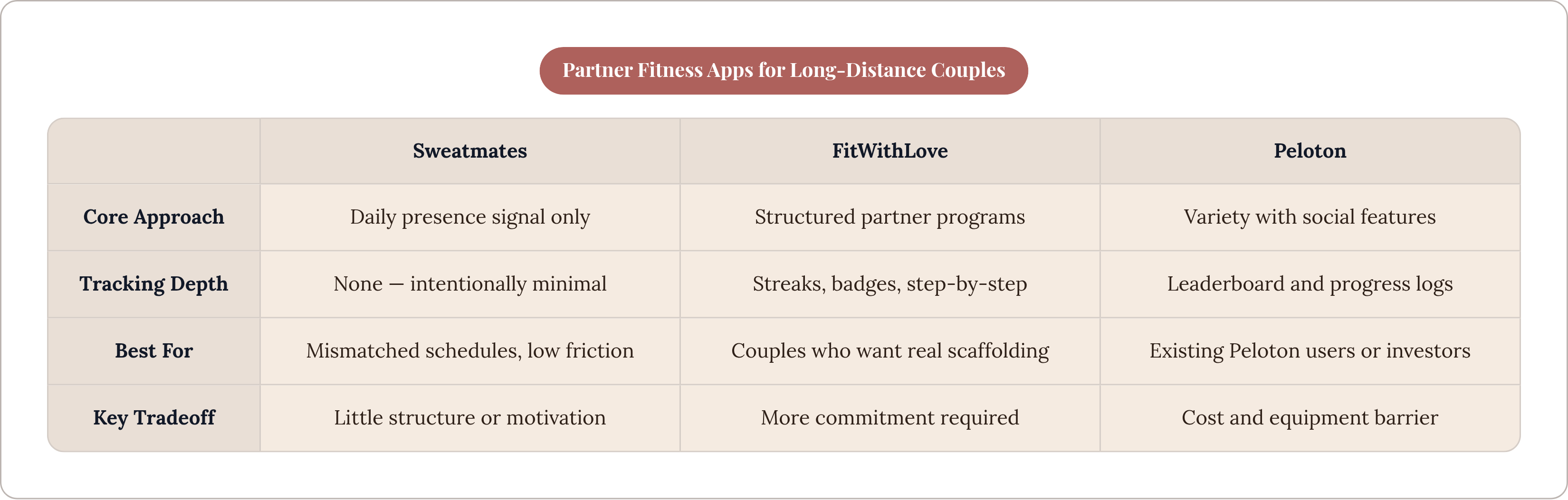
General fitness apps work fine, but a few tools exist specifically for couples training apart, and they're worth knowing about.
Sweatmates keeps things deliberately lightweight, with no stats and no tracking dashboard, just a simple daily signal that says "I showed up." It's designed to feel separate from your regular video calls, so it becomes a low-friction touchpoint instead of one more scheduled obligation on top of an already packed week. Best fit: couples who want connection without complexity, especially when your schedules rarely line up.
FitWithLove goes the other direction, with structured programs built for two people, step-by-step partner exercises, streak tracking, more than 30 achievement badges, and reminders that nudge you both along. Best fit: couples who want more scaffolding and like the feeling of working through a real program together, not just checking a box.
Peloton rounds things out for couples who want variety and social features baked in. You can coordinate class selection, challenge each other on the leaderboard, and track progress regardless of location. Best fit: couples where at least one of you already has Peloton access or equipment, or where investing in it lines up with your longer-term fitness goals anyway.
No single app fits every couple, and comparison-shopping for a month before you start is a great way to never start. Pick the one that removes your biggest friction point (scheduling, structure, or variety), try it for a few weeks, and adjust from there.
Check-in systems that make accountability feel supportive rather than supervisory
Structure matters more than frequency here. "Let me know how the week goes" produces vague nothing, while a specific shared agreement produces actual follow-through.
A workable check-in system needs three pieces. A weekly goal you both set together, simple enough to complete, specific enough that you can tell whether it happened. A designated check-in moment, whether that's a Sunday night recap call, a midweek voice note, or a quick photo after each session. And a shared definition of what counts as a win, because showing up twice out of three planned days is still a win, and skipping one day doesn't erase the other two.
The framing of the question matters more than people expect. "Did you work out?" lands like an audit, while "How did Tuesday feel?" lands like a conversation between two people who are actually on the same team. Same information, completely different emotional weight.
Celebrate the check-in itself, not just the personal record or the mile time. The habit of checking in is the actual asset you're building here, arguably more than the fitness gains themselves. And when someone misses a goal, the right move is a short, honest conversation about what got in the way, not silence and definitely not guilt. Distance amplifies everything, good communication patterns and bad ones alike, so a little grace here goes further than it would if you saw each other every day. Given that the average long-distance couple already sends around 343 texts and spends about 8 hours on calls a week, the fitness check-in doesn't need to be a new event on the calendar. It just needs to slide into the conversation you're already having.
Using nutrition check-ins and meal prep calls to extend accountability beyond workouts
Pre-wedding fitness experts keep saying the same thing: nutrition drives the majority of sustainable results, more than the workouts do. So a shared fitness strategy that skips food is only doing half the job.
The format that actually works across distance is simple. Hop on a video call while you both cook or prep meals on the same evening. It's not a scheduled obligation bolted onto an already busy week, it's a task you both need to do anyway, just done together instead of apart. You chop vegetables, they season chicken, and somewhere in there you end up talking about the wedding seating chart or how work went, which is really just dinner with extra steps and a webcam.
It also extends accountability past the gym. Workouts are easy to track because they're binary: you did it or you didn't. Nutrition is messier, more emotional, and easier to hide from a partner who isn't in the room to see what's actually on your plate. A weekly meal prep call closes that gap without turning food into another category for shame or scorekeeping. You're just two people, on two different couches, cutting up the same peppers on purpose.