Fitness Accountability Apps for Friends in Different Cities
Long-distance friends need apps that feel like support, not surveillance.
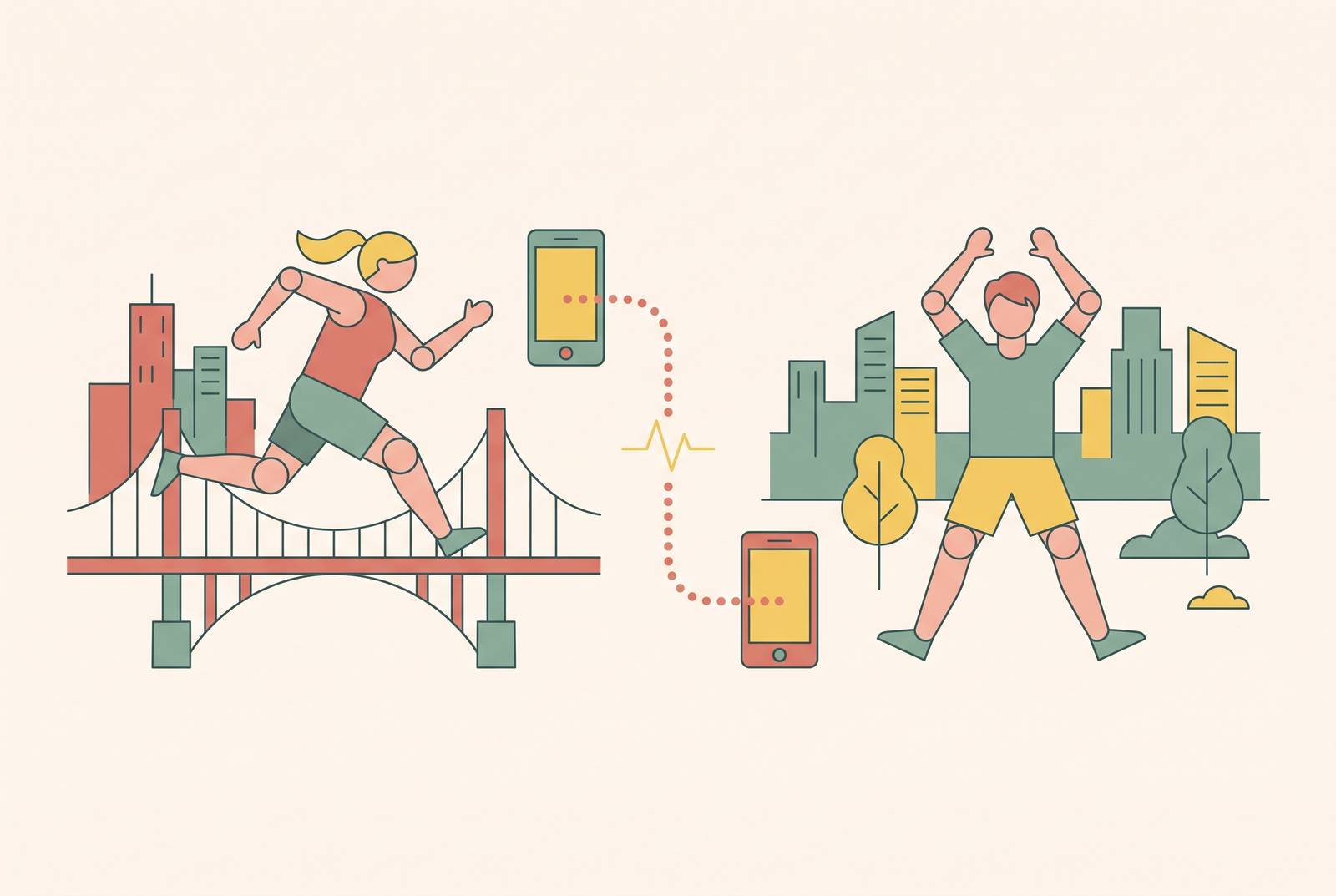
A friend in another city texts "did you work out today?" and gets no answer. That silence is the whole problem this article is about: when you can't share a gym with someone, the app you pick has to replace a very specific feeling, the feeling of being noticed, not just a workout log.
Why long-distance friends need different features
A local gym buddy works through a dead-simple mechanism: someone is physically standing at the squat rack waiting for you, and skipping means leaving them there. That mechanism vanishes the moment friends live in different time zones. Nobody is standing anywhere. Whatever replaces that pressure has to be built on purpose, not left to happen by accident the way it did when you both lived three miles from the same gym.
A follow-up study on the PERMANENTO online exercise program found social support ranks among the top reasons exercisers stick with a routine. Picking an app means finding the one that makes your friend feel seen on a Tuesday when nobody feels like moving, not the one with the deepest charts and the fanciest data export.
The four accountability mechanisms apps use
Accountability apps lean on four distinct pressure types, and each one behaves differently once you stretch it across a few hundred miles.
Small-group visibility works by putting your check-in in front of a handful of specific people the moment you log it. The mechanism breaks when a friend goes quiet, whether from travel, a rough week, or just a schedule that stopped lining up with yours. Once that loop breaks, the pressure that depended on it disappears right along with it.
Time-boxed competition runs on points, rankings, and scoreboards inside a set window, and it's genuinely great for a focused month-long push. For mixed remote groups there's a structural snag, too: friends in different cities tend to own different devices, so step counts and workout minutes stop comparing cleanly unless the app bridges every tracker involved.
Financial commitment contracts put money on the line when a goal gets missed, and loss aversion is a well-documented enough behavioral lever that this mechanism works. The downside is that the motivation runs on anxiety, so when the contract ends, the habit often doesn't survive on its own.
The honest objection to all four mechanisms is that external pressure can crowd out a person's own internal motivation over time. A 2025 scoping review in the Journal of Medical Internet Research names low user engagement and dropout as the central challenge facing digital health tools generally, and points to structured human support, through what researchers call the Supportive Accountability Model, as one strategy for improving adherence, while noting real gaps in how well that's been studied. The mechanisms that last longest tend to feel supportive rather than like surveillance, and that distinction carries more weight across a distance, where you can't read a friend's body language the way you could across a gym floor.
What matters when evaluating a long-distance fitness app
Three qualities separate the apps that keep two distant friends consistent from the apps that feel great for two weeks and then quietly die: low-friction visibility, cross-platform reach, and a group size built to stay alive.
Visibility without friction means the check-in itself has to be fast. A one-tap check-in survives a tired Tuesday. The goal is simple: your friend sees that you showed up, not a wall of metrics proving it. An optional photo makes the moment feel real and often carries more motivational weight than a data export.
Cross-platform reach matters because remote friend groups almost never share a device ecosystem. Apps built for iOS, Android, and ideally the web remove that choice.
Flexibility about workout type matters just as much, since long-distance friends rarely train the same way. One runs, one lifts, one does yoga in a living room. An app that lets any activity count as a check-in keeps the whole group inside the tent. Fitness Pact states this directly in its own pitch: friends using it don't need to do the same workouts, meet in person, or live in the same city.
Apps built around small-group check-ins: Habit Huddle and HabitShare
Small-group visibility apps are the closest digital stand-in for a friend holding your spot at the 6 a.m. class, and for remote pairs they're the lowest-friction way to stay in each other's daily line of sight.
Habit Huddle runs on one core idea. A small group, called a huddle, commits to a shared habit, everyone posts a one-tap daily check-in, and the group builds what it calls a Checkin Chain, a visible streak that gains a new link every day a member checks in. The Floor and Ceiling mechanic solves a real long-distance problem: every habit has a Floor, a worst-day minimum like a ten-minute walk, and a Ceiling, the bigger goal to aim for on a good day, so one rough week doesn't snap the whole chain. The trade-off: one behavior per huddle, no wearable sync, no GPS tracking. A quiet huddle defeats its own purpose.
HabitShare runs on a similar small-group visibility model, friends see each other's daily check-ins and streaks, with cross-platform apps on both iOS and Android. Like Habit Huddle, it's built for habit follow-through rather than performance analytics, so the accountability lives in the relationship, not in a spreadsheet. A workout photo shared inside a huddle can carry more motivational weight than another chart ever could, and showing up deserves recognition even when nobody's measuring performance. Sweatmates, a fitness accountability app for couples that keeps two partners consistent through shared workout tracking, photo check-ins, and weekly recaps, runs on exactly that logic, pairing people who already share a relationship rather than a gym.
Apps built around challenges and competition: challenge-based apps and Stridekick
Some friend groups stay consistent through competition rather than quiet daily visibility, and that's a different motivation style, not a more serious one.
Some challenge-based apps turn a friend group into its own small league. One person creates a challenge, sets the scoring metric (workout count, minutes, miles, calories, steps, or a custom point system), and everyone posts workouts to a shared group feed for the length of the challenge. That feed adds a layer of visibility on top of the competition itself, since members watch each other's workouts land in real time. The limitation appears after the challenge ends: the format is strong for a defined window but doesn't naturally carry over into year-round routine building once the scoreboard resets.
Stridekick solves a structural problem mixed remote groups run into: everyone wears a different tracker. It syncs most major wearables, so a group spanning Fitbit, Apple Watch, and Garmin can compete inside the same step challenge without anyone switching devices. Creating a basic public challenge is free, capped at 10 participants and 7 days, while private or longer challenges need a paid plan. The honest limit is that Stridekick measures whatever the device tracked: steps and general movement. Lifters, yoga practitioners, and anyone whose workout doesn't translate into step counts stay largely invisible inside a challenge built this way.
Apps built around financial stakes: StickK and Fitness Pact
Commitment contracts travel across distance better than almost any other mechanism, since the referee confirming your compliance doesn't need to live anywhere near you. A trusted friend in another city can do that job just fine from a screen.
StickK was founded by behavioral economists at Yale University, and it structures goals as formal commitment contracts: users set a goal, define a stake, and appoint a referee who confirms whether the commitment held. That referee model is the long-distance feature that matters most here, since a friend elsewhere receives the reports and signs off without ever needing to be in the room. The limitation: this motivation runs on stakes, which can feel punitive rather than supportive, and once the contract period ends, nothing guarantees the habit sticks around without signing a new one.
Fitness Pact was built specifically for friends who don't live in the same city and don't do the same workouts, requiring no shared gym, no in-person meetups, and no matching workout type. It pairs financial commitment with actual partner accountability instead of relying on stakes alone, which softens the "anxiety and nothing else" problem that pure financial contracts run into. The honest tension still stands: the same 2025 scoping review in the Journal of Medical Internet Research raises a real question about what happens to behavior once external financial pressure disappears, which matters a lot for someone picking this as a long-term plan.
Apps built around human coaching: Trainwell and similar services
When the friend-to-friend loop isn't quite enough on its own, maybe one person travels constantly, works irregular hours, or just wants more structured guidance, a dedicated coach can fill the "somebody noticed I went quiet" role without depending on the other friend's own consistency holding steady.
Trainwell, formerly called CoPilot, matches every member with a dedicated certified personal trainer rather than a chatbot or a rotating pool of strangers. That trainer builds a personalized plan, adjusts it as life changes, and follows up proactively when a member goes quiet. Trainers are full-time W-2 employees holding a nationally accredited certification such as NASM CPT, with at least three years of remote training experience behind them. Forbes named it Best Personal Trainer App of 2025, and it holds a 4.9-star rating across more than 5,000 Apple App Store reviews. It also powers the Peloton Personal Trainer experience that launched in February 2026.
Future offers similar dedicated 1-on-1 remote coaching through contractor trainers, with unlimited messaging but more limited live motion feedback than Trainwell provides. Pricing starts around $199 per month, a ceiling plenty of casual friend groups simply won't reach.
Caliber offers dedicated 1-on-1 coaching with contractor trainers at roughly $200 or more per month on its Premium tier, without live form or motion feedback. Ladder takes a different shape entirely, offering group coaching rather than 1-on-1 attention, starting around $30 per month, with more limited messaging and no dedicated trainer assigned.
The distinction that separates all of these from peer apps is simple: a coach's entire job is to notice when someone goes quiet. That obligation is built into the arrangement itself, and it doesn't depend on a friend's own motivation staying steady week to week.
Peloton's approach to long-distance connected workouts
Peloton takes a different route to long-distance accountability. Instead of asking two friends to log separately that they exercised, it puts them in the exact same class at the exact same time, closing the gap between intending to work out together and actually doing it.
In September 2024, Peloton introduced invite-only Teams of up to 100 friends built around shared goals and challenges, later expanding that feature to support Teams of up to 50,000 people with tools for discovering and joining new ones. The Invite Friends feature, updated in June 2025, keeps classes perfectly synced, so two friends hear the same music and hit the same hills and sprints at the same moment, start to finish, no matter where either of them is sitting on a bike. That's structural accountability in its purest form: the "when" has already been decided, so the only question left is whether to show up, and knowing a friend is pedaling through the same class at the same second raises the cost of bailing in a way a push notification never could.
Peloton requires either Peloton equipment or the Peloton app, and the whole synchronization idea only works if both friends are free at the same scheduled time, a real obstacle for friends spread across multiple time zones or juggling mismatched schedules.
The Better Together app and weight-loss focused accountability for friend groups
Sometimes the shared goal isn't "work out consistently," it's "lose weight together," and that calls for a different shape of accountability than a workout log can provide.
Better Together is built around weight-loss challenges designed for friend and family groups, with team-based accountability as the core motivating mechanism. It's a narrower tool than the apps covered above, built for one specific goal, so it fits best when a friend group's actual shared target is weight loss.
How to choose based on what breaks your consistency
The right app matches whatever specific thing already derails this particular friendship, not whichever app has the longest feature list or the biggest name attached to it.
If the two of you tend to go quiet on each other, small-group visibility apps like Habit Huddle or HabitShare fit best, since the daily check-in makes a missed day visible. And if the goal is exercising at the same moment rather than just reporting in afterward, Peloton's synchronized classes come closest to sharing a gym across distance, schedules permitting.
Device mix needs checking before anything else gets decided. A group spanning iPhone, Android, and three different wearable brands needs cross-platform support confirmed up front, because a great accountability loop that only half the group can actually open fails the whole group.
Simplicity tends to outlast cleverness. An app demanding daily GPS uploads, manual calorie logs, and weekly progress reports will look great for exactly one week and sit abandoned by week four. The version that survives is the one both friends can still run on a tired Thursday night with three minutes to spare.
Group size matters even for a pair of two. Adding one more person to the group buys some insurance against that, without growing the group large enough to trigger the diffusion problem that starts creeping in around five or more people.
Consistency between two friends in two different cities comes down to how little friction a check-in takes and how genuinely visible each person stays to the other, not which app has the most impressive dashboard sitting behind it.