How Engaged Couples Choose a Workout Tracking App That Fits Both Their Training Styles
Couples with mismatched fitness levels need separate plans and shared visibility.
Engaged couples choosing a fitness app are really negotiating what "training together" means when one person runs marathons and the other just started doing push-ups off the kitchen counter. The right answer, for most couples with mismatched fitness levels, is an app built around separate goals and shared visibility rather than one shared workout, with Sweatmates, Edge, and FitWithLove each fitting a different version of that gap, and Apple Fitness+ and Peloton covering couples who want content libraries over accountability tools.
Why engaged couples face a different app-choice problem
Engagement sits at an odd intersection. Two people are merging finances, calendars, and in-laws, and somewhere in that pile sits a much smaller question: how do we work out together? It sounds minor next to the venue deposit, but it's really a stand-in for a bigger one, because fitness habits get built over years alone, and now two separate habits have to live under one roof.
One partner is almost always more experienced, more motivated, or chasing a different goal than the other. That's just how two adults who didn't meet at the same gym on the same day tend to show up. One person has been lifting for six years. The other just downloaded an app because the wedding is in ten months and someone mentioned a dress fitting. Neither is wrong. They're just starting from different places, and the app they pick has to hold both of those places without making either partner feel like the weak link.
That's why app choice carries more weight than it seems on the surface. Picking a tool means agreeing, often without saying it out loud, on what shared fitness actually looks like for this particular couple. Research published in Family Relations found that couples who exercised together showed somewhat stronger links to positive marital outcomes, better communication, and smoother conflict resolution than couples who exercised separately, though the difference didn't reach statistical significance. The same research found walking was the most commonly reported form of shared exercise, suggesting couples want time spent near each other, moving, more than a matching workout. That one detail should reshape how a couple thinks about app features before they open the App Store.
Mismatched fitness levels and couples' app experiments
Most fitness apps are built for one person, full stop. When two people with different fitness levels try to share one, the gap between them causes real friction.
The breakdown follows a pattern. One partner finds the workouts too easy. The other finds them too hard. The stronger partner gets bored waiting around, the newer partner feels like they're constantly behind, and within a few weeks the shared plan quietly stops happening. Nobody announces it's over; the shared plan simply vanishes from the calendar.
Visibility, which sounds like it should help, can work against the couple instead. When both partners' check-ins sit side by side on a screen, the one who's doing less of it gets a daily reminder of that gap, whether anyone intends it that way or not. Even a kind, well-meant check-in from a partner can start to land like a performance review nobody asked for. And the more experienced partner, often without noticing, starts offering tips, correcting form, suggesting heavier weights. That shift, from workout partner to unpaid personal trainer, tends to flatten the equal footing the relationship had before the app entered the picture.
Most popular apps only show stats side by side. They don't adjust to what each person actually needs. A photo of today's run and a photo of today's five-mile run are not the same thing to look at, even if both partners showed up. That difference between passive comparison and active adaptation is the whole reason these experiments tend to fizzle by week three.
Fitting an app to two people training differently
A good app for mismatched couples has to solve two separate problems at the same time: fitting each partner's own plan, and giving both of them something to hold each other accountable to. Most apps only manage one of the two.
Plan fit means each partner gets a routine built around their own level, goals, and schedule. Neither person should be throttled by the slower partner's pace, and neither should be shoved past a reasonable limit just to keep up. That sounds obvious written down. Most apps skip it, because building one plan for two people is a lot easier to code than building two plans that still talk to each other.
Shared accountability lets both partners see what the other is doing in a way that encourages them. What gets displayed often shapes which of those two outcomes a couple ends up with. A completed workout feels different from a leaderboard ranking, even when the underlying action (both people worked out today) is identical.
A third piece follows naturally from the first two: couples need to be able to train on their own schedules and still feel like a team, because two calendars rarely line up on command. One partner's 6 a.m. gym slot and the other's lunchtime jog don't need to happen together to count as shared effort.
Light stakes help turn good intentions into actual consistency. Metrics based on effort, like sessions completed or minutes moved, stay fair no matter how different two bodies or two fitness levels are, as Flamme's couples fitness guide notes. And cost matters here in a very practical way. Couples merging finances before a wedding don't want a tool that charges each person separately and quietly doubles the price of something meant to be shared.
App categories for couples with different training styles
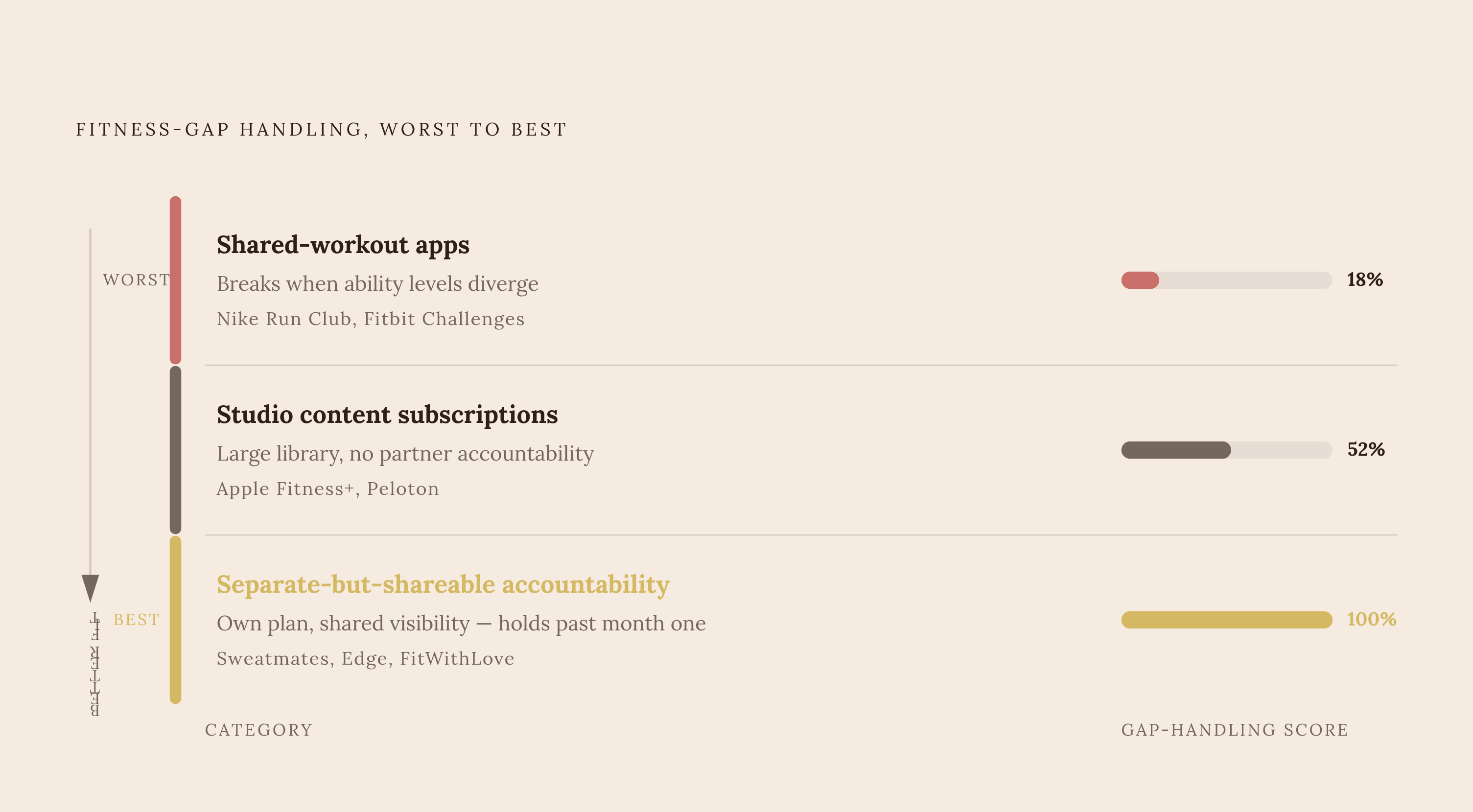
The market for this problem has settled into three rough groups, and each one makes a trade-off that lands differently depending on how far apart a couple's fitness levels sit.
Shared-workout apps ask both partners to do the same routine at the same time. They work fine when both people are close in fitness level, but the moment one partner is noticeably stronger or faster, the format breaks. The stronger partner is held back, the newer partner is pushed too hard, and the shared session stops feeling shared.
Studio content subscriptions, Apple Fitness+ and Peloton among them, are built for solo use with large content libraries covering everything from cycling to yoga to strength training. They answer the question of what to do today, but not the question of staying connected to a partner while doing it. Social features in this category tend to be thin or missing.
Separate-but-shareable accountability apps are the category built specifically around the problem this article is about. They let each partner follow a plan suited to their own level while keeping both people visibly connected to what the other is doing. For couples with a real fitness gap, this is the category that tends to hold up past the first month, because it doesn't ask either partner to pretend they're at the same starting line.
Which apps fit which couple types
No single app wins across every couple. The right pick depends on how wide the fitness gap is, how much shared accountability actually matters to the couple, and what they're willing to pay.
Sweatmates fits couples who train on their own schedules but want a real daily connection point. Each partner sets a weekly workout goal on their own, then logs sessions with SweatCam, a photo the other partner sees right away. App Store reviews describe it as feeling less like a fitness log and more like a daily check-in between two people. Because the log is a photo rather than a performance number, the app's screen never displays the fitness gap. What a partner sees is proof that the other person showed up, not how fast they ran or how much they lifted. Goals are set per person rather than jointly, so someone running three times a week and someone else doing yoga twice a week can both have a successful week without either one comparing numbers. There's a built-in wager system too: miss the weekly goal and you owe something small, like buying dinner or doing a chore, while hitting the goal just means you're safe. A newer feature called Lock-In Mode lets one partner, once a week, lock the other's distracting apps until they finish a workout, which gives couples who want a sharper nudge something more active than a gentle reminder. Sweatmates doesn't build workout plans, track workout type, or log duration, and Google Play reviews say so directly, so couples who want structured programming will need a second tool alongside it. It fits couples who care more about consistency and connection than shared programming, long-distance partners, and anyone just starting to build a shared fitness habit from scratch.
Edge, based in the UK, suits couples who want separate structured plans with an actual coach behind them. Instead of forcing both partners onto one shared programme, Edge builds a plan around each person's own fitness level, and the couple can choose which sessions to do side by side when schedules allow. A real coach is reachable by message, which helps when one partner wants more guidance or reassurance than the other. This fits couples where at least one partner wants a calibrated plan plus a human to ask questions to, and it's built with UK users specifically in mind. The coaching layer adds cost, and free tiers rarely include a plan tailored to each person.
FitWithLove suits couples who want to physically work out together at home with no equipment involved. It offers day-by-day couple workout plans, including couples yoga and partner exercises built for two people moving at the same time. It tracks streaks, offers more than 30 achievement badges across six categories (including "Week Warrior" and a 60-day "Iron Will" badge), logs calories per person per session, hands out completion certificates, and backs everything up through Google sign-in. This fits couples who are close in fitness level and want to literally move through the same routine together, plus beginners who want guided structure without paying for a subscription. Because the plans are built for two people doing identical movements, a couple with a real fitness gap will find the fit gets worse the wider that gap grows. It doesn't adjust intensity per person.
Apple Fitness+ suits couples who prefer different types of workouts but share Apple hardware. Family Sharing costs nothing extra, letting each partner use their own Apple ID and get their own recommendations, all within a $9.99 monthly subscription (cheaper annually, and bundled into Apple One Premier at a higher combined price). The content library spans cycling, strength, yoga, meditation, and more, which works well for a couple where one person wants yoga and the other wants HIIT, without either one compromising. There's no feature letting partners see each other's activity, so it offers no shared accountability.
Peloton suits couples who are each independently motivated and enjoy a bit of community energy. It lets users follow friends, send high-fives during live classes, and compete on leaderboards, with a content library covering cycling, strength, yoga, and running. There's no family sharing plan, so each person needs their own subscription, which adds up fast for two. The cost and the lack of a joint plan structure make it a better fit for two people running parallel fitness journeys than for a couple looking for one shared experience.
Running a low-stakes trial before committing to an app
The best app for any couple is the one both people will actually keep opening a month from now, and a single weekend of testing tells you more than any feature comparison can. Most of the apps above offer a free trial, and a practical way to use it is to pick one weekend and start together rather than one partner downloading it alone and reporting back later.
Before the weekend starts, agree on one thing each partner will track, and keep it simple: sessions completed or minutes moved tend to stay fair even when two people are at very different fitness levels. During the trial, each partner should log at least two sessions using whatever the app gives them, not to chase a perfect score, but to get an actual feel for what the accountability and visibility features are like day to day. At the end of the week, the question is whether seeing your partner's check-in made you more likely to do yours. A yes means the core loop is doing its job.
Starting with a free tier makes sense before either partner commits money to anything, even though free versions usually skip the personalized plan a couple might eventually want. And if the trial week includes a missed goal or two, that's just information about what needs to change before the next week starts. Fitness identity is personal, training styles rarely match perfectly between two people, and the app a couple lands on should feel less like a compromise and more like proof that showing up, even differently, still counts as showing up together.