How Engaged Couples Can Get in Shape Together Before the Wedding
Shared workouts build habits better than solo sprints before the wedding.
It usually starts the same way: one partner, phone lit up at 11pm, typing "how to lose weight before the wedding" into a search bar while the other sleeps. That's the old model of wedding fitness, and in 2026 it's finally losing ground to something sturdier. The shift underway is away from crash diets and last-minute bootcamp sprints and toward routines built for energy, confidence, and a clear head across the whole engagement, not just the final six weeks. The old model fails for a predictable reason: it asks two stressed, busy people to white-knuckle their way through a deadline instead of building a habit. Couples who show up to the wedding feeling strong usually didn't run two separate fitness projects that happened to finish at the same time. They built one shared routine, early, and that single difference changes almost everything downstream.
Why starting at least six months out changes what is actually possible
Six months is close to the minimum amount of time needed for the kind of slow, steady progress that can survive a wedding planning schedule without falling apart. Experts point to six months as the baseline for real, lasting change in muscle tone and energy, and even a low-impact routine done from home needs several weeks of steady work before it shows anything. Some sources stretch the ideal window to twelve months, while others, including FITPASS, point to a three-to-six-month range for gradual progress that doesn't run anyone into the ground. Smaller changes closer to the date can still lift energy and mood, but habits don't form in a few weeks. They take time to settle in.
For couples, that runway has to stretch further than it would for one person training alone. Two schedules, two starting fitness levels, and two sets of goals all have to line up, and that negotiation itself eats into the calendar. A good early milestone: aim to hit your target shape by the first dress or suit fitting, then shift into maintenance mode. That protects against alteration costs and takes the pressure off chasing last-minute results while also managing seating charts. Starting six months out also changes the emotional math. Couples who begin that early are building a habit, not racing a clock, and that distinction is what keeps things steady once vendor stress peaks around weeks eight through ten, which, for anyone who hasn't lived through it yet, is roughly when every outstanding decision seems to land in the inbox at once.
How shared training produces consistency that solo training cannot replicate
Joint training beats solo training on consistency, and the reason has nothing to do with willpower. It comes down to structure. When another person is lacing up shoes next to you, skipping the workout becomes a social decision rather than a private one, and that shift changes behavior more reliably than any amount of personal discipline.
The numbers back this up in a fairly dramatic way. Exercising with a partner has been shown to increase workout duration by up to 200% compared to training alone, and couples who exercise together report sticking with their routines more consistently than people who go it solo. The mechanism is mutual commitment: each partner's presence raises the social cost of bailing, in a way an app notification simply can't. A reminder buzzing on a phone is easy to swipe away. A partner standing by the door in workout clothes is a different kind of prompt, and it tends to work. Tools like Sweatmates, which track workout accountability for partners through shared photo logging and weekly recaps, make that shift tangible by keeping both people visible to the same goal instead of running two private projects that happen to share an address.
Most sources point to two to three shared sessions a week as the sweet spot, often enough to build rhythm, rare enough that it doesn't swallow two already-busy calendars.
None of this works, though, if it's sold as a magic fix, so the honest version has to include the failure mode. When two partners start from very different fitness levels, training "together" can backfire. The fitter partner gets bored or holds back, the less fit partner feels watched and judged, and a plan meant to bring two people closer ends up creating friction instead.
The fix is to separate the workout from the session. Same time, same room, same commitment to show up, but different programming for each partner based on where they actually are. One person might be working through a beginner strength circuit while the other runs intervals a few feet away. Both still showed up. Both still get the accountability benefit of a partner who's also putting in effort right there. The goal was never to match each other rep for rep. It's to grow in the same direction, even if the path looks a little different for each person, and that distinction is what makes a flexible plan hold up better over six months than a rigid one built for a single idealized version of "us."
Individual sessions on the days couples don't train together give each partner room for goals that don't line up, more upper body work for one, longer runs for the other, without turning those differences into a source of tension on the days that matter most.
What the research on couples exercising together actually shows, and what it does not
The research on exercising together as couples is more modest than most headlines about it suggest, and the honest version of the story is the more useful one anyway.
Research out of Brigham Young University, led by Jeremy Yorgason and published in the journal Family Relations, found that couples who exercise together see a small but measurable improvement in their ability to resolve conflict peacefully. That's a documented finding, not a marketing line, and it's worth taking seriously on its own modest terms.
The nuance that matters: married couples who exercise, whether they do it side by side or separately, report better communication and fewer serious arguments overall. Couples who worked out together showed slightly larger gains in relationship outcomes than those who exercised solo, but that gap between training together and training apart wasn't statistically significant. It could be a real effect. It could also be noise in the data. Honesty requires sitting with that uncertainty instead of rounding it up into a bigger claim than the research supports.
So joint exercise isn't flatly superior to solo exercise when it comes to relationship benefits. What the evidence actually supports is narrower and, in a way, more useful: the shared habit, shared time, and shared goal appear to produce real gains, and those gains don't depend on both partners doing identical movements at identical intensity.
That reframes the whole plan. The relational payoff seems to come less from synchronized burpees and more from the act of showing up together, setting goals together, and noticing each other's progress. Couples who build their pre-wedding fitness around weekly check-ins, visible progress, and simple encouragement are building exactly the mechanism the research points to, even if neither partner ever does the same set of exercises on the same day. It also lifts the pressure off couples with mismatched fitness levels. You don't need to match your partner's pace to get the relationship benefit.
How stress management belongs inside the fitness plan, not alongside it
Stress is an active ingredient that decides whether a wedding fitness plan actually works, and couples who manage it together start with a real advantage over those who treat it as someone else's problem.
Cortisol, the hormone released under stress or during poor sleep, is the main driver of pre-wedding bloating and inflammatory breakouts, and no training block, however well designed, overrides a body that's running on four hours of sleep and a spreadsheet of vendor deadlines. Research comparing diet-and-activity interventions against stress-and-sleep interventions found both produced significant, roughly comparable improvements in daily stress levels. That puts stress management on equal footing with diet and exercise. Recovery work, foam rolling, stretching, basic mobility drills, has moved from optional extra to core piece of the plan, because it releases muscle tension, improves range of motion, and cuts soreness at a time when energy needs to stay high, not get drained by week nine.
Yoga and stretching do double duty here. They build flexibility, sure, but couples are increasingly leaning on them specifically for the calm they bring during the chaotic stretch of planning, which makes them a stress tool as much as a fitness one.
For couples, the opportunity is to handle this together. An evening walk, a shared yoga session, even meal prep treated as a weekly ritual rather than a chore, all of it turns recovery into one more habit the two of you build side by side instead of one more item each person has to squeeze in alone. The same practical rule from the timing section applies here too: reach your target shape by the first fitting, then shift from building to maintaining. That one change takes a meaningful amount of cortisol-spiking pressure off the final month and protects progress that's already been made. In the last week before the wedding, the plan should go light. Stretching, yoga, rest, hydration, sleep. The goal that week is showing up calm and rested, because by then, the training is already done.
What a couples fitness plan actually looks like week to week
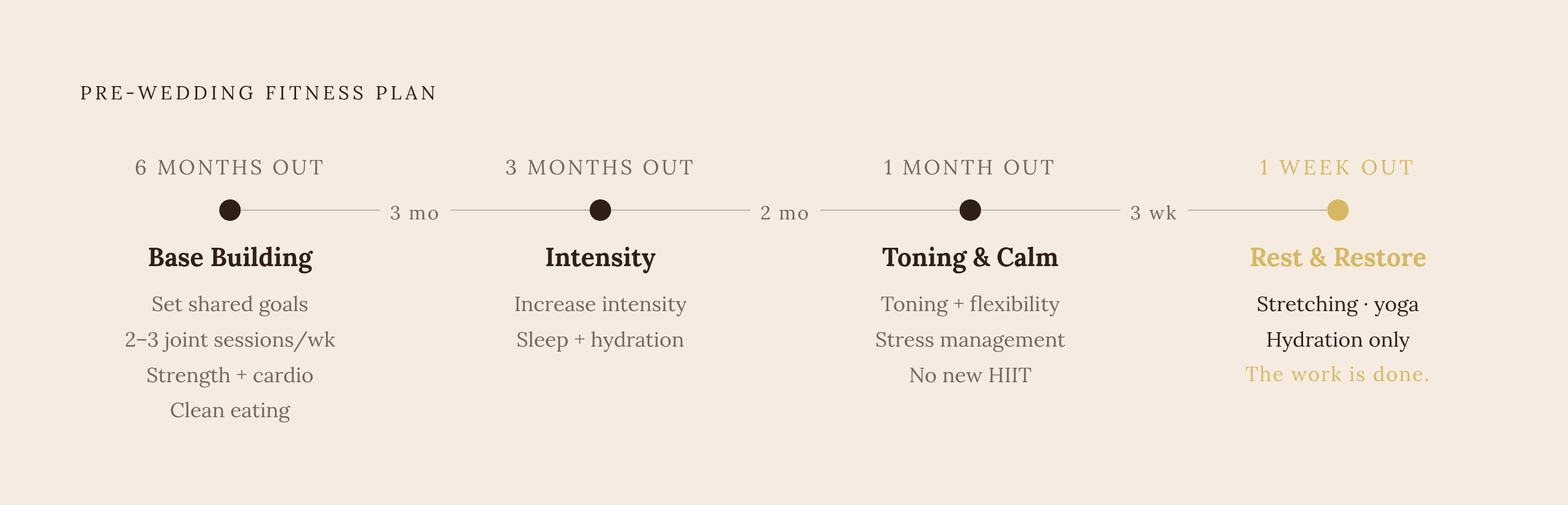
A plan that works for two people depends less on picking the perfect exercises and more on finding a rhythm simple enough to survive the busiest, most chaotic weeks of planning a wedding.
The timeline breaks down cleanly into four stretches. Six months out, the job is to set shared goals, settle into two to three joint sessions a week, build a base of strength training and cardio, and start treating clean eating as a shared practice. Three months out, intensity goes up a notch, sleep and hydration move into focus, and the joint session rhythm holds steady. One month out, the emphasis shifts to toning, flexibility, and stress management. That month is not the time to start a new high-intensity program. One week out, everything goes light: stretching, yoga, rest, and hydration, since by that point the actual work is behind you.
The exercises that hold up across that whole stretch share a few traits. Strength training builds lean muscle, which pays off in posture, metabolism, and plain confidence, and a set of adjustable dumbbells or resistance bands at home covers everything needed, no gym membership required. Compound lifts like squats, deadlifts, and overhead presses do the most work for the least time spent. Dance cardio earns a specific mention because it solves two problems at once: it burns calories and doubles as practice for the sangeet or first dance, and it happens to be one of the few workouts that partners at very different fitness levels can genuinely enjoy side by side, since nobody's really counting form points on the dance floor. Pilates builds the kind of core strength and posture that matters when a dress or suit involves hours of standing and dancing, particularly for backless or structurally demanding garments. Yoga and stretching round things out as both a fitness tool and a wind-down ritual that works just as well done as a couple as it does solo.
Recovery fits into the same weekly rhythm rather than sitting off to the side: foam rolling and mobility work two to three times a week, plus a few minutes of light stretching daily. As a frequency rule, two to three joint sessions a week builds real consistency without flattening either partner's schedule, and training solo on the other days leaves room for individual goals, whether that's a longer run or more upper-body focus, without turning those differences into friction.
A few adjustments can be tailored to the big day itself. A strapless or backless dress rewards shoulder, tricep, and upper-back work. A fitted mermaid silhouette leans on core stability and lower-body definition. A ballgown calls for functional strength and posture work, since carrying that much fabric around for a full day is its own kind of workout. They're practical prep for a specific physical demand.
Food matters just as much as the workouts, and it works best as a shared project. A plate built around protein, fiber, and healthy fats covers the basics, and meal prepping together turns a chore into something closer to a weekly date, equal parts practical and bonding. The 90/10 rule, eating well most of the time while still leaving room to enjoy a slice of cake or a glass of wine, keeps the whole plan from tipping into the binge-restrict cycle that derails a lot of otherwise well-meaning engaged couples. Training together works relationally the same way: the accountability is a commitment made visible to someone who's paying attention, and apps like Sweatmates lean into exactly that by turning weekly progress into something both partners actually see and acknowledge together.