Couple Gym Workout Plan for Wedding Preparation
Couples who work out together are 90 percent more likely to stick with it than solo trainers.
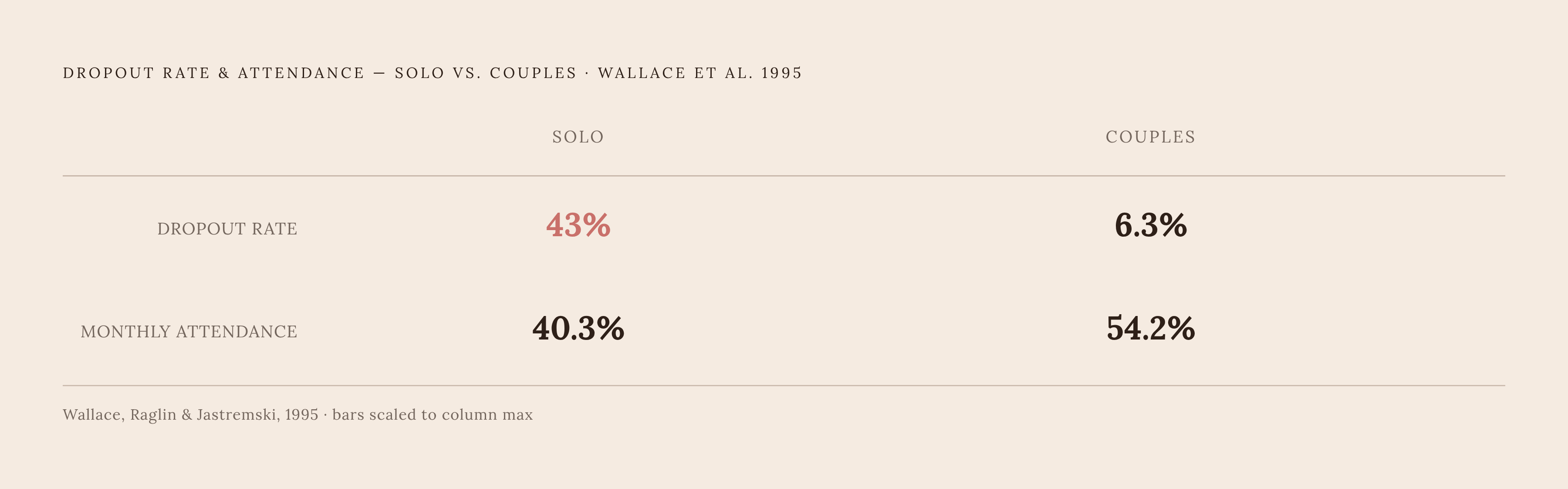
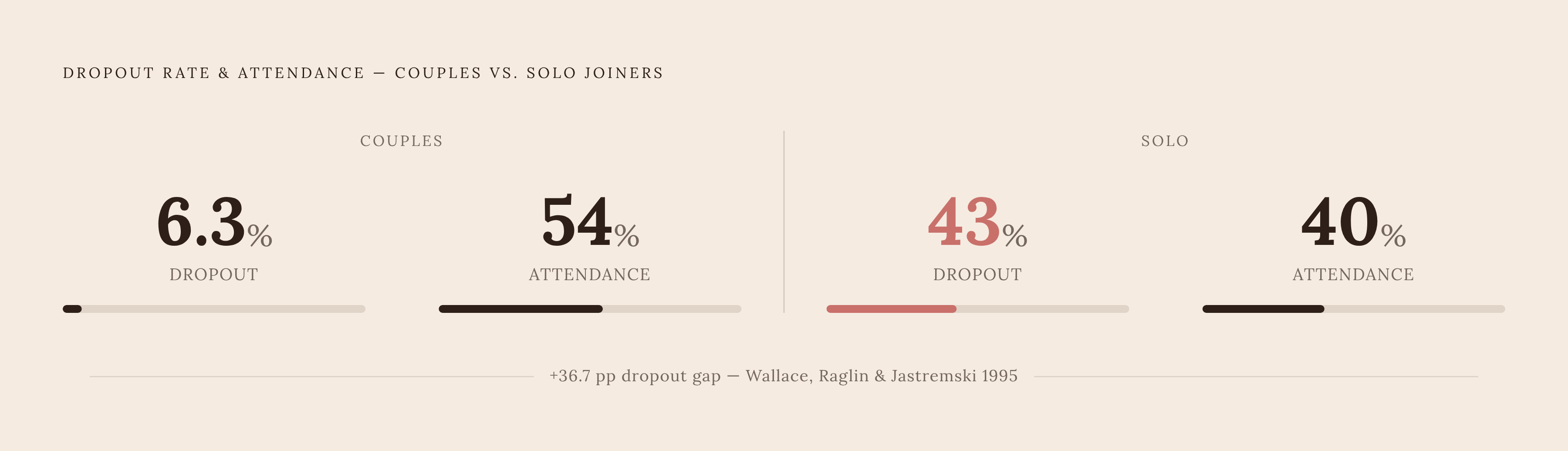
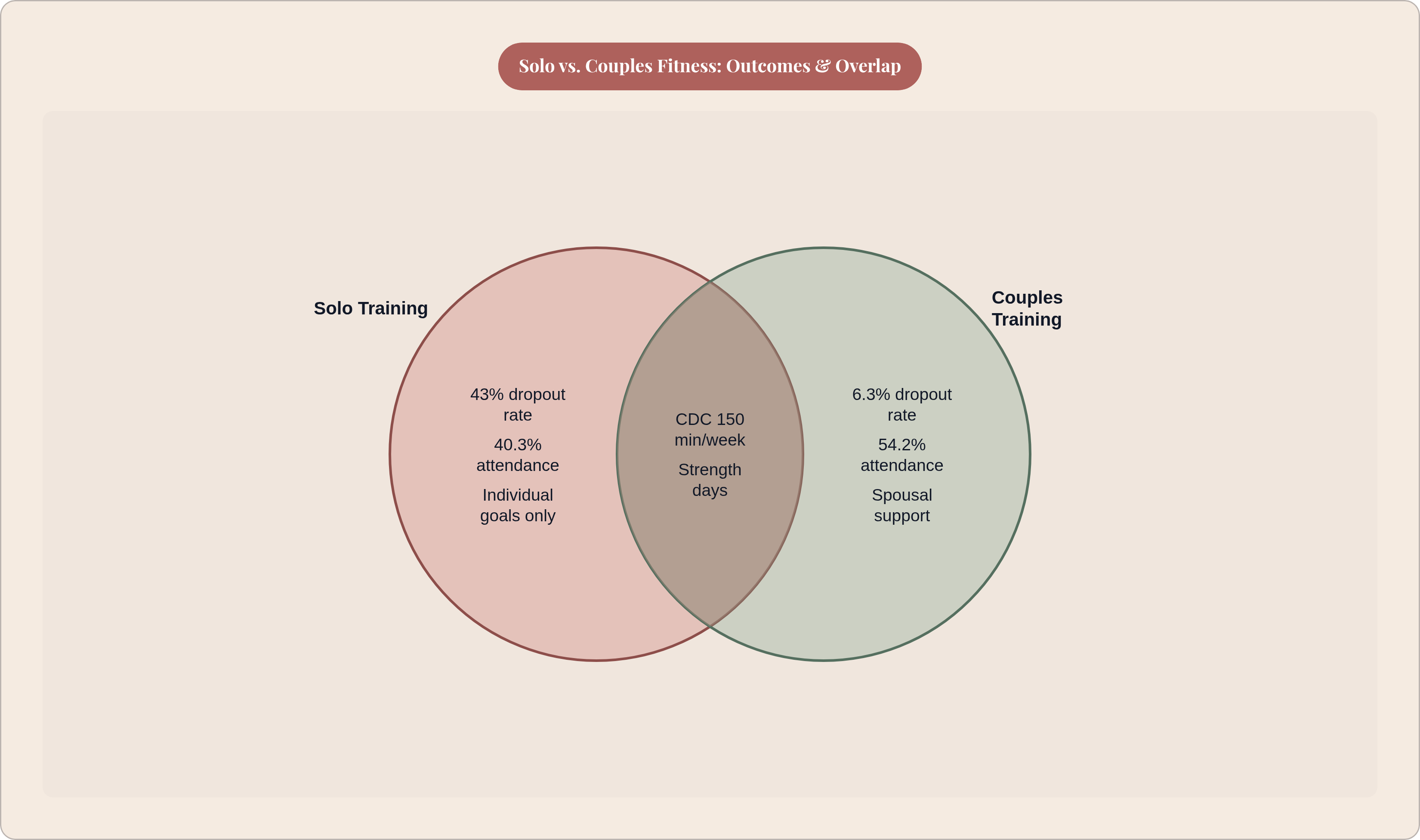
Start with the number that should make you rethink whatever plan you've currently got taped to the fridge. Wallace, Raglin & Jastremski ran a study back in 1995, published in the Journal of Sports Medicine and Physical Fitness, and it found that married people who joined a fitness program solo dropped out 43% of the time. Couples who joined together? 6.3%. Sit with that gap for a second. That's not a small edge, that's the difference between something you do and something you meant to do.
Attendance told the same story. Couples showed up 54.2% of the time on a monthly basis; solo joiners managed 40.3%. And here's the part I find most useful: the researchers didn't pin the gap on discipline or personality type. They traced it to spousal support, not willpower.
A 2018 University of Aberdeen study landed in the same neighborhood. Couples who nudged each other to stay active were up to 90% more likely to keep the habit alive than people flying solo. Ninety percent. I've seen training plans built on far shakier ground than that.
There's a physical piece to this too, not just a motivational one. Move together, whether that's a run, a lift session, or a slow lap around the neighborhood, and you're building something that talking never quite manages — shared effort that stacks endorphins and dopamine on top, which turns a workout into something closer to a ritual than a chore.
So the engagement isn't just a countdown to a date. It's the best window you'll get, in your entire life probably, to build a habit that outlasts the wedding itself.
How to think about the 12–18 month engagement window in fitness terms
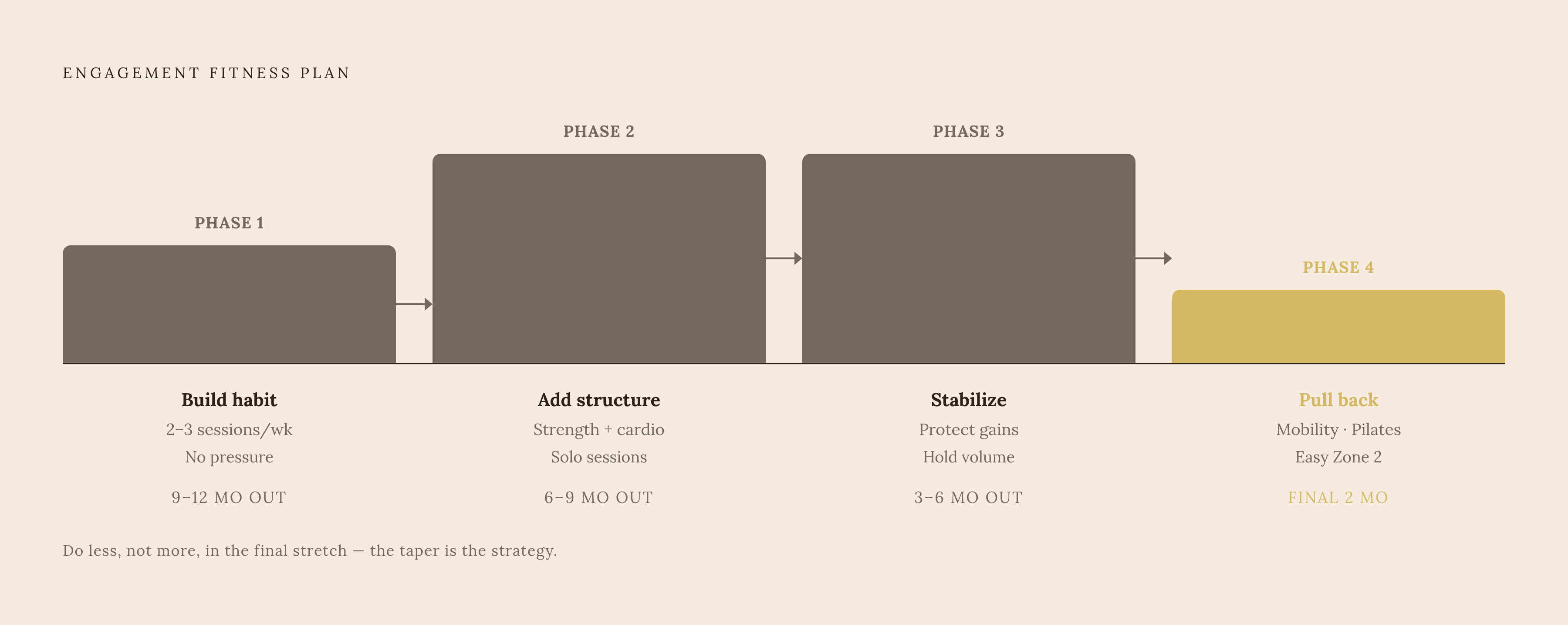
Most engagements run 12 to 18 months. That's not a sprint, no matter what the "shred for the wedding" crowd on Instagram wants you to believe. Starting 6 to 9 months out hits the sweet spot, strength gets built, habits settle, and you're cruising by the time fittings roll around. Six months is roughly the floor for seeing real, sticky changes in tone and energy; go shorter than that and you're negotiating with your own biology.
Three stretches, loosely:
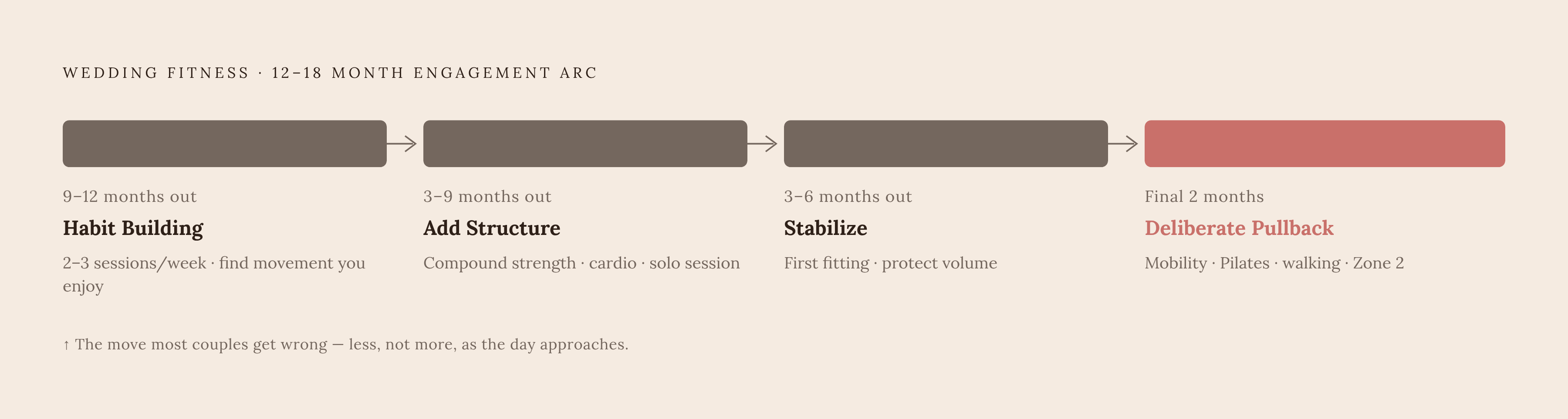
Nine to twelve months out is habit territory. Find movement you both actually enjoy, not just tolerate, and show up for it. Nobody cares about performance yet.
Three to six months out is when attire gets picked, so training can sharpen a bit. The real target is the first fitting, usually 2 to 3 months out, and arriving there in stable shape saves you from the special hell of last-minute alterations.
The final two months are for pulling back, not pushing harder. Mobility work, Pilates, walking. Stress spikes cortisol, cortisol causes bloating and fatigue, and the last thing you want two weeks out is your body fighting you.
Couples with a long runway don't need to come out of the gate hot. Build the habit first, let intensity show up later. The people who get hurt, or just quit from exhaustion, are almost always the ones who started late and tried to compress a year of progress into six frantic weeks.
A weekly workout structure that works for two people with potentially different goals
The CDC's baseline, 150 minutes of moderate exercise weekly plus two strength days, works fine as a shared floor no matter where either of you is starting from.
Training together twice a week? Both sessions should be full-body. Splitting by muscle group only makes sense once you're at 4 to 7 sessions a week; do it any less than that and you'll leave whole muscle groups untouched for days at a stretch.
A rhythm that actually holds up:
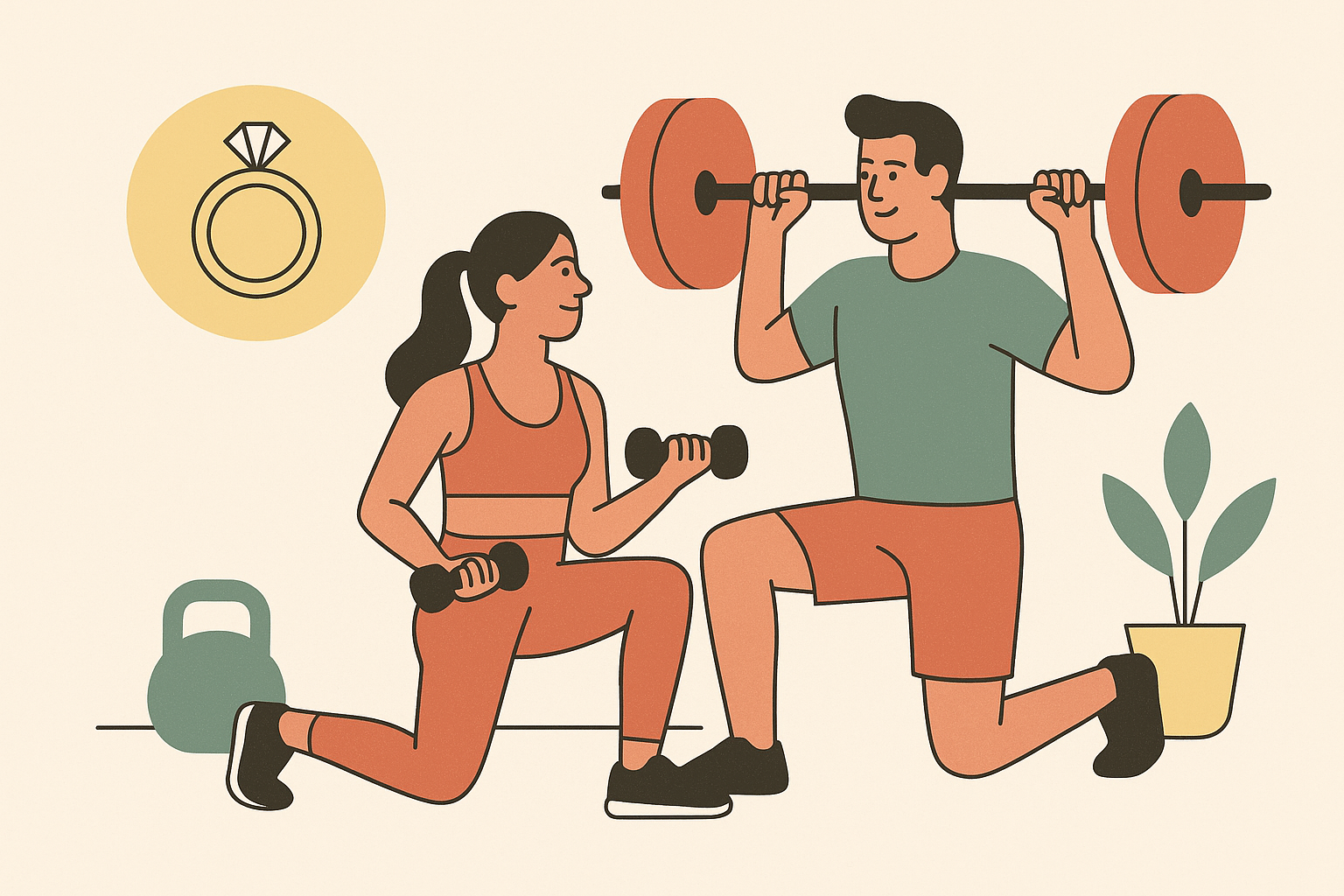
- Two shared full-body strength sessions, compound lifts (squats, deadlifts, overhead presses), 20 to 40 minutes each
- One or two shared cardio sessions, dancing, cycling, walking, whatever gets the heart rate up, these double as connection time whether you plan it that way or not
- One solo session per partner, for whatever each of you is chasing individually
- At least one or two recovery days, and these aren't optional. They're part of the plan, not a break from it.
The solo session exists because goals genuinely split. A lot of brides want arms, back, and shoulders dialed in for the dress, so curls, tricep work, resistance bands. Grooms often chase upper-body definition through heavier compound lifts, though nutrition does more of that work than any amount of extra reps ever will. Both partners benefit from squats, lunges, and core work; you'll need the endurance for a night of dancing, and core work does quiet things for posture that nobody notices until it's missing.
Divergent goals aren't a crisis. They're just the reason each of you gets one session a week that belongs entirely to you. And once you hit that final two-month stretch, dial the emphasis toward mobility and easy cardio instead of stacking on more volume.
One thing that doesn't get mentioned enough: dance lessons for the first dance count as real cardio, they directly serve the actual wedding day, and they beat another Tuesday staring at a treadmill wall.
The pitfalls that derail wedding fitness plans — and what actually causes them
Crash dieting tops the list, and the data isn't subtle about it. A 2023 study in the Journal of the Academy of Nutrition and Dietetics found eating below a safe caloric floor spikes cortisol by 34%, which causes water retention and fatigue. That's the opposite of the goal, and it shows up right when you need it least, two weeks out.
It gets worse. Somewhere between 20% and 40% of weight lost through severe restriction is lean muscle, not fat. Your composition moves the wrong direction, your metabolism slows, and you've done real damage chasing a number on a scale.
Overtraining is the same mistake wearing a different hat. Research from the National Strength and Conditioning Association found overtraining without adequate recovery cuts muscle protein synthesis by up to 40%. More isn't more, it's often just more tired, with nothing to show for it.
Then there's the cardio-only trap. Cardio-only routines produce minimal gains in lean muscle or composition compared to programs mixing strength and cardio. Run all you want; without lifting, you're leaving results on the table.
The relational risk doesn't make it into any brochure, but it's the one that actually sinks people. Couples who start competing, policing each other's plates, or comparing progress turn a shared goal into a source of friction. The entire benefit of training together rests on mutual encouragement, and tipping it into surveillance loses the thing that made it work.
And on the wedding day itself: skip the sunrise HIIT session. High-intensity workouts the morning of cause facial redness and fatigue, and neither belongs in your wedding photos. A slow walk or gentle yoga flow is the ceiling that day, not the floor.
Nearly every one of these traces back to the same root: urgency crowding out judgment, usually because someone started too late and narrowed a whole plan down to one number on a scale.
Nutrition as a shared habit, not a separate diet plan
Trainers like to cite an 80/20 split: 80% of that pre-wedding glow comes from nutrition and hydration, only 20% from the gym. Nail your workouts and ignore your plate, and you've built the equation backwards.
Shared nutrition habits are also just easier to live with than two competing diets in one kitchen. Couples who eat similarly aren't managing two food environments under one roof, which sounds minor until you've tried to meal-prep two separate plans on a Sunday night.
A sustainable baseline isn't a rigid meal plan. It's an orientation: protein-forward, lean meats, omega-3 sources like turkey, eggs, and seafood, the kind of eating that supports muscle and keeps cravings in check. Hydration deserves its own mention here, probably the most underrated lever in this entire plan. Skin, energy, recovery, all of it runs on water, and it's the lowest-effort change with the highest payoff you'll find anywhere in this list.
Treat nutrition as a countdown restriction and you'll unwind it the day after the wedding, almost guaranteed. Treat it as a habit for the marriage, and it survives the honeymoon intact. Drop calories too low, and you risk "skinny fat," muscle gone while fat stores stay put, which is the exact opposite of what most couples say they want.
How accountability between partners actually works — and when it goes wrong
That Wallace study again: the mechanism behind those attendance numbers was spousal support, not competition, not obligation. That distinction carries more weight than nearly anything else here.
Supportive accountability and controlling accountability look nothing alike once you're inside them. "Are we going tonight?" is support. Monitoring what your partner eats, or picking apart their effort, is not. Celebrating that a workout happened during a genuinely brutal week matters more than celebrating a personal record, and letting one partner have an off day without turning it into a referendum on the relationship keeps the whole thing standing.
A few low-friction tools, nothing that adds more to an already overloaded engagement season:
- Shared weekly goals instead of daily perfection, simple enough to hold in your head without a spreadsheet
- Workout photos sent on the days you train apart, a small way to stay looped in
- Friendly wagers tied to showing up, never to weight or performance numbers
Missed workout? The right response is a question, "what got in the way?", not a lecture. The engagement period is already loaded: vendors, family opinions, a hundred small decisions a week that nobody warned you about. The fitness plan should be one of the stable things in that chaos, not one more obligation waiting to fail and add to the pile.
What a realistic shared plan looks like across the engagement, start to finish
Stop thinking of this as a program with a finish line. It's a rhythm, and rhythms don't end, they just continue.
Months 1 through 3, roughly 9 to 12 months out: commit to 2 or 3 sessions together weekly, and experiment until you find what you can actually sustain past the novelty phase. Months 4 through 9, 6 to 9 months out, is where structure gets layered in: compound strength twice a week, 1 to 2 cardio sessions, one solo session each. Track that you're showing up, not what the mirror says.
Months 10 through 12, 3 to 6 months out, is about stabilizing around the first fitting. Don't add volume here, just protect what you've built. The habit should feel close to automatic by now, and the final two months pull back further: less intensity, more recovery, more Pilates, yoga, walking, easy Zone 2 work.
The fitting itself works as a checkpoint, not because your body owes anyone a specific size, but because it confirms the plan is doing its job and kills the urge to make some drastic last-minute change out of panic.
Here's the part that actually sticks once the wedding's behind you: you've already solved the hardest problem in fitness, which is figuring out how to show up together, consistently, without turning it into a fight. The wedding is a milestone inside that process. It was never the finish line.
Strength training for just 30 to 60 minutes a week, across 16 separate studies, lowers the risk of diabetes, heart disease, and other chronic conditions down the line. That's not a wedding statistic, that's a life one, and it's the actual return on the habit the two of you are building, long after the flowers are gone.