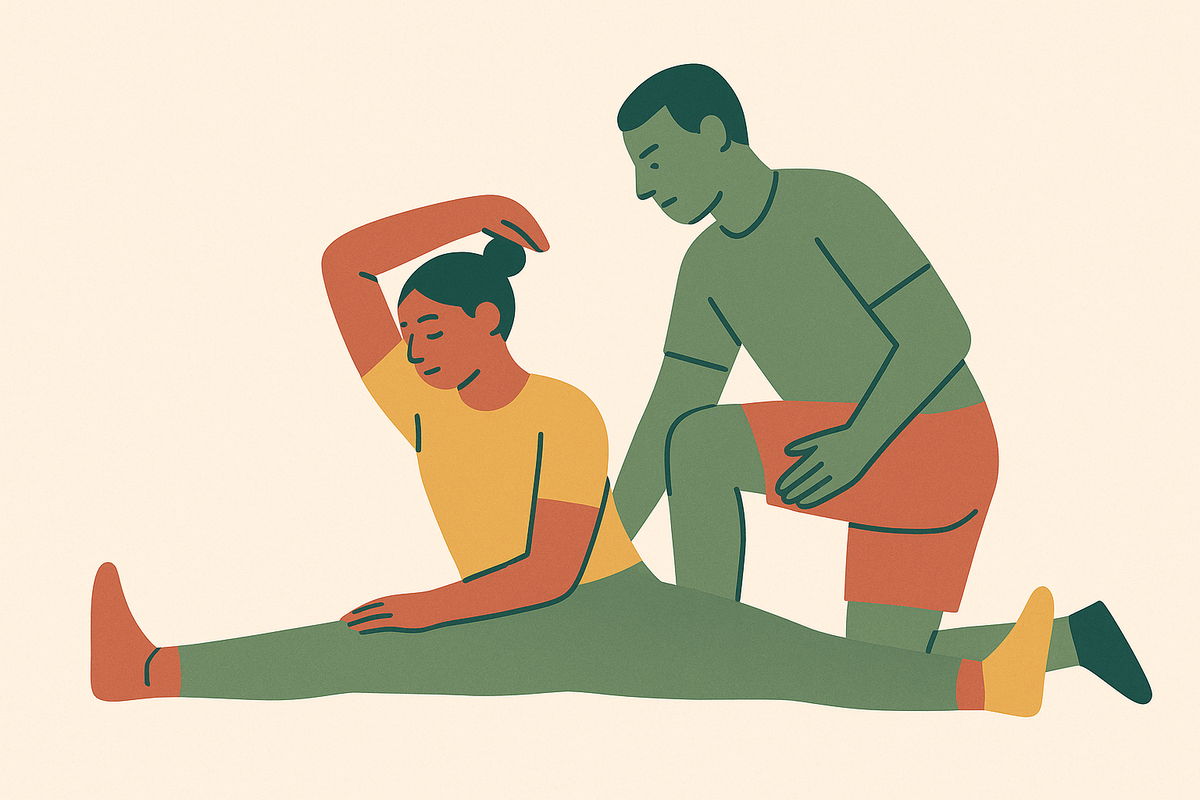
How to Set Shared Fitness Goals When Partners Have Different Abilities
Couples exercise best when they focus on showing up together, not matching performance.
My spouse thinks a "good workout" means a 10K before breakfast. I think it means winning the fight against my own couch. This piece is about what happens when two people with wildly different fitness levels try to build a routine together, without one of them faking a smile and the other faking a limp.
The exercise gap is real, it's common, and almost nobody talks about it directly. One partner ends up more active, more able, or just more into it, and the other one resents getting left behind, or getting nagged about it, or both on alternating Tuesdays. Over a quarter of U.S. adults between 18 and 64 have a disability by the CDC's definition (serious difficulty walking, climbing stairs, hearing, seeing, concentrating, remembering, or deciding), so this touches most couples eventually, in one form or another.
The friction rarely shows up labeled "different fitness levels." Instead it shows up as guilt. As one partner suddenly remembering an urgent errand around workout time. As someone scrolling their phone during a walk they used to actually enjoy. Relationship therapists have noted that exercise drags a lot of hidden stuff along with it: feelings about attractiveness, fear of decline, and identity questions that go well beyond the gym. Others have put it straighter: the real fight is often about control over a partner's body, with fitness as the surface issue. Most pushback from the less-active partner comes from feeling judged by someone who used to be on the same team.
Words do real damage here. Therapist Dodson told Yahoo Life in July 2026 that lines like "you've let yourself go" don't motivate anyone. They just get filed away and pulled out again three years later, mid-argument, fully loaded. Naming the dynamic out loud, before any goal-setting talk happens, isn't optional. Skip it, and no shared calendar invite is going to save you.
What the research actually shows about exercising together — and what it doesn't settle
The adherence numbers are the strongest thing anyone's got here. A study tracked married pairs who joined a fitness program together against people who joined solo. Dropout rate for couples: 6.3%. Solo joiners: 43%. Monthly attendance ran 54.2% versus 40.3%. That's the gap between a habit and a New Year's resolution that's dead by February.
A 2017 study in BMC Geriatrics found older couples who exercised together had 3.68 times higher odds of sticking with a walking program than non-couple groups, a 29.2-point adherence gap. Research on almost 1,700 young married couples, published in Family Relations and reported by FOX17 in August 2026, found couples who worked out together communicated better and fought less. A 2021 daily diary study of 95 young adults in the Journal of Personal Relationships found people reported better mood and more relationship satisfaction on days they exercised with a partner instead of alone.
Here's the hole in all of it, though: most of these studies used couples already at similar fitness levels. Nobody's measuring what happens when one person runs marathons and the other treats parallel parking as a cardio event. That's the actual question. The rest of this piece is trying to answer it.
Why a moderate ability gap can actually help the less-fit partner perform better
There's a real, named phenomenon called the Köhler effect, and it's one of the few genuinely useful findings in this whole area. The short version: a weaker team member performs better on a shared task than their solo numbers would predict, because the group's result depends on them. Nobody wants to be the reason the team loses, and that pressure turns into fuel.
A 2023 meta-analysis in Kinesiology Review pulled together 19 studies and 1,912 people. The effect was statistically significant, with a large effect size (g = 0.91). A real, repeatable performance boost, caused just by pairing with someone slightly stronger.
Here's the catch: the gap has to sit in a specific range. Too wide, and the weaker partner gives up, because the task feels hopeless no matter what they do. Too narrow, and nothing pulls at all, because there's no real challenge left. This is the actual case for why a fitter partner is an asset instead of a source of shame, as long as the task is built so both people's effort genuinely counts. Get the structure right, and the gap becomes an engine. Get it wrong, and it's just guilt with a gym membership.
The framing shift that makes shared goals possible: connection over identical performance
The biggest mistake couples make is assuming "training together" means matching pace, matching weight, matching reps. Chase that, and you'll end up with a silent breakfast every Saturday. GoFit Gym said it well in 2026: the real issue is almost always a mismatch in expectations about what "together" even means.
A working fitness partnership means moving in the same direction. Two people can walk into the same gym, split off to completely different machines, and still be working out together in every way that matters.
Two questions come before any goal gets set:
- Do I need my partner to share this exact goal with me?
- Or do I just need them to not get in the way of it?
Different problems, different fixes. Mixing them up is where most of the resentment starts. The point is plain: couples don't need perfect alignment on fitness goals. They need clear communication, basic respect, and room for each person to want things the other one doesn't.
So what should couples actually line up on, if not identical performance? Showing up at the same time and place, even if what happens once you're there looks nothing alike. A shared calendar, a shared streak, some kind of check-in both people actually do. And visibility, meaning progress both partners can see and celebrate, not just the fitter one's personal records taped to the fridge like a report card nobody else signed up for.
How to set shared goals that account for both partners' actual starting points
Start separately, before any negotiating. Each person writes down what they actually want: lose weight, more energy, run a 5K, manage stress, lower blood pressure. Get it on paper before anyone starts compromising on the other's behalf.
Then sort. Which goals actually benefit from doing them together, and which are personal projects that don't need a shared structure at all? Some things are better solo. That's fine.
A version of SMART goals applied at the couple level works well here:
- Specific: name the actual shared activity, not a vague outcome like "get fit"
- Measurable: track how often you show up, not how well you perform
- Achievable: set the bar at the less-fit partner's current ceiling, with room to grow
- Relevant: tie it to something both people actually care about beyond the scale
- Time-bound: eight weeks, a season, something short enough that reassessing feels normal instead of like quitting
There's a real difference between process goals ("we walk together three times a week") and outcome goals ("we both finish a 5K"). Process goals hold up better when ability levels differ, since nobody's individual performance decides whether the whole thing succeeds.
Event-based goals make a solid bridge. Sign up for the same 5K or charity walk: one partner runs, one walks, same start line, same finish line, wildly different paces, and nobody's standing around feeling like a burden.
Keep the tracking simple. Elaborate spreadsheets die the first time real life shows up uninvited. And when a week gets missed, because it will, that should start a conversation, not a guilt trip. Build that expectation in from day one.
Practical ways to train at the same time without training at the same level
Match the effort, not the numbers. One partner does bodyweight squats, the other loads a barbell. One walks briskly, the other jogs. Both are working hard against their own ceiling, which is the actual point.
Bodyweight movements are natural equalizers. Push-ups, squats, burpees, all of them scale without extra equipment, hard enough for someone advanced, doable for a total beginner.
A few tricks keep the shared structure intact while quietly adjusting difficulty. Slow the tempo down; more time under tension makes the same move brutal for the stronger partner. Add a pause mid-rep. Adjust the range of motion, or add isometric holds, as a natural progression.
Partner exercises that need real teamwork, resistance band drills, moves where one person's effort depends on the other, trigger the Köhler effect directly, because the result is genuinely shared instead of just happening in the same zip code. Taking turns leading the workout helps too. It hands the less-fit partner real ownership instead of just tagging along.
Different activities carry their own built-in fixes. Cycling: loop routes, out-and-backs, or meeting points let both people ride their own pace, and e-bikes work as a genuine equalizer. Running: run/walk intervals cover the same route together, and the faster partner can tack on extra distance at the far end. Gym sessions: different stations, same time window, training alongside instead of identically.
A shared photo. A quick check-in text. A simple log both people update. All of it makes the effort visible even when the workouts themselves run at completely different intensities, which matters most for couples who train solo all week and only overlap on weekends.
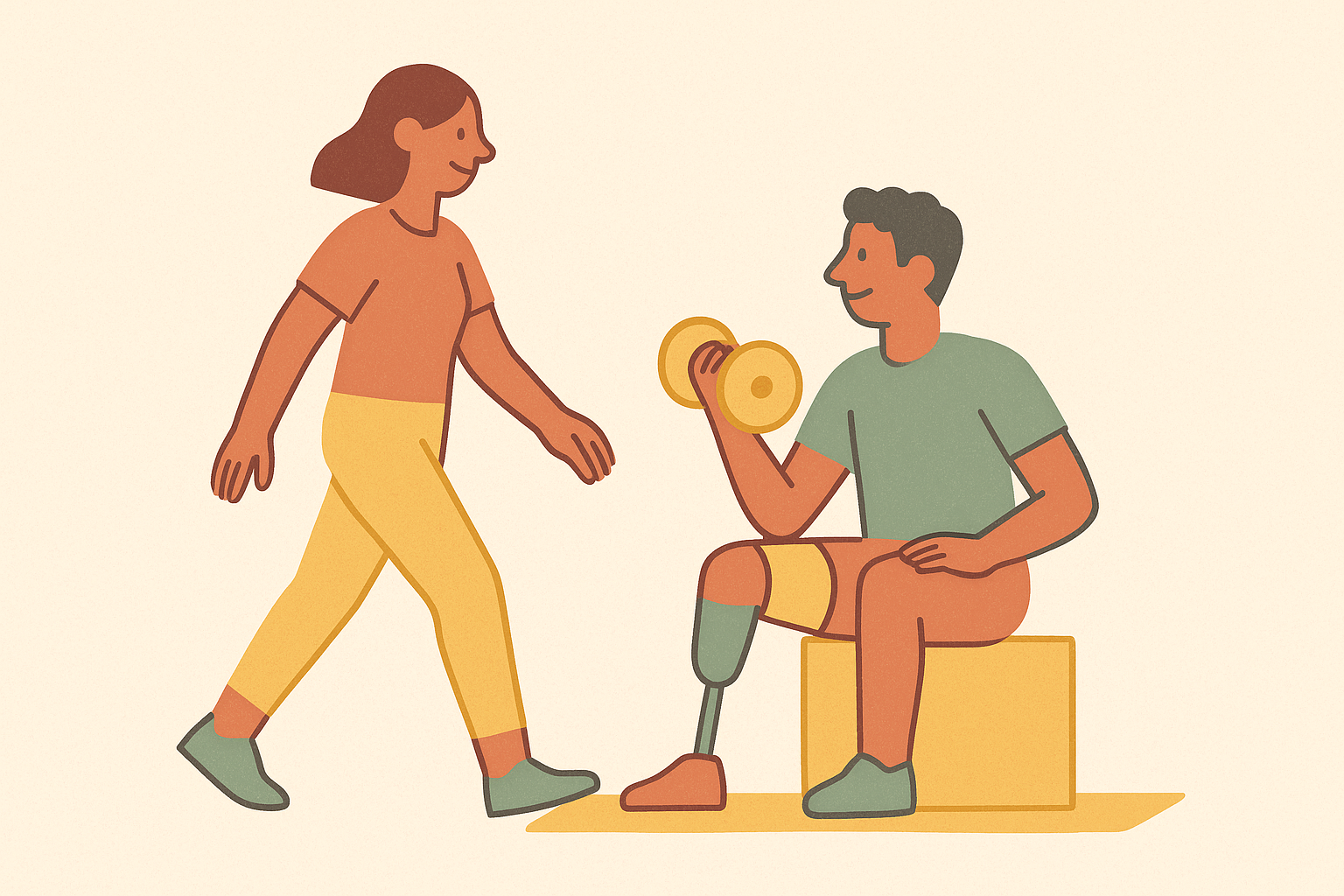
When one partner has a disability, chronic illness, or is in recovery
Again, more than a quarter of U.S. adults 18 to 64 live with a disability, per the CDC. This isn't a rare edge case tucked into a footnote. The CDC's guidance keeps it simple: some activity beats none, be as active as you're able.
The shared-goal framework doesn't really change here. What shifts is the baseline and the timeline. Matching effort matters even more in this setup; showing up and finishing a modified session earns the same celebration as a personal record, maybe bigger. People with physical or developmental disabilities can have unpredictable physical responses to exercise, so real modification decisions need a doctor or a qualified trainer involved, not a guess made on a Sunday afternoon.
A few adaptations tend to work across this particular gap: seated or low-impact movement happening next to someone standing, shared outdoor time where a slow walk counts fully as shared exercise, one partner supporting the other's rehab by showing up, timing sets, or just cheering from a folding chair.
The fitter partner's role shifts here, from training partner to support partner, and that shift needs saying out loud. Left unspoken, it breeds resentment on both sides: the supporting partner feels unseen, the other feels like a project. A missed session because of pain, fatigue, or a doctor's appointment is information. It deserves a conversation, not a verdict.
How accountability works when partners train at different levels or on different schedules
Partners can train on totally separate schedules all week and still feel like they're doing this together. What actually counts is both people knowing the other one is working toward the same shared goal, even from across town, even at 6am versus 9pm.
Accountability works when it feels supportive, not supervisory. Checking in on effort and consistency lands fine. Policing someone's pace backfires almost every time.
A few things tend to hold up across mismatched levels: a weekly session count both people add to, regardless of what any single session looked like; a shared post-workout photo, low effort, low friction, that celebrates showing up rather than output; a friendly bet tied to consistency instead of a metric one partner will win automatically; a small shared reward at the end of a streak that reinforces the relationship, not just the fitness.
Apps built around partner fitness work best tracking consistency and shared participation, not demanding matching numbers from two people who never started in the same place. Sweatmates, a shared fitness accountability app for couples that runs on photo check-ins, weekly goals, and friendly wagers rather than raw performance numbers, is one example built around that idea. The goal is a record that both people showed up and both people noticed.
Research has found people stuck with goals, quitting smoking, exercising, losing weight, more often when a partner joined them. The mechanism was being seen, not matching ability.
What to do when the gap widens — or when one partner stops progressing
Fitness gaps move. Injury, illness, stress, pregnancy, aging, a sudden burst of motivation or the total loss of one, all of it shifts the balance over time, sometimes overnight.
The moment the fitter partner starts feeling held back, or the other starts feeling like dead weight, that's the signal to revisit the original shared goal, not quietly build separate training plans behind each other's backs.
A few honest questions are worth asking on repeat. Is this structure still working for both of us? Are we celebrating what we're both doing, or only tracking what one person racks up? Does the accountability still feel supportive, or has it drifted into something closer to surveillance?
Revisiting the goal is the system working exactly as intended, which is why time-bound structures, eight weeks, a season, matter so much. They make reassessment routine instead of a big emotional standoff. And the fitter partner chasing individual goals on the side, a longer run, a heavier lift, keeps both people actually engaged instead of one person quietly resenting the whole setup.
The Köhler research explains why the balance matters so much: stretch the gap too wide, and the motivational pull disappears entirely. Keeping it in the productive range takes an honest, ongoing conversation, not a one-time deal signed in January. The best fitness system for a couple is the one both people keep coming back to, even after life rearranges what "coming back" looks like.