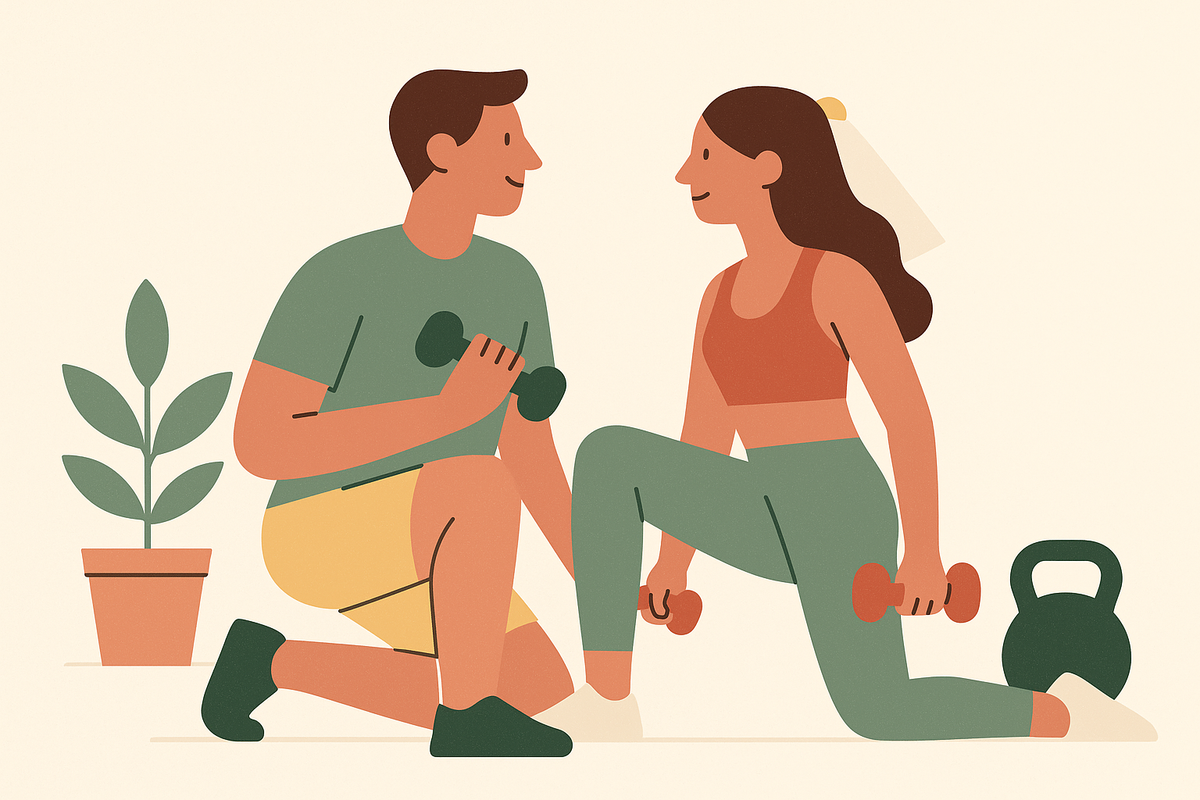
Fun Partner Exercises for Engaged Couples
Shared movement builds the communication couples need more than the fitness gains alone.
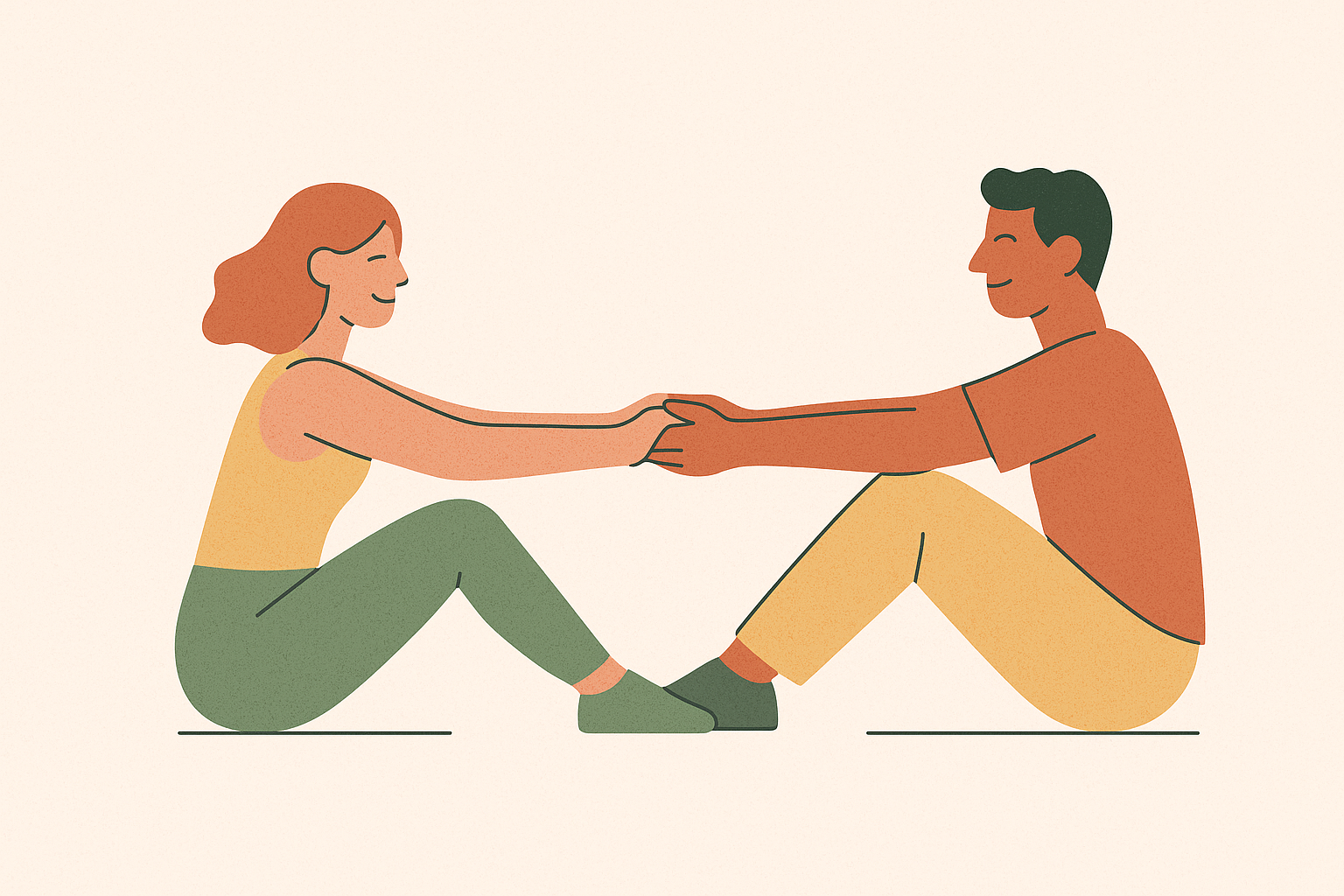
Engaged couples work out together for one reason that actually matters: it builds a habit that survives the wedding, not just the diet before it. The research backs this up, and the format matters less than most people think. Skip the matching Lululemon and the six-week shred plan. What you're really building is a pattern of showing up for each other, and it happens to burn calories along the way.
What the research actually shows about couples who move together
A study out of BYU, published in Family Relations in 2026, looked at almost 1,700 young married couples through a nationally representative project called the Couple Relationships and Transition Experiences study. The finding: couples who exercised together reported better communication, stronger conflict resolution, and less marital conflict than couples who kept their workouts separate.
Here's the part worth sitting with. Of everything the researchers measured, communication showed the strongest tie to shared exercise, ahead of weight loss and fitness scores alike. Listening, feeling heard, feeling backed up by your partner — that's what moved the needle.
And the exercise itself was nothing fancy. Walking was the most commonly reported shared activity in the study, with no gym membership, no fancy equipment, and no personal trainer charging by the hour involved. Just two people walking next to each other on a regular basis.
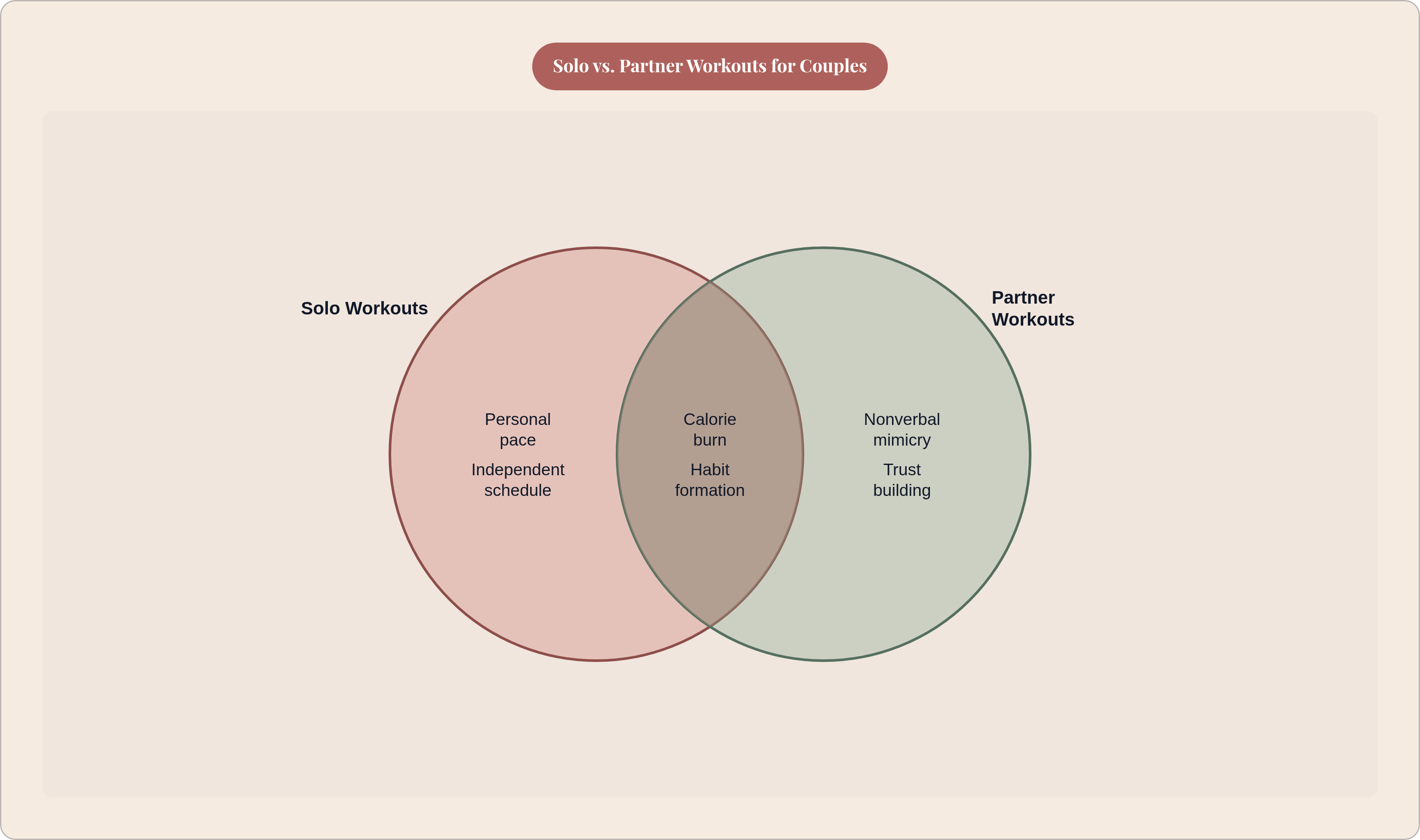
There's a mechanism behind this called nonverbal mimicry. When two people move in sync, matching pace or rhythm without thinking about it, it creates a kind of emotional closeness that doesn't need words. A Psychology Today review of the same territory found shared workouts linked to better mood, both during the session and for the rest of the day, plus higher satisfaction in the relationship overall.
One honest caveat: the BYU study didn't find a statistically significant gap between couples who worked out together versus those who worked out apart. So don't let anyone tell you couples workouts are magic. The real message is simpler and, frankly, more useful: any shared movement, done regularly, does something for a relationship that solo movement doesn't. You don't need synchronized burpees. You need synchrony, period.
Why consistency is the real goal — and what makes partner workouts more likely to stick
Most people who start a new workout routine quit within a few months, and that's not a hot take, just what happens. The issue was never lighting the fire. It's keeping it burning past week three, when the couch starts calling your name louder than your alarm.
A partner changes the math. When someone else is standing in your kitchen at 6am waiting for you, bailing costs something socially that bailing on yourself never does. Research on workout partners backs this up directly: having a workout buddy increases how often people show up, and the more encouraging that buddy is, the bigger the effect. Encouragement, not enforcement, is the active ingredient.
A little competition helps too. Racing your fiancé up the last hill of a hike, or seeing who can hold a plank longer, adds spark without turning the whole thing into a performance review. The line to watch: accountability should feel like support, not surveillance. The second someone starts to dread the check-in, you've built an obligation, not a habit.
Here's the good news for engaged couples specifically. You don't need to agree on pace, intensity, or even the exercise itself. What you need is a structure that makes skipping the workout feel harder than just doing it. "Three sessions this week, together" beats any spreadsheet with sets, reps, and macros nobody actually reads after day four.
Bodyweight partner moves that require no equipment and work in any space
No equipment means no excuse. Living room, backyard, hotel room during a venue tour — it doesn't matter. Here's what to actually try:
Partner push-up with high-five. Face each other, both doing push-ups, and alternate reaching across to slap hands at the top. It forces you to move in the same rhythm and makes an otherwise miserable exercise briefly hilarious.
Synchronized lunges, holding hands. Face each other, hold hands, lunge at the same time. The contact keeps you in sync and gives you a little extra balance support, which matters more than people expect once the burn kicks in.
Partner squats, facing, holding hands. Same logic as the lunges. Your combined weight offsets each other's balance, and holding hands gives you instant feedback on depth and form, no coach required.
Plank jump-over. One partner holds a plank, the other jumps side to side over their back. The plank-holder's break depends entirely on how fast the jumper decides to go, which turns pacing into a conversation instead of a guess.
Wheelbarrow walk. One partner in a plank, the other holding their ankles, walking forward slowly. Keep it controlled, and take it outdoors if you can, since indoor furniture rarely survives it.
Back-to-back wall sit and tricep dips. Switch roles so both partners get both exercises in, trading off like a relay.
None of this requires either of you to be fit, and that's the point. Two people at wildly different fitness levels can do all six moves, and the touch and timing, not the difficulty, are what make it feel like a shared activity instead of two people sweating in the same room. That high-five isn't decoration. Per the nonverbal mimicry research above, the physical coordination itself is the bonding mechanism, not a side effect of it.
Medicine ball and resistance band exercises that introduce light equipment without complexity
A medicine ball adds something bodyweight moves can't: a literal back-and-forth. Passing an object is its own little communication loop, whether you notice it or not.
Medicine ball sit-up pass. Sit facing each other, feet touching, and pass the ball at the top of each sit-up. Suddenly a core workout has a shared rhythm baked in.
Back-to-back medicine ball twist. Stand back-to-back and rotate to hand the ball off, alternating knee-level and overhead. The ball travels in a loop around both of you, and staying in sync becomes the whole game.
Partner medicine ball lunge pass. One steps forward as the other steps back, passing the ball at the bottom of the lunge. This one takes real spatial awareness. Healthline suggests starting with a 5 to 8 pound ball, which is light enough that early fumbles won't end in a bruise.
Resistance bands do something similar without any actual weight involved.
Partner band sprint. One person runs against resistance while the other holds the band, all indoors, no track required.
Partner resistance band walk. Band around both waists, walking in opposite directions. You feel your partner's effort directly through the band tension, which is a strange but effective form of instant feedback.
Partner tricep press-down. Both hold the same band and press at the same time, which forces you to match resistance and pace without either person overpowering the other.
One band and one ball run a full session. Cost stays low, storage takes up a drawer, and for couples watching a wedding budget, that matters more than it sounds like it should.
HIIT circuits structured for two people, and why the work/rest format suits couples
Partner HIIT works on a simple swap: one person goes hard, the other rests or recovers, then you switch. That structure does something quietly smart. It puts one partner's effort directly in front of the other's eyes, which naturally pulls encouragement out of you, even if you weren't planning to be a cheerleader that day.
It also solves the fitness-mismatch problem. The less-fit partner can hold a plank or jog lightly while the other sprints, then trade off, and neither person ends up feeling behind.
A sample structure:
- Plank hold (partner A) while partner B does jump-overs
- Wall sit (partner A) while partner B does tricep dips
- Light jogging or stepping for one while the other does medicine ball sit-ups
Skip the stopwatch obsession. A fixed number of rounds works better than tracking every split, and progress here means both of you finishing the circuit together, not finishing it fast.
The switching itself creates conversation almost by accident: "You ready?" "Two more seconds." That's a tiny loop of checking in and being heard, which happens to be exactly what the BYU researchers flagged as the biggest relationship payoff of shared exercise.
Cardio activities that feel like dates rather than workouts
These count as real cardio, even though they don't feel like a workout, which is the whole trick.
Hiking mixes cardio with resistance from uneven ground, and conversation shows up on its own when you're not staring at a treadmill display. Reaching the top of a trail together is a small, physical version of the goal-setting you're already doing for the wedding.
Cycling is easy on the joints and lets you dial intensity up or down without either person feeling like they're dragging the other. Riding side by side at a matched pace builds leg strength without demanding any technical skill first.
Dance classes, salsa, Zumba, ballroom, whatever, are cardio in disguise. You're learning something together, which adds a social layer on top of the exercise, and the physical contact built into partner dancing amplifies that nonverbal-sync effect from earlier.
Indoor rock climbing puts trust on full display. One of you belays while the other climbs, meaning your partner's safety is quite literally in your hands. Figuring out a route together is communication and problem-solving with a wall attached.
Tennis, badminton, squash, played as doubles or a friendly rally, add competitive stimulation without pitting you against each other.
If either of you hates the word "workout," this whole category is the workaround. You're framing movement as an outing, not a chore, and that reframe is often the difference between quitting in March and still going strong in October. And walking, the same activity the BYU study flagged as most common among couples, belongs right here too. It's the lowest-barrier option on this list, and arguably the most sustainable one.
Partner yoga and acro yoga as a trust-building practice, not a flexibility test
Acro yoga blends yoga, acrobatics, and elements of Thai massage. One partner, the "base," stays grounded and stable, while the other, the "flyer," gets lifted and balances in different shapes above them. It sounds intense, and it is intense, in the best way.
The trust part isn't a metaphor here. The flyer puts actual body weight into the base's hands. You can't fake commitment when you're literally suspended by your fiancé's forearms.
Communication stops being optional too, since you have to talk through every shift in weight and position — staying quiet just means someone ends up on the floor.
A few beginner poses that don't require any yoga background:
Seated back-to-back twist. Sit back-to-back, twist gently to each side, and rest a hand on your partner's knee. It opens up the spine and naturally syncs your breathing. Completely doable on day one.
Double downward dog. Both partners in downward dog, facing opposite directions, walking feet toward each other until hips touch. Great hamstring and shoulder stretch, and the contact point keeps your form honest.
Supported backbend. One partner stands while the other leans back into their arms. Simple shape, real trust required.
Seated boat pose. Face each other, legs lifted, feet pressed together, hands gripped. A core challenge that only works if both of you commit at the same time.
One safety note, and it's not optional: learn from an actual instructor before attempting lifts or flying poses. A beginner's class at a local studio is the right call, not a YouTube video at 9pm on a Tuesday. Acro yoga done wrong can hurt someone, and that defeats the entire purpose.
Of everything on this list, acro yoga probably mirrors engagement itself the closest. Two people learning a new skill together, tolerating the wobble and the near-falls, and somehow finding it fun anyway. That's basically the whole job description of a marriage, minus the balancing on someone's feet.
How to build a weekly routine that actually fits engaged-couple life
Wedding planning eats time and energy that a workout routine also wants. Any plan that ignores this will collapse by the time cake tastings and seating charts show up on the calendar.
The goal isn't a perfectly periodized training block. It's a habit that survives a bad Tuesday.
A realistic structure looks like this: two to three sessions a week, mixing formats so it doesn't get stale. One bodyweight or band session at home, one activity that doubles as a date (a hike, a dance class, a bike ride), and one flexible slot that can shrink down to a 20-minute walk if the week goes sideways. That flexible slot is the one that actually saves the habit, since a short walk still counts and keeps the streak alive when everything else is on fire.
Skip the elaborate tracking apps and spreadsheets nobody opens after the first week. A shared note, a quick photo texted after a session, something simple, does more work than a dashboard full of numbers you'll ignore by March.
If you miss a session, talk about what got in the way and plan the next attempt, with no shame spiral required. That conversation is, itself, a small rehearsal of the exact communication skills the BYU research ties to shared exercise in the first place.
Celebrate showing up together, not hitting some arbitrary performance number, because consistency comes first and everything else is a bonus.
The couples who keep this going long-term aren't running the fanciest program or hitting personal records every week. They're the ones who made moving together a normal part of how they treat each other, and who started before the wedding, not after it.