Partner HIIT Workout Routines for Wedding Prep
Partner accountability cuts wedding prep stress and boosts your odds of actually sticking with it.
Wedding prep gives you six months and a to-do list that multiplies faster than you can cross things off. Partner HIIT helps here: no gym, no wasted time, and you're doing it next to the one person who's supposed to be on your team through all of this.
HIIT is short bursts of hard effort, short breaks, repeat until you're rethinking your cardio history. No membership required, no equipment mandatory. It scales up or down depending on who's doing it and how their knees feel that particular Tuesday, which matters a lot more than the wellness blogs let on.
The research backs the format, though the honest version is less dramatic than the headlines. A 2024 network meta-analysis on NCBI, covering 28 randomized controlled trials and 1,620 patients, found HIIT beat every other exercise type tested for cutting waist size (down 5.93 cm on average) and body fat percentage (down 3.93%). A February 2025 systematic review zeroed in on adults 18 to 30, which happens to be where a lot of engaged couples live, and found HIIT particularly effective for fat loss in that age group.
None of that replaces months of real work. Three panicked sessions the week before the wedding lose to twenty weeks of shorter, steady effort every single time; consistency wins, full stop. HIIT just makes consistency possible on the nights your calendar is eaten alive by seating charts and vendor calls that always run fifteen minutes long.
What the afterburn effect actually adds, and what it doesn't
You've heard the pitch: "afterburn," known to exercise scientists as EPOC (excess post-exercise oxygen consumption). Your body keeps burning calories above its resting rate after you stop, because it's still working to recover, which sounds like a cheat code.
It's real, though smaller than Instagram wants you to believe. A 2024 study in Scientific Reports measured EPOC after HIIT at 66.20 kcal, against 53.91 kcal after moderate continuous training, with most of that gap showing up in the first ten minutes post-workout. A 2025 study on NCBI found the same pattern using oxygen volume instead of calories, so the finding isn't a fluke of one lab.
Here's the part nobody mentions in the caption. Afterburn runs around 15% of total calories burned in a session, so a 400-calorie HIIT workout nets you maybe 60 extra calories. A MuscleEvo analysis comparing full calorie burn, workout plus afterburn, actually found steady-state cardio slightly ahead: 348 kcal versus 329 for HIIT in the scenarios they tested. Afterburn closes the gap, but it doesn't flip it.
So why build a wedding plan around HIIT instead of a treadmill? The afterburn math alone doesn't make the case. What makes the case is that a 20-minute session actually happens on the night you've got a cake tasting at seven and nothing left in the tank. The edge is behavioral, not metabolic, which brings us to the real lever: who you're sweating next to.
How training together changes adherence rates and effort levels
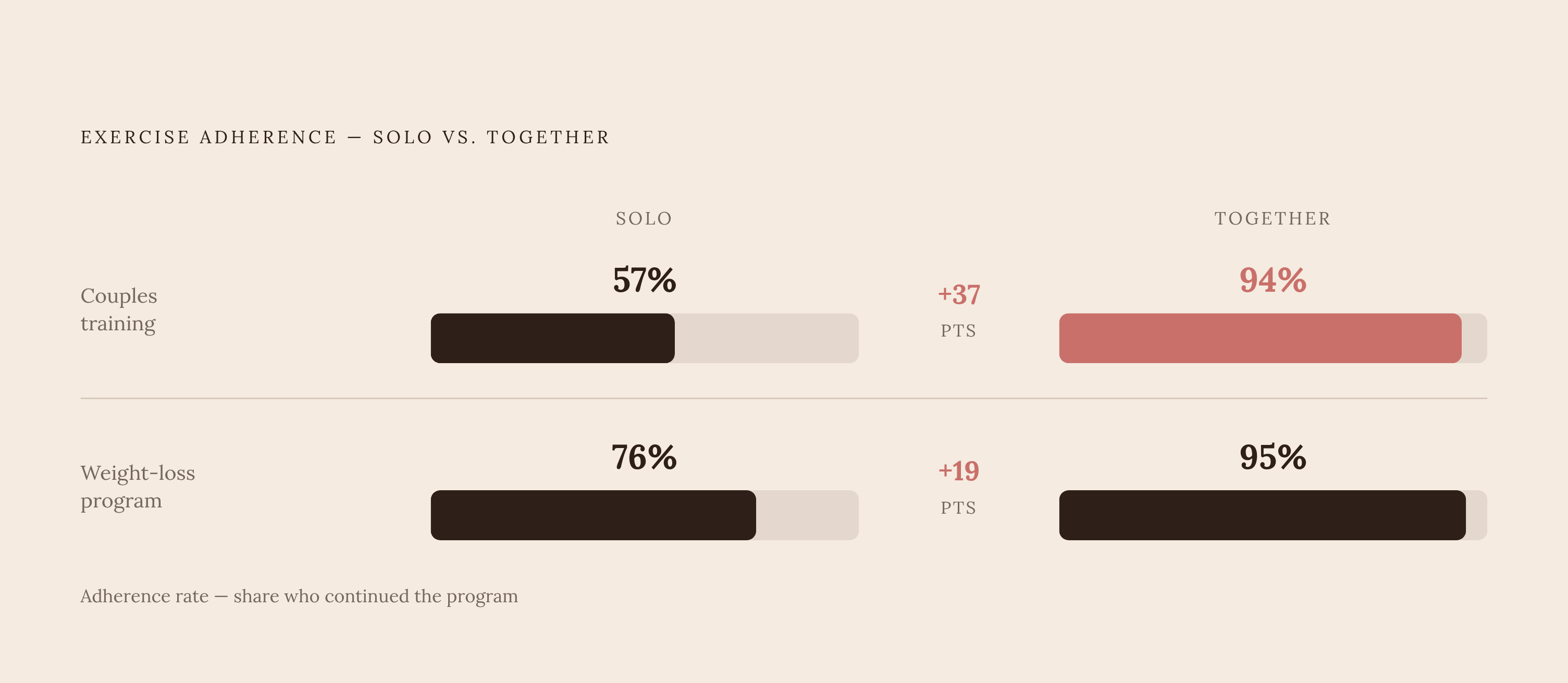
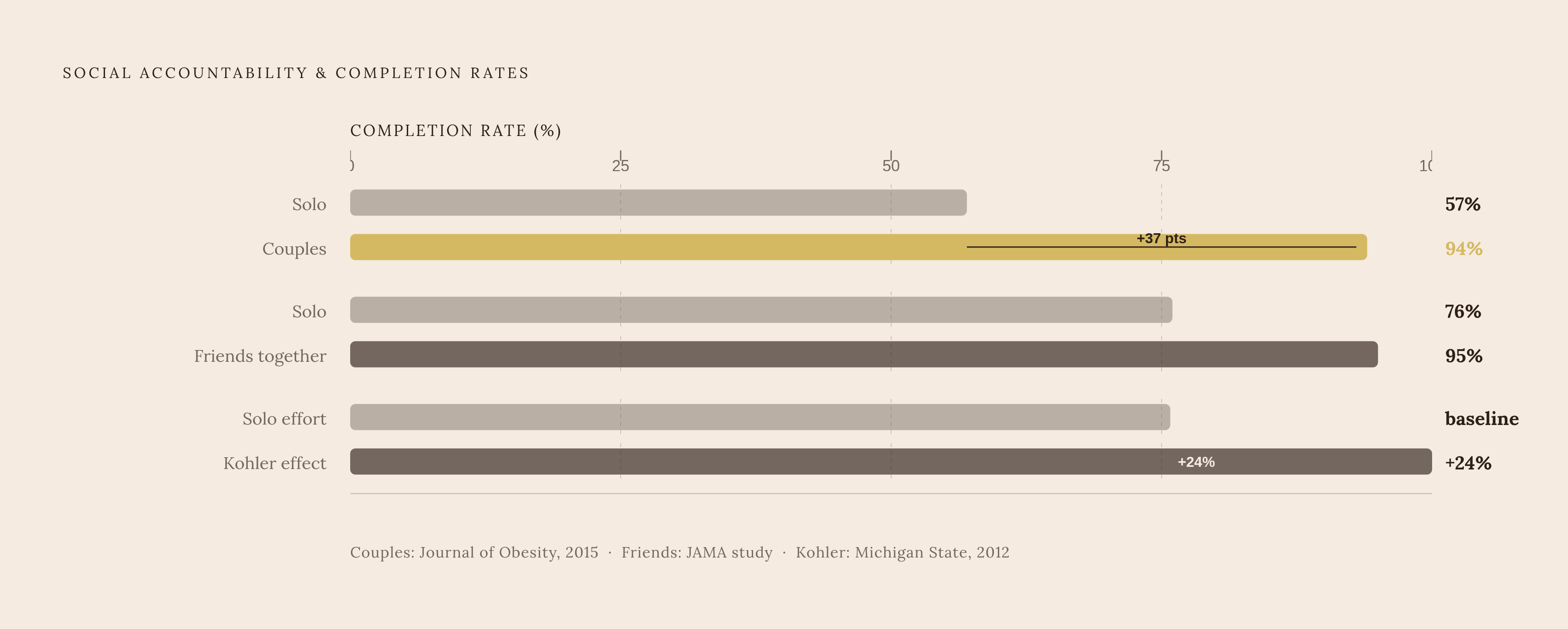
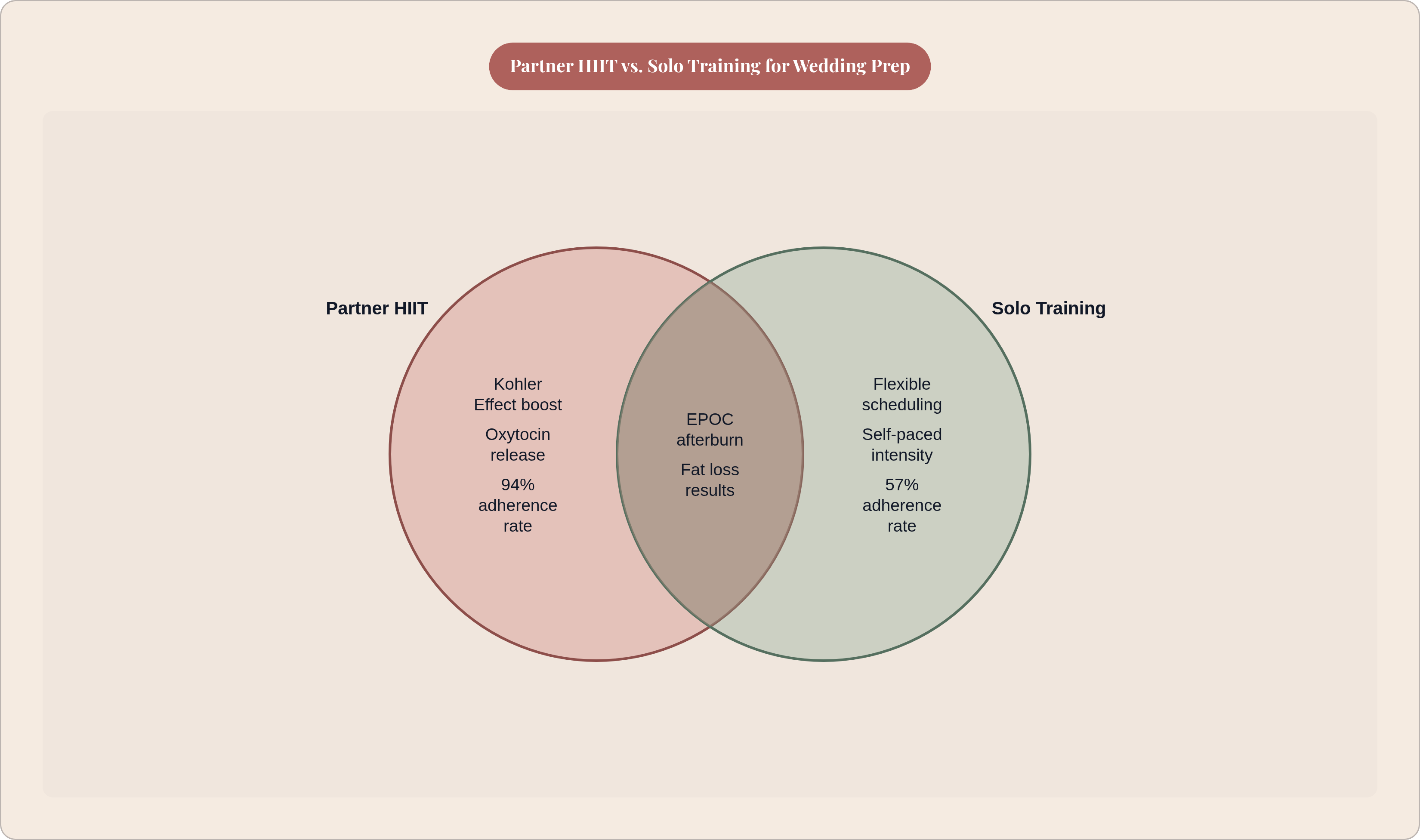
Couples who train together stick with it 94% of the time, while solo exercisers land at 57%. Stretch that gap across six months of wedding prep and you're comparing a program that survives planning season against one that quietly dies sometime in February, without anyone officially calling it off.
The pattern isn't unique to couples. People who start a weight-loss program with a friend finish it 95% of the time, versus 76% going solo. Something about another person waiting at the door makes the couch a lot less convincing.
There's a psychology quirk called the Kohler Effect: training next to someone more capable than you pushes you harder, sometimes by up to 24%, without you consciously deciding anything. Useful for wedding couples, since it's common for one partner to be noticeably fitter than the other. Instead of that gap breeding resentment, it quietly drags the less-fit partner upward, and nobody has to have an awkward conversation about it.
Exercise also raises oxytocin. Research has found that couples who tackled something physically hard together felt closer and more satisfied with the relationship right afterward, compared to couples who did something neutral together. A 2019 Decathlon survey of 7,600 UK adults backs this up at scale: 66% said working out with their partner improved the relationship, 21% said it made them more attracted to each other.
Wedding planning already runs hot on emotion, mostly the bad kind. A shared workout works like a pressure valve instead of one more source of friction, so partner HIIT ends up doing two jobs at once: building fitness and building connection, together rather than at odds.
How to phase a six-month wedding fitness plan
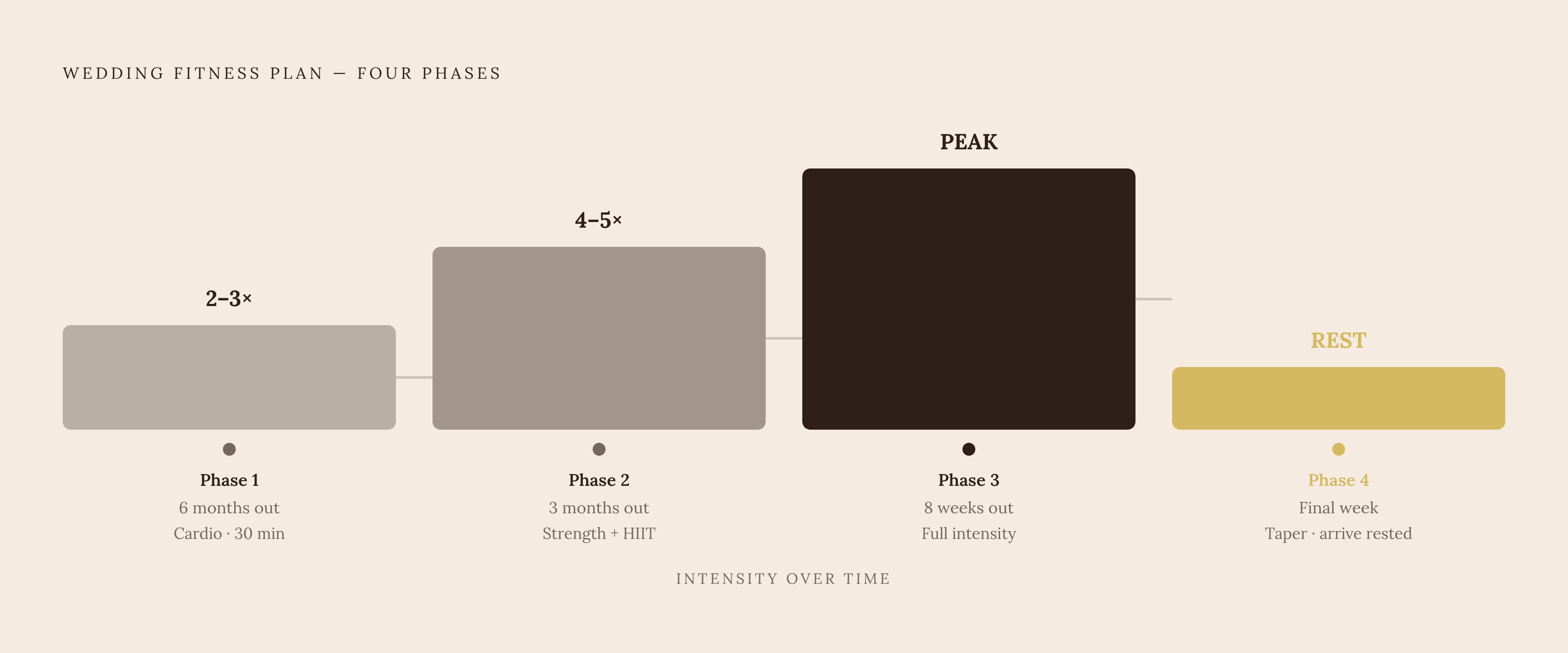
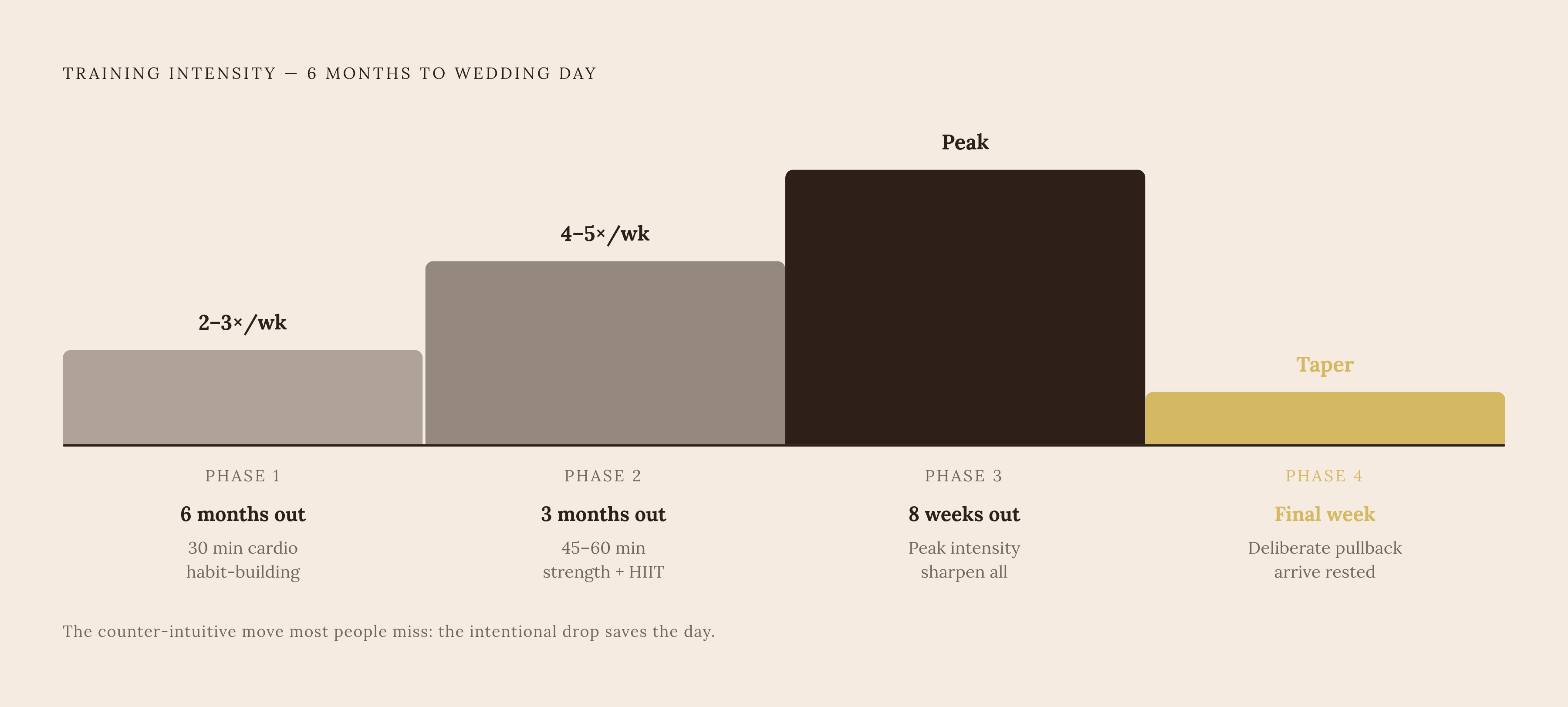
Most trainers say start six months out, though four to six is the more honest real-world window, per Men's Journal. Starting earlier is about letting your body adapt gradually instead of getting flattened by week three. Research on training load has found that piling on volume without enough recovery raises fatigue, tanks adherence, and increases injury risk, none of which you want two months before squeezing into a dress or a suit.
Six months out: build the habit, not the intensity. Two to three cardio sessions a week, 30 minutes each, is the entire assignment for now, and resisting the urge to do more is half the discipline.
Three months out: bump to four or five sessions a week, 45 to 60 minutes, mixing strength, cardio, and HIIT. Partner HIIT slots in naturally here, short enough to survive a packed week, intense enough to actually move the needle.
Eight weeks out: sharpen everything. The Sculpt Society's bridal program kicks off around here, for reference, leaving enough runway for real change before the big day.
Final week: pull back on purpose, just making sure nobody's sore or hobbling down the aisle.
Starting later is fine too, since eight weeks is still enough runway for real progress. Starting earlier just buys more slack for rest days and a missed week here or there without the whole plan collapsing. Worth agreeing on up front: set phase-based goals together, so you've got a shared checkpoint every few weeks instead of one vague deadline floating six months out.
How to structure a partner HIIT session from warm-up to cooldown
A HIIT session doesn't need to eat your evening. Twenty to thirty minutes of real working time is plenty, and tacking on a warm-up and cooldown puts you at 40 to 45 minutes, door to door.
Two interval formats are worth testing. ACE Fitness recommends 40 seconds of work, 20 seconds of rest, four rounds through the circuit. AYBL Community runs 45 seconds of work with 15 seconds of rest between moves. Neither wins on paper, so try both and let your lungs decide.
Warm-up, five minutes: light movement done together, jumping jacks, arm circles, bodyweight squats. Moving in sync sets the tone for the whole session.
Circuit block, twenty minutes: four to six partner exercises, rotated through (full menu below).
Cooldown, five to ten minutes: paired stretching, one partner assisting the other's hip flexor or hamstring stretch, keeping the cooperation running even as the intensity drops.
Aim for four to five sessions a week during the three-month phase, alternating HIIT with strength work or rest days so recovery doesn't get squeezed out. Build a scaled-down version of every move too, so neither person ever feels like the one holding the group back. That's what keeps the Kohler Effect working for you instead of against you.
Eight partner HIIT exercises to build a wedding-prep circuit
A menu to pull from, loosely organized by what each move hits hardest.
Medicine Ball Squat Toss. Stand five feet apart. Partner A squats and tosses the ball, Partner B catches it low and returns it. Keep the knees behind the toes and the weight in the heels. Targets quads and glutes.
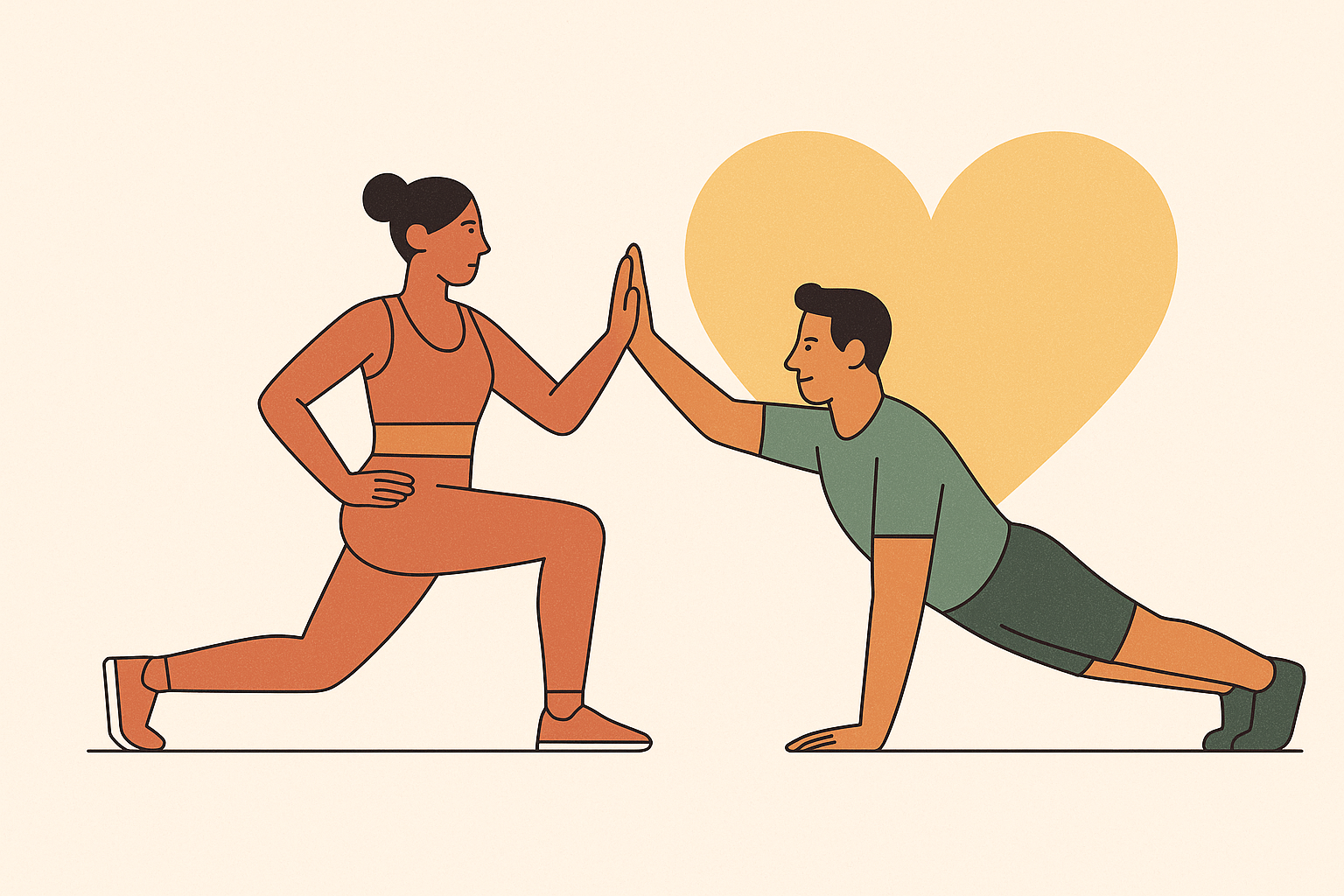
Push-Up High-Five. High plank, facing each other. Both drop into a push-up together, then slap opposite hands at the top. Ten to 15 reps, up to three rounds, 30 to 60 seconds rest. Drop one or both knees to modify (per Dick's Sporting Goods).
Back-to-Back Medicine Ball Twist. Sit or stand back-to-back, pass a 5 to 10 pound ball side to side for 10 to 15 reps, then reverse. Hits the core and obliques. Three rounds max, 30 to 60 seconds rest (per Dick's Sporting Goods).
Partner Burpee Jump-Over. Partner A holds a low plank on their elbows. Partner B burpees, then jumps or steps over them, switching after 30 seconds. Full-body, high-intensity, easy to scale down for whoever's newer to this (per Dick's Sporting Goods).
Synchronized Squat Jumps. Face each other and perform squat jumps in unison. The syncing turns it into a game, which makes it a lot harder to bail early.
Squat See-Saw with Resistance Band. Each partner grabs one handle. One squats while the other stands tall with arms extended, then swap. Constant tension keeps both people locked in for the whole set.
Partner Lateral Side-Plank Press. Side-by-side side planks, facing each other, palms pressing together at the top. Challenges balance and hits the shoulders and obliques of both people at once.
Partner Plié Squat with Biceps Curl. Face each other, feet wider than hip-width, toes out at 45 degrees, dumbbells in hand. Squat down, curl on the way up. One move, upper and lower body covered, good for the arms and shoulders that'll be front and center in the photos.
Most of these need nothing but two willing bodies. The medicine ball and resistance band add variety later, so skip them entirely in the early months if you don't own the gear. Sample circuit: pick four exercises, 40 seconds on, 20 off, four rounds, for sixteen minutes of real work and zero equipment.
Keeping the momentum going when planning stress peaks
The three-months-out phase is usually when wedding planning gets loudest, and workouts are the first casualty when the week goes sideways, since that's just what happens when the to-do list outgrows the calendar.
Skip the elaborate tracking spreadsheet. Agree on a target number of joint sessions per week instead, something realistic, two on a rough week, four on a calm one, and let the number flex instead of treating it like law.
A quick post-workout photo does more for a visible streak than any dashboard ever will. It costs nothing, takes five seconds, and doubles as a check-in on days you train apart.
Friendly wagers help too. Loser books the next vendor call, winner picks the next workout. Keep the stakes small enough that missing a session doesn't turn into a guilt trip nobody asked for.
When someone does miss a session, the fix is a reschedule, not a lecture. Six months of consistency matters more than any single Tuesday, and training at the exact same time isn't required either. A text that says "done, pushed hard today" keeps the accountability alive without forcing identical schedules. Research has found that having an exercise companion boosted how much people worked out, and the effect got stronger when that companion was actually supportive rather than just present in the room. Tone does more work here than structure ever will.
Tools and apps that support couples training together
At this point, couples need less friction, not more data. Look for a shared workout log both people can see and add to, a simple way to set a weekly session goal (count of workouts, not calorie targets), and some way to mark that you showed up, a photo, a streak counter, whatever sticks.
Light gamification helps, streaks, small challenges, as long as it adds motivation instead of another obligation. If a fitness app's friend or challenge feature hits that mark and you both actually enjoy opening it, keep it.
Don't over-engineer this, though. An app tracking fifteen metrics starts to feel like one more wedding spreadsheet, and nobody's signing up for that on top of seating charts. The best tool is whichever one you both keep opening without a reminder.
Honestly, a shared text thread with a one-line note after each workout, "done, 25 minutes, pushed hard today," beats a slick dashboard neither of you checks after week two.
What to expect in the weeks before the wedding and how to finish well
Eight weeks out is the last real push. If the earlier months built the base, this is where intensity peaks and the changes actually show up in the mirror.
Then the final week arrives and the job flips entirely: pull back on purpose. Showing up rested and injury-free matters more on the actual day than one last brutal session ever could.
"Done" doesn't mean crushing a personal best in the final workout before the wedding. A couple that trained together three times a week for five months has already won the thing, whatever that last session looks like. Consistency across the whole stretch beats a strong finish, every time, no contest.
The physical results are real: tighter waistline, better endurance, all of it measurable. But the part that outlasts the wedding is the habit itself, a routine built for two that doesn't expire when the flowers get thrown out. That same 2019 Decathlon survey found 66% of couples said training together improved the relationship, and nothing in that data says the benefit stops at the altar.
None of the circuits, the extra reps, the post-workout photos nobody else will ever see, were really about the dress or the suit. They were about showing up for each other on a random Tuesday, over and over, until showing up stopped being a decision and just became what you do.