Couples Workout Routine at Home for Wedding Season
Couples who work out together stick with it three times longer.
Wedding planning wrecks fitness routines faster than anything else in a couple's life, and the data backs that up. This piece is about building a home workout routine that survives that chaos, one that doesn't assume you have the time and calm you had before you got engaged.
Most engaged couples report feeling stressed during planning. Zola's survey of over 4,000 engaged couples found 52% called the process stressful outright, 43% said it strained their relationship, and 86% experienced physical symptoms like insomnia, anxiety, mood swings, and headaches. Estimates put planning time at 6 to 12 hours a week, on top of jobs, families, and whatever else was already filling the calendar. That's a part-time job nobody applied for, and something has to give.
Here's the annoying part. Couples themselves name exercise as one of the top tools for managing wedding stress, right up there with music and journaling. So the thing most likely to help is also the first thing to get cut when the seating chart fight runs long. A routine built for this season needs to survive on less time and less willpower than a normal routine, or it's not going to survive at all.
What the research actually shows about couples working out together
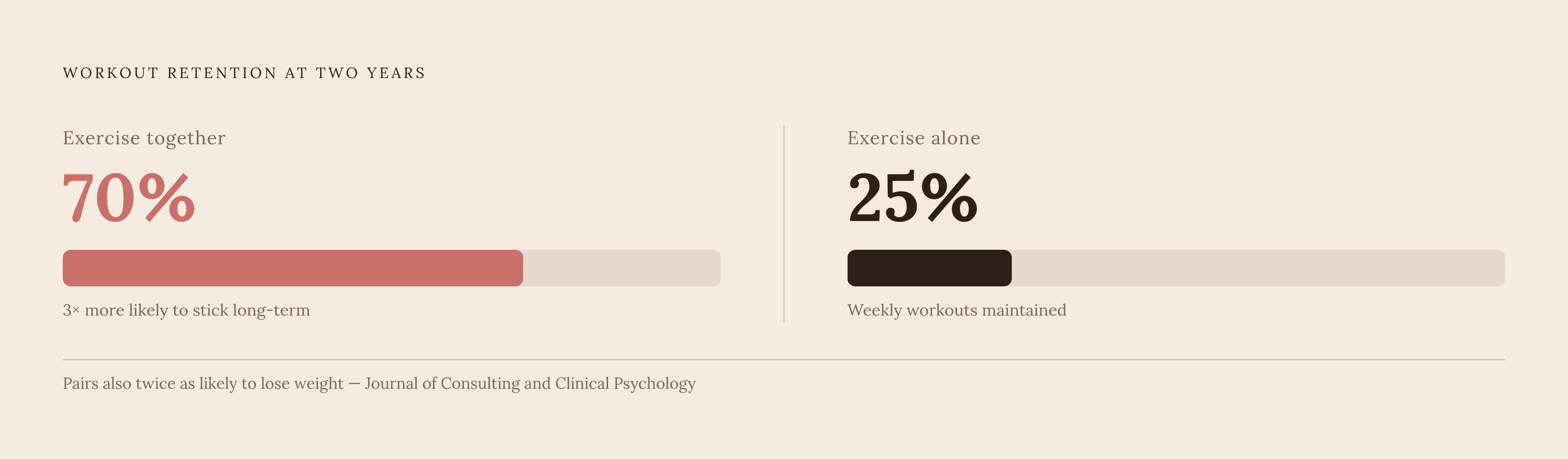
Start with the number that matters most: couples who work out together are more than three times as likely to stick with it long-term. One study comparing married couples who exercised together against married individuals who went solo found the pairs were twice as likely to lose weight. Two years out, 70% of the paired-up couples were still working out weekly. Only 25% of the solo group could say the same.
That's the real argument for doing this together: the staying power matters more than the aesthetics.
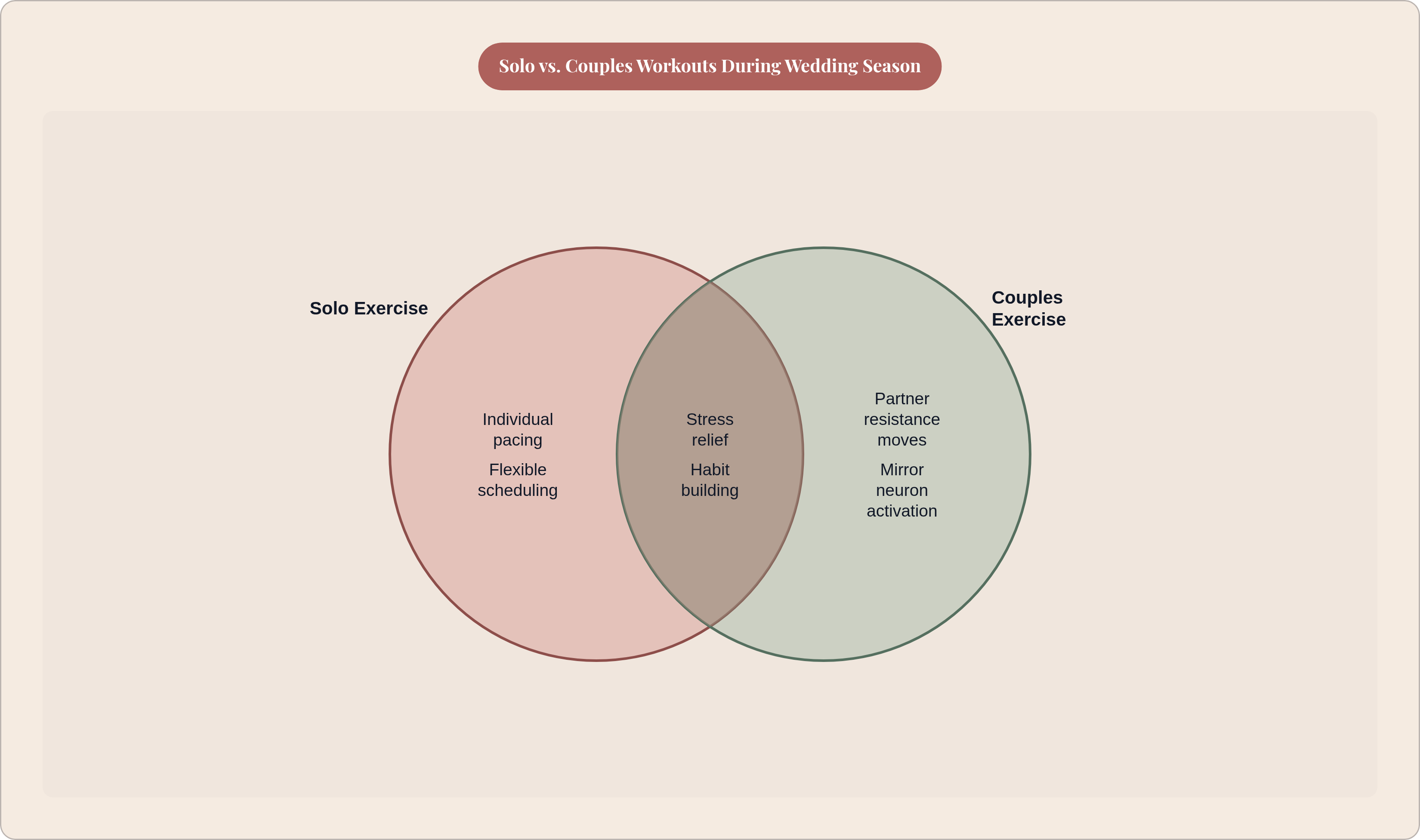
The relationship side holds up just as well. Synchronized movement activates mirror neurons, the brain structures tied to empathy, and researchers think that spills over into better emotional attunement outside the gym too. Shared exercise also releases endorphins and dopamine at the same time, for both people, which reinforces the bond in a way solo exercise just can't replicate. Research suggests couples who train together report higher relationship satisfaction and feel more supported by their partner day to day. Couples with shared activities in general report 12% higher relationship satisfaction after five years compared to couples without common interests.
Dr. David Moore at Henry Ford Hospital put it plainly in May 2025: exercising with a partner increases the odds of forming a lasting habit and amplifies the emotional payoff of the activity itself. Put that all together and the takeaway is simple. A couples routine during wedding season is less about how you'll look in photos and more about keeping a shared ritual alive, one that keeps you feeling like a team while a hundred other decisions are pulling you in opposite directions.
When to start and what kind of goal actually makes sense
Three to six months out is the general sweet spot, according to most trainers and wedding fitness experts. That's enough time for real physical change without adding pressure during the busiest stretch of planning. If you want something structured, eight weeks is the floor, since that's roughly how long it takes to complete a full training cycle and actually build a habit around it.
The bigger shift worth naming: wedding fitness has moved away from "shredding for the big day" and toward wellness as the actual goal, heading into 2025 and 2026. Crash approaches (extreme diets, sudden high-intensity plans crammed into the final weeks) tend to backfire. They cause exhaustion, irritability, and skin problems right when you need to look and feel your best.
A better shared goal: show up consistently, feel steadier during planning, arrive at the wedding with more energy and less cortisol running through your system, all more useful measures than a number on a scale. This also kills the shame spiral that hits when a session gets skipped, which it will, probably during the exact week you're finalizing the seating chart.
Pick your workout days now, and treat them like a vendor meeting you can't reschedule. Two days a week is genuinely enough to build something real.
How much and how often a home routine actually needs to be
There's a persistent myth that real strength training means four gym sessions a week, minimum. One review of 16 studies found that just 30 to 60 minutes of strength training per week cut risks of diabetes, heart disease, certain cancers, and all-cause mortality, according to trainwell.net. Total weekly minutes matter more than how long any single session runs.
For couples in wedding season, the working target is 15 to 30 minutes, three or four times a week, or two longer sessions on weeks that allow it. A well-structured partner bodyweight circuit can hit upper body, lower body, cardio, and core in 15 minutes flat, according to Nourish Move Love's April 2026 breakdown. Three short sessions spread across the week deliver benefits similar to one long one, without needing to clear a 90-minute block that doesn't exist during cake tasting season.
Micro-movement counts too, and it carries real value on its own. A 2025 trend in wedding fitness has couples walking on a walking pad at a slight incline during vendor emails, or squeezing in short bursts of movement between planning tasks. It's not a replacement for training, but it helps regulate stress hormones on days a real workout isn't happening. Design the routine for the busiest week of planning, not the easiest one. If it survives a florist appointment marathon, it'll survive anything.
A home partner workout structure that doesn't require equipment or much space
Healthline's benchmark for a complete partner session: at least 5 exercises, ideally around 7, three sets of 12 reps each. None of this requires a gym membership or a spare bedroom.
Start with a 2 to 3 minute warm-up together, something loose and synced to music. It's a small ritual, but it signals the session has actually started, and it makes the whole thing feel shared instead of obligatory.
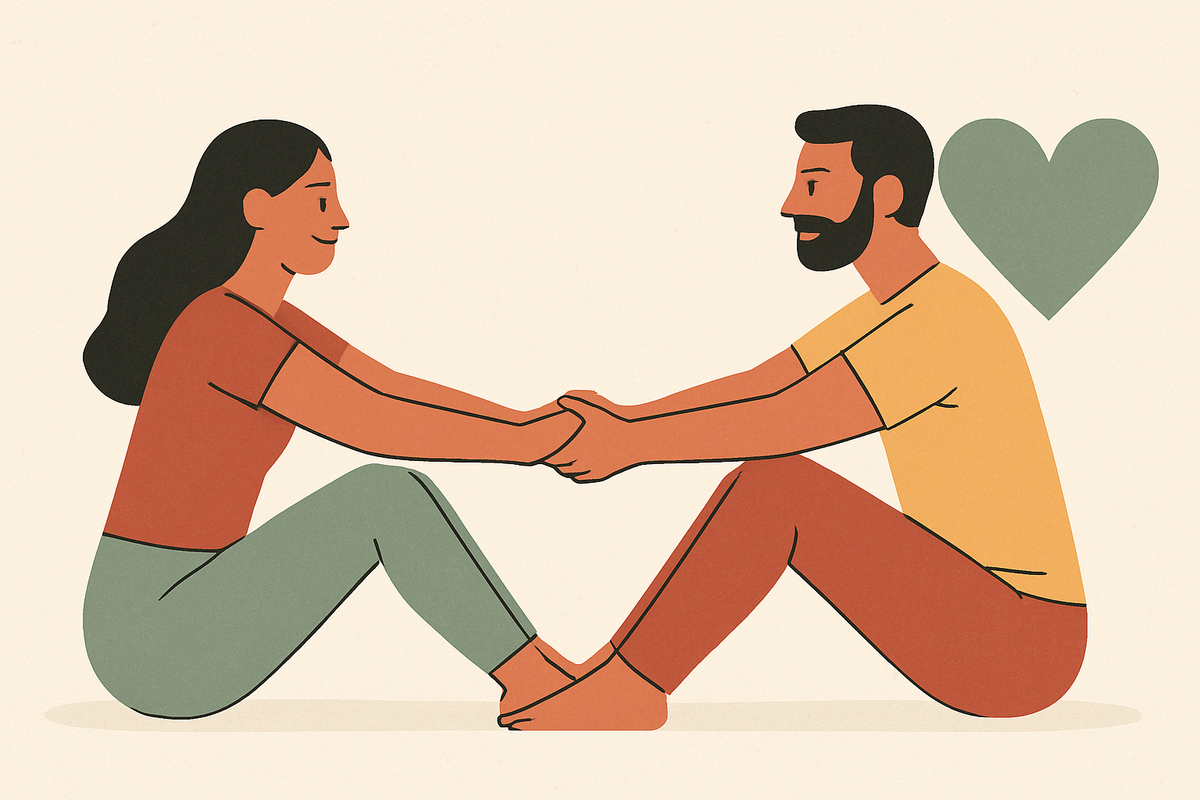
For lower body, try a back-to-back wall sit. Partners press their backs together and lower into a sit position; no wall required, since each person is the resistance for the other. It hits glutes, quads, and hamstrings. Pair that with a hook squat: hook arms back-to-back, squat until thighs are parallel to the floor, then rotate and switch sides. It adds a coordination element, and usually a decent amount of laughing.
For upper body and core, partner plank high-fives work well. Both partners hold a high plank facing each other and alternate high-fives, which challenges shoulder strength and core stability at once. Wheelbarrow push-ups are another option: one partner holds a high plank, the other holds their ankles, and the push-up gets real resistance without any actual weight involved.
Round it out with a partner-assisted glute bridge (both partners lie on their backs, press the soles of their feet together, and lift hips into a straight line) or a medicine ball crunch pass if you happen to own a medicine ball. Finish with something playful: race through the circuit, sync a cooldown to a shared playlist, or just dance it out for two minutes. The point of all of this is that it can't be done solo. These aren't two people exercising side by side and calling it a couples workout; each move needs both of you to actually work.
What to emphasize in the weeks closest to the wedding
The honest version of this section: nothing dramatic should happen in the final weeks. The goal is feeling strong and composed on one specific day, not chasing a late transformation. Crash intensity this close to the wedding causes exhaustion and skin issues, the exact opposite of what anyone wants for photos.
Upper body work matters more here, mainly because of dress and suit fit. Short resistance circuits with minimal rest, tricep dips, overhead presses, resistance band work, all doable at home and all worth keeping in rotation. Core work matters for posture rather than appearance; planks, bicycle crunches, and leg raises pay off in how you stand for photos, more than in any six-pack nobody's checking for. Most of the partner exercises above already train this anyway, since planks and back-to-back holds demand stability by default.
Keep yoga or stretching in the mix for the last two weeks. It helps with pre-wedding nerves, keeps flexibility up for photos, and gives both partners a calmer session to share right when planning stress peaks. And resist the urge to change anything major this close to the date. No new exercises, no sudden calorie cuts, no skipping sleep to squeeze in an extra session. The routine that got you here is the one to keep riding.
How to keep each other accountable without it becoming another source of pressure
Accountability during wedding planning is a little dangerous. When both people are already stretched thin, a missed workout can turn into tension fast, instead of just being a missed workout. The system needs to survive the hard weeks, not just the easy ones.
A few things that keep accountability light instead of heavy:
- Set simple weekly goals ("three sessions this week") instead of tracking daily. Easier to hit, easier to recover from if you don't.
- Take a quick photo or send a one-line check-in after a session. Marking that it happened builds a sense of progress even without any data behind it.
- Try a low-stakes bet tied to showing up, not performance. Whoever misses first buys dinner. It adds a little fun without turning workouts into a performance review.
- When schedules don't line up (one of you is at a venue walkthrough, the other's home), a quick shared check-in keeps the connection alive even if the sessions happen apart.
When a week falls apart completely, and some will, treat it as a conversation instead of a scoreboard. "What do we need to protect next week?" gets you further than obsessing over a broken streak. A couple that finishes wedding season still working out together, even messily, has built something sturdier than a pre-wedding body that fades the week after the honeymoon.
Putting a simple weekly structure together that both partners can actually return to
Here's a structure that holds up under real conditions: two to three partner sessions a week, one focused on lower body, one on upper body and core, one optional full-body or yoga session if the week allows. Keep each one at 15 to 30 minutes, timed to fit before an evening planning call or on a Saturday morning before vendor visits eat the day. Add one or two micro-movement days on top, a walk together, a short stretch, anything that keeps the habit breathing without demanding a full block of free time.
Test the routine against the hardest week you can picture: final dress fitting, rehearsal dinner, caterer walkthrough, all in the same seven days. If the plan can't survive that week, it's too long or too complicated, and it needs to shrink.
Success here doesn't look like a dramatic before-and-after. It looks like reaching the wedding having trained together consistently for months, feeling energized instead of drained, having treated the routine as something you did together rather than one more box to check. The physical result is real, sure. But the habit you built, the one that outlasts the wedding itself, is worth more than the six weeks of extra definition in your arms. Whatever tool or app helps you set simple shared goals and stay connected when your schedules don't match, use it. The best one is whichever makes it easiest to keep coming back to.