Using Workout Photos as Accountability Between Partners
Sharing workout photos with a partner turns solitary effort into witnessed commitment.
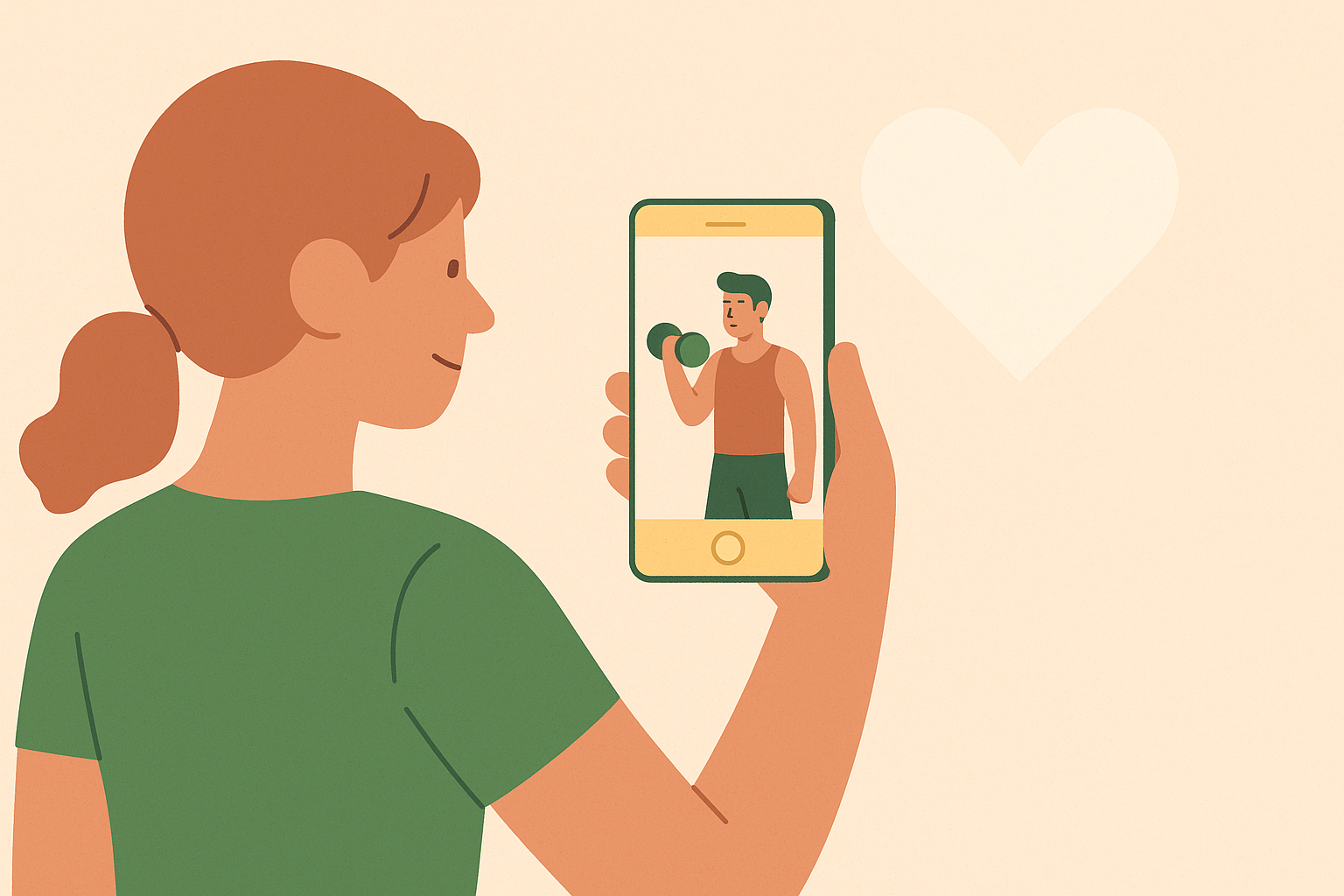
A workout photo texted to your partner isn't really about proving you did lunges. It's about being seen, and that's the whole trick. Once you get it, the rest of this makes a lot more sense.
How a partner converts a private intention into a social commitment
Here's the quiet math of most fitness routines: the effort happens alone, the miss happens alone, and nobody's around to notice either one. That second part is the problem. Skip a Tuesday and nothing happens, and no alarm goes off. The floor doesn't open up, so Thursday gets skipped too, and by the following week you're renegotiating with yourself about what "three times a week" even means.
A partner changes the equation by adding a witness. Research out of the University of Aberdeen found that picking up a new exercise companion increased how often people worked out, and the effect got stronger when that companion brought emotional support along with the check-in. Someone who actually asks how it went makes a measurable difference.
There's also something almost competitive baked into human wiring, even when we don't mean it to be. Researchers call it the Kohler effect: put someone slightly better than you in the picture, even a stranger on a screen, and effort climbs because nobody wants to be the one dragging the group down. One study tested this directly, and participants paired with a stronger virtual partner exercised for a mean of 21.89 minutes, compared to 10.6 minutes for people working out solo. Same workout, same person, nearly double the output, just from knowing someone else was in the room, sort of.
None of this requires physical presence, either. Your accountability partner doesn't need to be on the next treadmill; they just need to know.
What a workout photo actually does in an accountability system
So if being seen is the mechanism, a photo is the cheapest way to get seen across time zones, different schedules, and the fact that your partner is at work while you're doing squats in your kitchen at 6 a.m.
A photo after a workout works as proof of attendance, and it functions a lot like texting "done," except with more warmth attached. Harder to fake, more satisfying to send, easier to respond to with something better than a thumbs-up emoji.
There's a sneaky upside here too: the anticipation of sending the photo can pull you through the workout itself. There's a well-observed pattern in fitness-related social sharing: people feel a real pull toward finishing things offline specifically so they'll have something to share. The photo works as part of what gets the workout done, alongside being a record of it, and the American Psychological Association backs this up in plainer terms, noting that sharing progress with others tends to boost commitment and turn intentions into action.
Practically, this fits into a rhythm without becoming its own project. A quick "done" text covers a normal Tuesday, while a sweaty selfie on Sunday can carry the whole week's effort without you writing a report about it. And to be clear, this stays private: it's one photo, one person, one shared goal.
The difference between a photo that encourages and one that pressures
Here's where it gets interesting, because the same photo can land two completely different ways depending on who's on the other end.
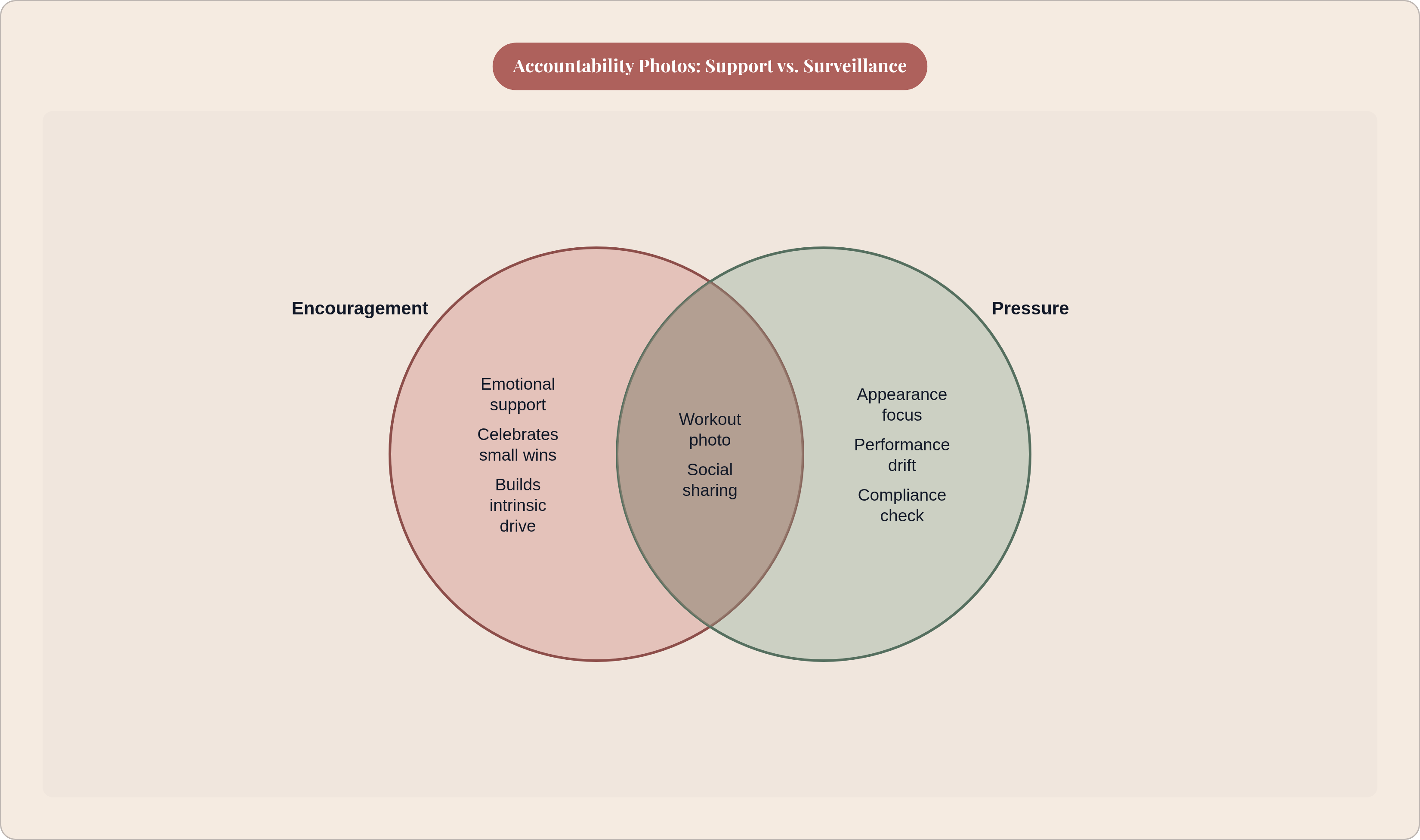
Research on exercise adherence has found that emotional support — encouragement, empathy, actually celebrating small wins — predicts whether people stick with exercise better than practical support like shared schedules or workout plans. Turns out logistics don't keep people going nearly as well as somebody saying "nice, how'd it feel?"
The underlying dynamic is worth understanding: connecting with someone else while being active turns exercise into something that feels good, and that feeling is one of the strongest predictors of whether you'll show up again. Her key distinction is worth sitting with, because accountability from the outside (someone checking whether you did it) gets people started, while what keeps people going long-term is the internal motivation that builds from real connection. Photos speed that process along, but only when the exchange feels like support rather than a compliance check.
A 2025 cross-sectional survey of 425 participants found that fitness-related social media use significantly predicted intrinsic motivation. The number backs up what most people already sense intuitively: the tone of the relationship shapes what the photo means. Send the same gym selfie to a partner who says "proud of you" versus one who says "you sure that's enough reps," and you're running two different experiments on the same data.
The question worth asking isn't whether to do photo check-ins, but whether your current system feels like support or surveillance, because the photo doesn't fix that. It just amplifies whatever's already there.
Where photo-based sharing goes wrong and how to recognize it early
Content matters more than people give it credit for. A 2025 study in Frontiers in Psychology found that people exposed to appearance-focused fitness images reported lower body esteem than people who saw performance-focused or neutral images. Same category of photo, wildly different psychological aftertaste depending on what's actually in the frame.
That finding maps directly onto partner check-ins. A photo that says "I showed up" is a different animal than a photo built around a physique comparison or a transformation angle. One confirms presence, while the other invites judgment, even when nobody intends it that way.
Watch for what I'd call public performance drift, which is when a private check-in starts creeping toward social-feed behavior. Once that happens, the incentive quietly shifts from consistency to optics. Rest days start to feel like reputational risk instead of recovery, and training decisions get made for an imagined audience instead of the actual plan.
A few warning signs worth knowing before they become habits: skipping a workout because you don't want to send a photo that "doesn't look like progress," feeling dread before you hit send instead of satisfaction after, or noticing your partner's response starting to feel like a grade rather than a reaction. That drift turns accountability into homework with extra steps.
The photo should lower the bar for showing up, not raise the stakes on how the workout looks. This is a private arrangement between two people, and either one of them should be able to call a rest day without treating it like a confession.
A simple structure for making photo check-ins consistent without making them a chore
The easier the check-in, the more likely it survives a chaotic Tuesday, and that's really the whole design principle. Complicated systems die first, usually on the exact day you needed them most.
A tiered rhythm tends to hold up better than a rigid rule. Daily or post-workout, keep it to a quick text, an emoji, or a sweaty selfie: something finishable in under a minute, no captions required. Weekly, allow for something slightly more substantial. A photo works here too, but it doesn't need to be appearance-focused; it can just as easily be a location, a mood, something you noticed on the run. Monthly, take a moment to actually look back together at the pattern of showing up, not the shape of anyone's body.
Vague goals produce vague photos. "I want to be healthier" gives a check-in nowhere to land, while "three sessions this week" gives the photo an actual job to do. Concreteness is doing a lot of quiet work here.
There's no universal template, either, and trying to force one is a mistake. A couple sharing a kitchen has different logistics than two friends split across cities, and the format should bend to match the relationship, not the other way around. Some apps and platforms are built specifically around this kind of private, low-stakes sharing between partners chasing a goal together, which can help keep the exchange separate from the pressure of a public feed.
Celebrate consistency over performance, always. A partner who logged three short, tired workouts through a genuinely bad week did something real, even if none of the sessions were impressive. That Tuesday run photo carries just as much weight as Saturday's personal best, and a small wager or reward tied to the streak itself, not the quality of any single workout, can add a bit of playfulness without turning the whole thing into a performance review.
What consistency looks like when it becomes a shared habit
The point was never a better body. It's a habit that quietly becomes part of the relationship, the way certain couples have a shared coffee order or a running joke nobody else gets.
Shared habits outlast solo resolutions because they have two owners instead of one. When your motivation dips, which it will, the shared practice carries you through the gap until it comes back, and that's the actual advantage over doing this alone. It's not a small one.
Eventually the photo stops being about accountability altogether. It becomes a small, recurring gesture that just says: still doing this, still with you. The broader pattern holds: shared goals and shared check-ins sustain engagement and mutual accountability over time in ways that solo tracking rarely does. The social texture is what holds the habit together, not the individual data points.
A workout photo works as a small thing offered to a person who cares whether you showed up, more than any kind of evidence submitted to some invisible tribunal. Progress counted in consistency (ordinary sessions, documented simply, shared between two people) outlasts any number a fitness app dashboard could ever spit out.