30-Day Couples Fitness Challenges Before the Wedding
30-day couples fitness challenges before the wedding work best when they're built to create a routine rather than chase a body. That distinction matters more than people think, because the habits couples form in that month are what actually survive past the photographer and the open bar. Wedding spending hit an average of $30,500 in 2024, up from $28,000 just two years earlier, and with that kind of money on the table, the pressure to look a certain way in front of 150 witnesses gets loud fast. This piece is about tuning that pressure into something useful instead of letting it run the show.
What the research actually says about exercising together as a couple
Here's the part nobody puts on the save-the-date: working out with your future spouse can be one of the better things you do for the marriage itself, and for your arms.
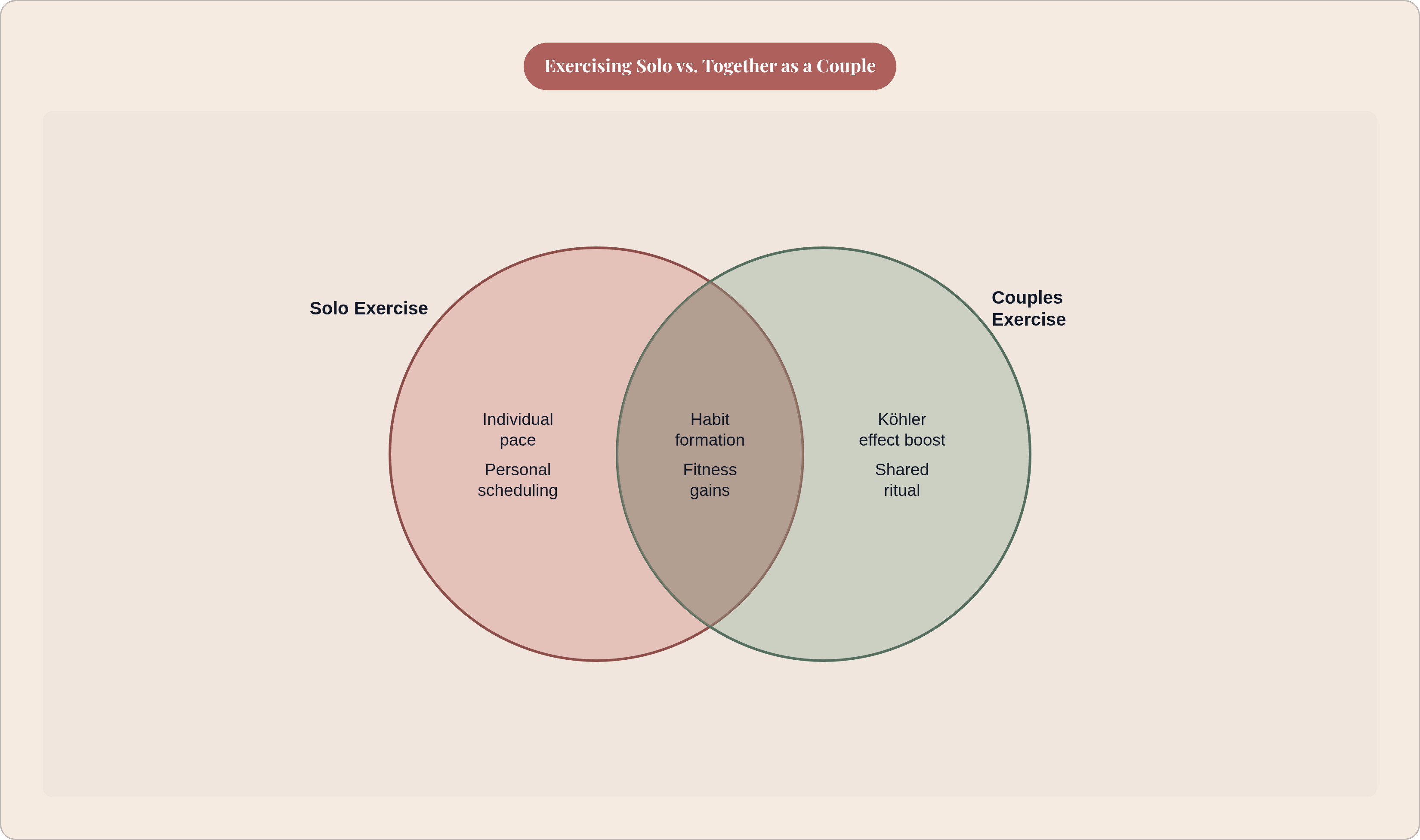
A 2026 BYU study in Family Relations followed almost 1,700 young married couples and found that spouses who exercised together reported better communication, better conflict resolution, and less overall marital conflict than couples who exercised solo. Both types of exercise helped, though together helped more, and communication showed the biggest bump of the three outcomes measured. Not bad for something that mostly involves grunting near each other.
Walking was the most common shared activity in that study. No membership, no equipment, no awkward gym small talk with a stranger on the next elliptical. Just two people and a sidewalk.
And yet, only about a third of couples in the sample actually exercised together, even though roughly 60% of husbands and wives said they exercised at all. That's the gap worth sitting with: the tool is sitting right there, mostly unused.
Kansas State University research adds a fun wrinkle. Working out alongside a partner can boost effort and workout duration by up to 200%, a phenomenon researchers call the Köhler effect. Translation: nobody wants to be the one who taps out first. Peer pressure, but productive.
Take the couple I'll call Dana and Mike, who told a group fitness instructor they'd been trying to run together for years and failing every time — one always finished a half-mile ahead, sulking at the mailbox while the other trudged in. Once they switched to walking side by side instead of racing, something clicked: same pace, same conversation, same finish line. Six months later they were still doing it every Tuesday and Thursday, rain or shine. Small format change, entirely different outcome.
One honest caveat. A 2023 study in the International Journal of Human-Computer Interaction found that older adults, ages 54 to 72, who exercised with a spouse were sometimes less active than those going it alone. That's a population-specific wrinkle. Engaged couples in their twenties and thirties are a different animal entirely.
Why 30 days is a useful starting point but not the finish line
The "it takes 30 days to build a habit" line gets repeated so often people assume it's science. It's a rounded-off myth that stuck because it's catchy and fits neatly on a calendar.
Phillippa Lally's research at UCL found the average time to make a behavior automatic is 66 days, with a real range of 18 to 254 depending on how complicated the behavior is. Drinking a glass of water after breakfast automates fast. A structured strength program does not. Treating a 30-day plank challenge the same as a 30-day strength program is comparing a light jog to a marathon and acting surprised when one takes longer.
Tracking of new gym members backs this up: hitting roughly four sessions a week for at least six weeks is closer to the real threshold for a habit that sticks on its own. Thirty days gets you close, though it doesn't quite get you there. Think of the 30 days as the on-ramp, not the highway — you need it to get up to speed, but nobody moves in permanently.
So what is 30 days good for? A clean, low-stakes on-ramp. A finish line you can actually see, which gives you a real sense of accomplishment along the way, and that feeling of accomplishment is itself part of what makes habits stick. Dr. Zachary Sprague of Scripps Coastal Medical Center puts it plainly: challenges work best as a starting point, and having someone to do it with is often the deciding factor in whether people finish the 30 days, let alone keep going after.
For couples, the honest way to frame it: the 30 days are chapter one, with the habits that carry into the marriage taking months to set, not weeks, so plan accordingly and don't panic if day 30 doesn't feel like a finished product.
How to design a 30-day challenge that builds a routine rather than chases a result
Frequency beats intensity, full stop. Two strength sessions a week is enough to build muscle, and beginners can start with 10-minute full-body sessions and build up from there. The goal is showing up. Suffering is optional, and frankly, overrated.
Data from exercise tracking shows 57% of people prefer sessions in the 45-to-60-minute range, with only 16% wanting to go longer. Shorter, repeatable sessions win, because the version of the workout you'll actually do beats the version you'll do once and regret.
A three-phase structure mirrors how habits actually form:
Days 1 through 10 are about low friction and high repetition. Same time, same place, every time; that repetition is the whole point. Walks, 10-minute sessions, basic bodyweight moves. Walking especially doubles as relationship time, since you can talk while you do it, which is more than you can say for a barbell.
Days 11 through 20 add a little spice. One or two new strength moves, a weekly HIIT session, maybe a simple points system. Small novelty, no disruption. You're seasoning the dish, not replacing it.
Days 21 through 30 bring it back to basics, except now the Week 1 stuff feels easier. This is where couples should measure consistency over performance. "We showed up 24 out of 30 days" is a better scoreboard than any number on a scale.
Keep a cardio floor of at least 30 minutes of moderate movement, two or three times a week: walking, cycling, jogging, whatever keeps the bar low enough that conversation is still possible mid-workout.
One warning worth repeating: research from the National Strength and Conditioning Association in 2024 found that overtraining without proper recovery can cut muscle protein synthesis by up to 40%. Rest days aren't a nice-to-have; they're structural. Skipping them is like skipping the mortar between bricks and wondering why the wall's wobbly.
Build in flexibility from day one, because wedding planning is chaos with a seating chart. A schedule that bends without breaking survives contact with real life.
Challenge formats that make the 30 days feel like something you're doing together
Format matters just as much as the exercise itself. Two people running side by side on treadmills, both wearing headphones, staring at separate screens, isn't a shared experience. It's parallel play for adults.
A daily walk streak is the most research-backed option here, since walking was the top shared activity in the BYU study. It needs no equipment, it scales to any fitness level, and it naturally invites conversation instead of blocking it. Keep a simple shared log and the streak becomes its own small motivator.
A points-based system works well for mismatched schedules or fitness levels. Both partners earn points for any 30 minutes of movement, whether that's walking, yoga, HIIT, or dancing around the kitchen. This sidesteps the real, well-documented difference in how men's and women's bodies respond to exercise, and it keeps the competition friendly instead of turning into a referendum on who looks better in a swimsuit.
A 30-day plank progression is refreshingly low-tech: start at 30 seconds, add 5 to 10 seconds daily, and hold it together. Shared discomfort builds accountability fast, and the benchmark has nothing to do with weight. Why did the couple bring a stopwatch to the wedding rehearsal? Old habits, apparently, hold on longer than planks do.
Partner HIIT circuits, where one person's rest is the other's work interval, build real interdependence. Save these for the middle phase, once the basic routine is already in place; introducing them on day one is like teaching someone to parallel park before they've started the car.
A friendly wager helps too, as long as the prize celebrates the relationship instead of the six-pack. Agree upfront: hit the consistency goal together, and you get a shared dinner, a weekend trip, something that isn't a smaller dress size. The reward should remind you the point was doing it together, not doing it perfectly.
And don't underestimate the power of a private workout photo sent just between the two of you, not posted anywhere. Research out of the University of Aberdeen found mutual encouragement between partners was linked to up to 90% better habit maintenance compared to training solo. A sweaty selfie with a thumbs-up emoji does more work than most fitness apps.
What to do when one partner is more motivated than the other
Mismatched motivation isn't a red flag; it's just Tuesday. Remember, only about a third of couples in the BYU sample exercised together even when both partners were already active on their own; getting in sync takes actual, deliberate effort, not just good intentions.
Here's where it can go sideways: the more motivated partner starts tracking the other's every session, and accountability quietly turns into surveillance. Suddenly the 30-day challenge feels less like teamwork and more like a performance review nobody asked for.
The fix is structural. Let partners exercise separately and still count toward the same shared goal. A solo walk still feeds the points board. A gym session done alone still counts toward the streak. The commitment and the check-in are shared, not every single rep.
Keep that check-in light. A photo, an emoji, a two-word text saying "I went." That's plenty. Nobody needs a spreadsheet of their spouse's squat form.
If a day gets missed, talk about it, briefly and without shame. Ask "what got in the way?" instead of "why didn't you do it?" That one word swap changes the whole conversation, and honestly, it's good practice for marriage generally, not just fitness.
The end goal: both people feel supported toward something they chose for themselves, not managed toward something the other person wants them to become.
How the habits formed in 30 days set the pattern for what comes after the wedding
Shared habits are just easier to keep than solo ones. When "Tuesday night is our walk" becomes part of how the relationship runs, it gets reinforced socially in a way a private New Year's resolution never does. Nobody guilt-trips you into a solo gym trip. A partner will.
The 30 days before the wedding are month one of something that can run for decades, and even Lally's UCL research suggests that an incomplete habit-formation stretch still makes the behavior more likely to restart after a break. So missing days two and seventeen doesn't erase the progress; it's a stumble, not a collapse.
Enjoyment matters more than people give it credit for. Positive feelings during a workout, the laughing, the shared sense of "we did that," measurably strengthen the habit itself. Making the challenge fun is the engine, not a nice bonus.
What actually carries out of a well-built 30-day challenge: a shared time slot, a little ritual of checking in, a real sense of what the two of you can pull off under pressure. All of that walks straight into the marriage with you, no alterations needed.
Plenty of brides report feeling more confident on the wedding day after following a structured fitness plan, and that's a real effect, worth acknowledging. But confidence built through showing up with a partner, day after day, is a different animal than confidence built by shrinking a dress size. One fades once the diet ends. The other one you get to keep using.
The tools that actually last past the wedding are unglamorous: simple weekly goals, visible shared progress, a way to celebrate consistency even on the days performance wasn't great. Same design principles that made the 30 days work in the first place. Turns out the blueprint for a good month and the blueprint for a good marriage aren't all that different.