6-Month Wedding Workout Plan for Couples
Couples who train together stay more committed and feel closer before saying "I do."
Six months. That's the window couples actually have between "we're engaged" and "walk down the aisle," and it turns out that's exactly enough time to build real fitness together instead of panic-dieting your way into a dress two sizes too tight. This piece breaks down what the research says about training as a couple, why six months beats a crash program every time, and how to split that time into phases that actually build on each other.
What the research actually says about couples who exercise together
Research on couples who exercise together points to something worth paying attention to: better communication, stronger conflict resolution, and lower marital stress compared to couples who didn't move together at all. Not surprising, maybe. But here's the part that matters for wedding planning specifically: couples who worked out together tended to report stronger feelings of connection with their partner. During a season where one of you is arguing with a florist and the other is trying to figure out why the seating chart looks like a hostage negotiation, that's not a small thing.
Now, the honest caveat. Couples who trained together showed somewhat bigger gains in those positive outcomes than couples who exercised apart, but that gap wasn't statistically significant. So don't go telling your partner science proves you have to be in the same room to get the benefits. It just helps.
Where the numbers get sharper is accountability. A 2018 University of Aberdeen study found couples who encouraged each other to stay active were up to 90% more likely to stick with their workout habits than people training solo. That's the real engine here: the nagging, the check-ins, the "you coming or what" text at 6am.
There's a psychological layer too. Research on shared physical challenge points to couples syncing up physically and emotionally when they push through something hard together. Couples who take on challenging activities together often report feeling closer afterward. Sweat as a bonding agent. Who knew.
And the accessibility piece deserves its own paragraph: walking is consistently one of the most common ways couples exercise together. No gym membership, no fancy equipment, no forty-five dollar juice afterward. Just two people and a sidewalk. Given how much money is already leaving your bank account for a wedding, that matters more than it sounds like it should.
Why six months is the right window to start, and what it makes possible
Wedding fitness coaches commonly note that four to six months out is the most practical window couples have for meaningful pre-wedding training. Six months isn't some arbitrary round number picked because it sounds nice on a calendar. It's the sweet spot between "too rushed to work" and "so far out you'll lose steam."
Starting early means you skip the part where couples try to cram two workouts a day into the final three weeks while eating lettuce and rage. That approach builds exhaustion, and exhausted people do not look radiant in photos. They look like they haven't slept, because they haven't.
Six months buys you real, measurable stuff:
- Muscular fitness gains of 25 to 100% are realistic within three to six months of consistent training, especially if you're starting from a beginner baseline.
- Fat loss and endurance improvements build across the entire window. This is not something a thirty-day program can fake.
- Cardiovascular fitness improves fastest of anything. Most beginners notice the same walk, run, or spin class feels noticeably easier within three to four weeks.
The logic compounds. Building the habit takes time. Seeing visible change takes more time. Hitting peak conditioning takes the most time. Only a six-month runway lets all three actually happen instead of you sprinting toward one while ignoring the other two.
The phase structure: how to divide six months so each block builds on the last
Coaches call this periodization, structuring training into blocks with a clear focus, so your body keeps adapting instead of stalling out and plateauing on you. You don't need to become a sports science major to use it. Just three terms, used once, then forgotten: macrocycle is the whole six months, mesocycle is a four-to-six-week chunk inside it, microcycle is a single week. That's it. Nobody's quizzing you later.
Shifting focus every four to six weeks isn't variety for variety's sake. It's deliberate. Muscles and cardiovascular systems adapt to whatever you keep throwing at them, and once they've adapted, that same workout stops doing much of anything. Changing the stimulus on a schedule keeps progress moving instead of flatlining.
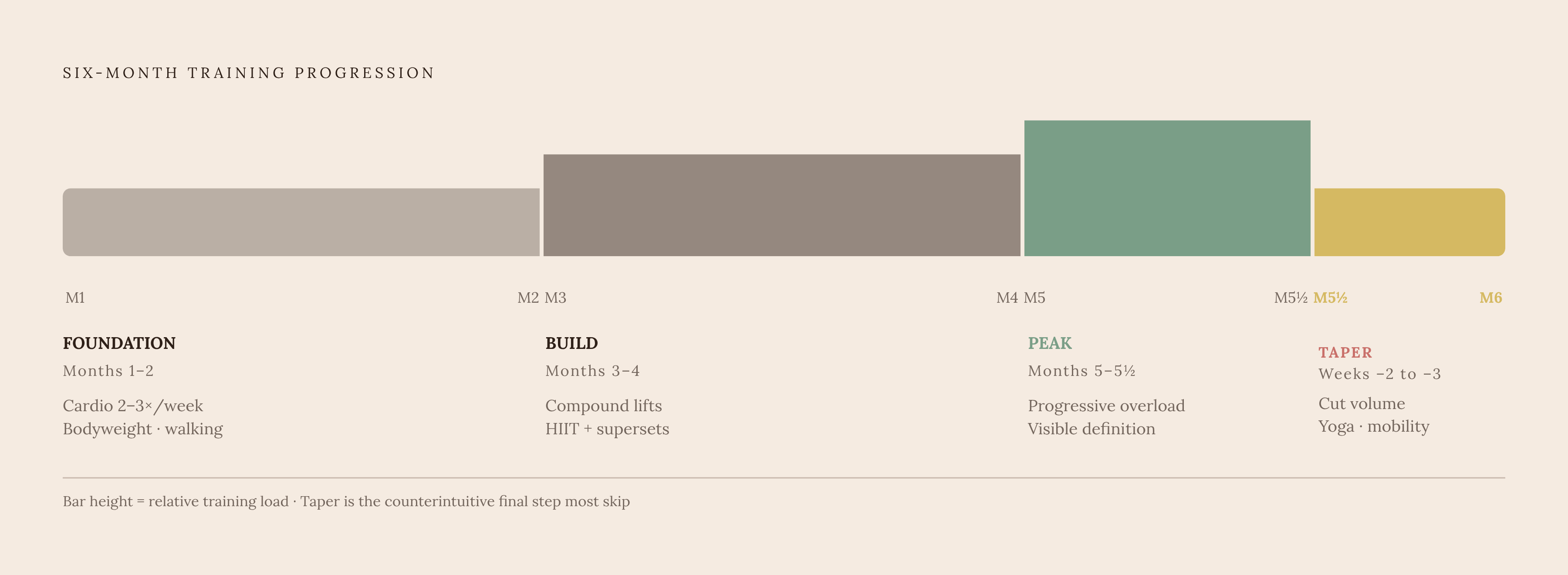
For a wedding, that shakes out into three mesocycles: foundation, build, and peak/taper. Each one has a job, and each one sets up the next. Skip the foundation phase and jump straight to intensity, and you're just inviting an injury to your engagement party.
As for how often, 30 minutes of focused training, four to five days a week, is enough to produce real results. Duration matters less than people think. Consistency and gradually increasing the challenge, what trainers call progressive overload, matter more.
Here's the part that matters specifically for couples: this phased structure lets two people at completely different fitness levels train in the same session. The phase's goal is the shared target, not matching each other rep for rep or mile for mile.
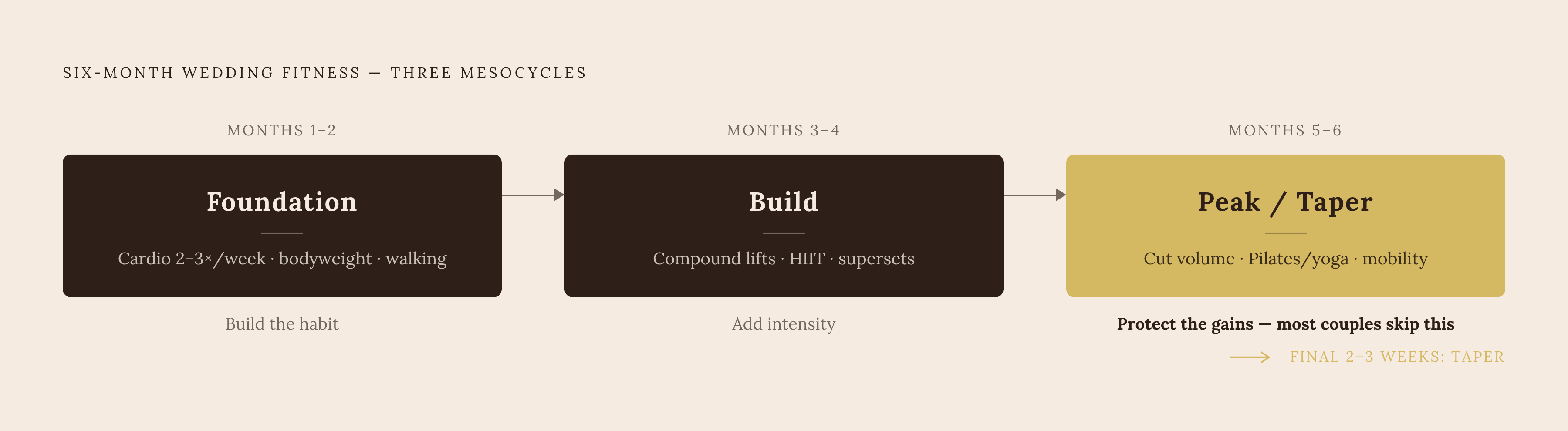
Months 1–2: building the habit before building the body
Nothing dramatic is supposed to happen here, and that's the point. The goal of month one and two is showing up enough times that month three becomes possible. That's it. That's the whole assignment.
Start with at least 30 minutes of cardio, two to three times a week. Ease in. Skip whatever intensity you saw on a fitness influencer's page, or you'll be questioning your life choices the next morning.
Here's what's actually happening inside your body during those first four weeks, because knowing this prevents you from quitting too early:
- Energy and mood improve first, usually within one to two weeks.
- Strength improves next, noticeable around weeks two to four, but this is mostly your nervous system getting better at recruiting muscle, not new muscle showing up yet.
- Visible body composition changes don't usually show up until weeks four to eight.
That gap between "feeling stronger" and "looking different" is exactly where couples quit, because they expect a mirror to reward them faster than biology allows. Knowing the timeline in advance keeps you from bailing right before the payoff.
The couple-specific work in this phase is logistical, not physical. Sit down and figure out which days you're training, what time, and who has veto power over the schedule if plans change. Negotiate that now. Doing it in month four, after resentment has had time to marinate, is a much worse conversation.
Walking earns its spot again here. It's the lowest-barrier option, it doubles as stress relief during the exact weeks you're also picking centerpieces, and it's free. Set one simple shared weekly goal, something like "three walks this week," not a body target. Give yourselves something to actually celebrate.
And if you want to make the early weeks less of a chore and more of a game, try a friendly wager tied purely to attendance. Loser buys coffee, loser does dishes for a week, whatever. Low stakes, high payoff in morale.
Months 3–4: adding structure and intensity once the habit is in place
This is where the real muscle-building work starts. According to Healthline, visible changes in muscle size typically take four to eight weeks of consistent resistance training paired with enough protein. Couples who were honest with themselves in months one and two are walking into this window right on schedule.
Meaningful fat loss usually needs three to four months of steady effort, which lines up perfectly with where you now are in the calendar. Nothing about this is instant, and that's fine, because you've got the time.
Training focus shifts toward:
- Compound movements: squats, lunges, push-ups, deadlifts. High calorie burn, functional strength, and they hit the areas people actually notice in wedding attire, arms, shoulders, legs.
- A HIIT-plus-resistance combo. Combining resistance training with HIIT is widely regarded as effective for building both muscle and cardiovascular fitness simultaneously.
- Supersets. Supersets are a time-efficient stand-in for traditional resistance training, useful when you're also trying to squeeze in cake tastings and vendor calls.
For couples at different fitness levels, you don't need separate sessions. Train side by side, same room, same hour, different emphasis. One partner leans into upper body strength, the other focuses on core and lower body stability. Same shared time slot, different load. The accountability stays intact even though the work doesn't match exactly.
Somewhere around week eight to ten, check in, but check in on energy and performance, not the scale. This is also when cardiovascular improvements become obvious enough that most couples start feeling like the plan is actually working, which is a nice morale boost right when wedding planning stress tends to peak.
Months 5–6: maintaining momentum, tapering toward the wedding, and avoiding the final-month trap
Plateaus show up for almost everyone eventually, and that's not failure, that's your body adapting. The fix is adjusting intensity or switching up variation, not doubling your sessions out of panic.
After three to six months of consistent strength training with progressive overload, visible muscle definition tends to show up, especially in arms, shoulders, and legs. For a lot of people, this is the stretch where the look they've been chasing actually starts to arrive in the mirror.
Now comes the taper, and this is the part people skip at their own risk. Cutting training volume in the final two to three weeks before the wedding lets your body recover. Skip this step, and you risk showing up in photos looking depleted instead of glowing, which defeats the entire purpose of six months of work.
The final stretch should include:
- Same frequency of movement, lower intensity. Keep the habit, drop the load.
- Yoga, Pilates, or mobility work with an emphasis on breathing and joint movement during the final deload week.
- Pilates in particular is worth calling out. It's accessible, low-impact, and fits a wind-down phase almost perfectly.
Steer clear of starting a new diet, trying a new workout style, or making any major change in the final three weeks. Your body wants predictability right now, not novelty. This is not the time to discover CrossFit.
The reframe for couples here is simple. The final weeks are about feeling good, together, walking into the day with energy instead of running on fumes, more than chasing a number on a scale or in a mirror. The work's already done. This part is just protecting it.
How to keep both partners consistent across all six months when motivation fluctuates
Motivation is flaky. It shows up some mornings and ghosts you completely on others, usually right when a seating chart argument has drained you both. Structure is what survives those weeks, not enthusiasm.
A few tools that build accountability without turning into pressure:
- A shared workout photo each week, not a performance number, just proof you both showed up. Celebrate consistency, not output.
- A simple weekly goal, days completed rather than calories burned, something both of you can glance at without it becoming a fight.
- Low-stakes wagers tied to attendance streaks, not performance. Dinner out, a massage, something that makes the streak worth protecting.
If your schedules don't line up, that's fine too. Partners with different work hours don't need to train at the same time to get the relational benefit. Checking in on each other's sessions, sharing the same phase goal, and celebrating completions keeps the connection alive even when the workouts themselves happen solo.
When one partner misses a week, and someone will, the response should be a short, honest conversation. What made it hard? What would help next week? The value of the plan lives in coming back to it, not in some unbroken streak that collapses the moment life gets messy.
There are apps built specifically for couples who want shared goal tracking, workout check-ins, and friendly challenges without needing to compare individual performance stats, and Sweatmates, a fitness accountability app for partners that connects two people through shared workout tracking, photo check-ins, and team streaks, is one of them.
Choosing modalities and settings that actually suit two people with different starting points
Different fitness levels aren't a dealbreaker, they're just a variable to plan around. Same session, same location, different load or distance. The shared experience is the point, not identical output.
Here's how modality should shift across the six months:
- Foundation phase: walking, light cardio, bodyweight circuits. Low injury risk, easy entry point for beginners.
- Build phase: shared gym sessions with compound lifts and HIIT circuits, group fitness classes, running or cycling side by side.
- Peak/taper phase: Pilates, yoga, mobility work. Lower intensity, genuinely calming, and honestly kind of enjoyable once the wedding is bearing down on you.
At-home versus gym is worth a quick word too. The BYU walking finding applies directly here, you don't need fancy equipment, especially early on. Build the habit first, buy the membership later if you still want one.
Booking a class together also works as its own accountability structure. It creates a commitment neither of you controls alone, which cuts down on the nightly negotiation of "do we actually feel like working out tonight." The modality that matters most isn't the trendiest one. It's whichever one you'll both actually keep showing up for. Novelty helps during the build phase, but reliability is the real goal across all six months.
What realistic success looks like at the six-month mark
Physically, expect better cardiovascular fitness, visible muscle definition in the areas people notice (arms, shoulders, legs), and more stamina for standing, dancing, and hugging every relative for twelve straight hours on the wedding day. All of that is realistic if the phases were followed with any consistency.
Relationally, the BYU research suggests the shared activity itself, spread across six months, will have strengthened how you communicate and cut down on conflict during one of the most stressful stretches a couple goes through together.
Here's the honest benchmark. Couples who make it through the full six months aren't necessarily at some magazine-cover physique. They're fitter, more consistent, and better at supporting each other than they were on day one. That combination is the actual win.
What a wedding day rewards is energy, confidence, and the ability to actually be present for it. That comes from a routine sustained over months, not a six-week scramble powered by desperation and grapefruit.
If you want one number to track progress by, skip the scale. Count the weeks both of you showed up. That number tells you more about whether the plan worked than any measurement taken the week before the wedding ever could.