12-Month Wedding Fitness Timeline for Couples
Couples who train together stick with fitness at rates solo dieters can only dream about.
The U.S. wedding market hit $66.16 billion in 2025, over 2 million weddings, and nearly all the fitness content built around that number is aimed at brides. Grooms need the same stamina and the same confidence walking down the aisle. Couples who train together in the year before a wedding stick with it at rates solo dieters can only dream about, and this piece maps out how to do that, month by month, as a team.
The pressure around wedding bodies is well documented and mostly aimed at one gender. A 2008 study in Appetite found over 90% of women tried to lose or maintain weight for their "ideal" wedding body. A Cornell study found more than 70% of brides-to-be had weight loss on the brain during planning. Chase that pressure solo, on a deadline, for purely cosmetic reasons, and you get habits that don't survive contact with the actual wedding day. Research published in a peer-reviewed journal found roughly half of brides-to-be wanted to lose weight before the wedding; six months later, participants had gained back about 2 kg on average. That's what happens when the whole plan hangs off one date instead of one habit.
What the research actually shows about training with a partner over a long period
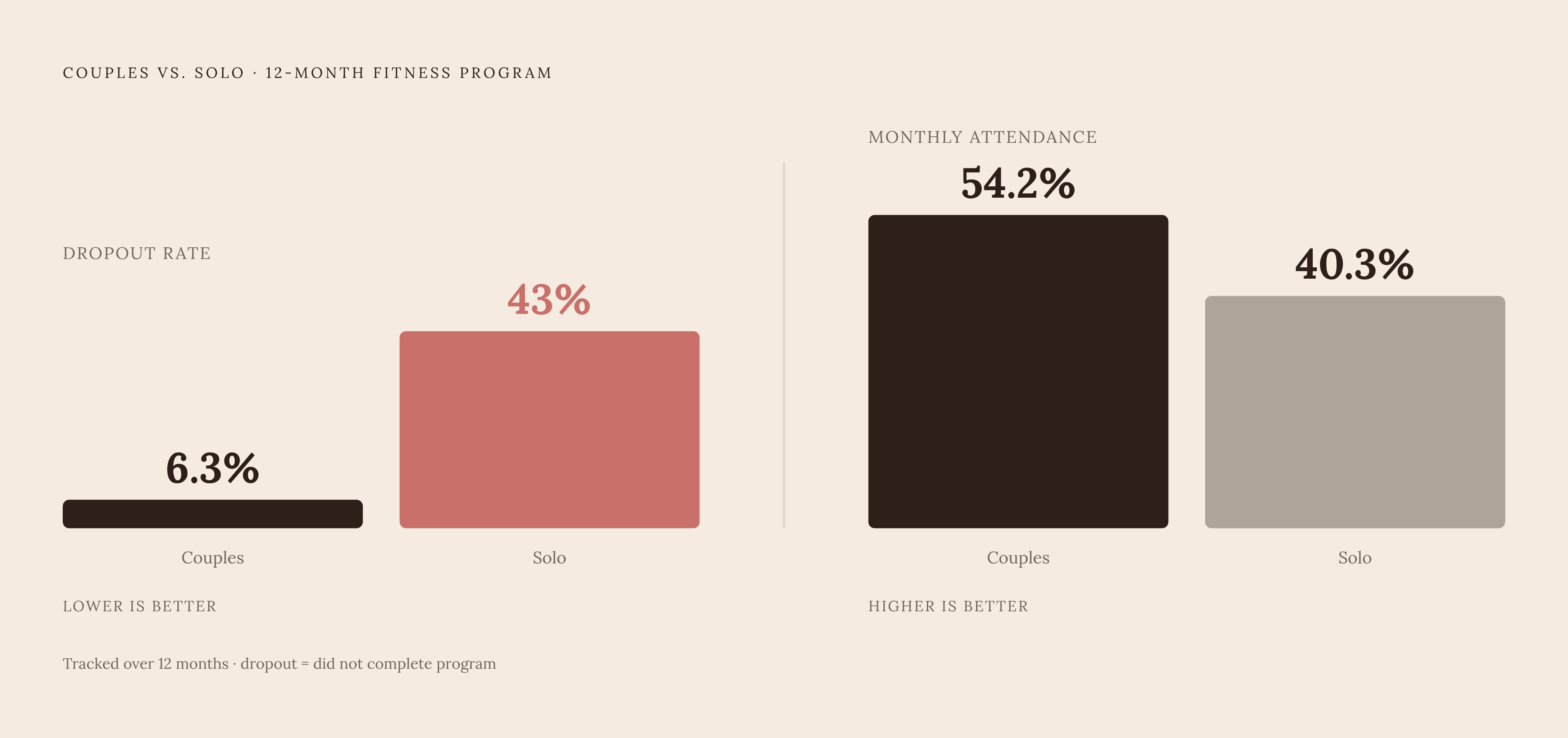
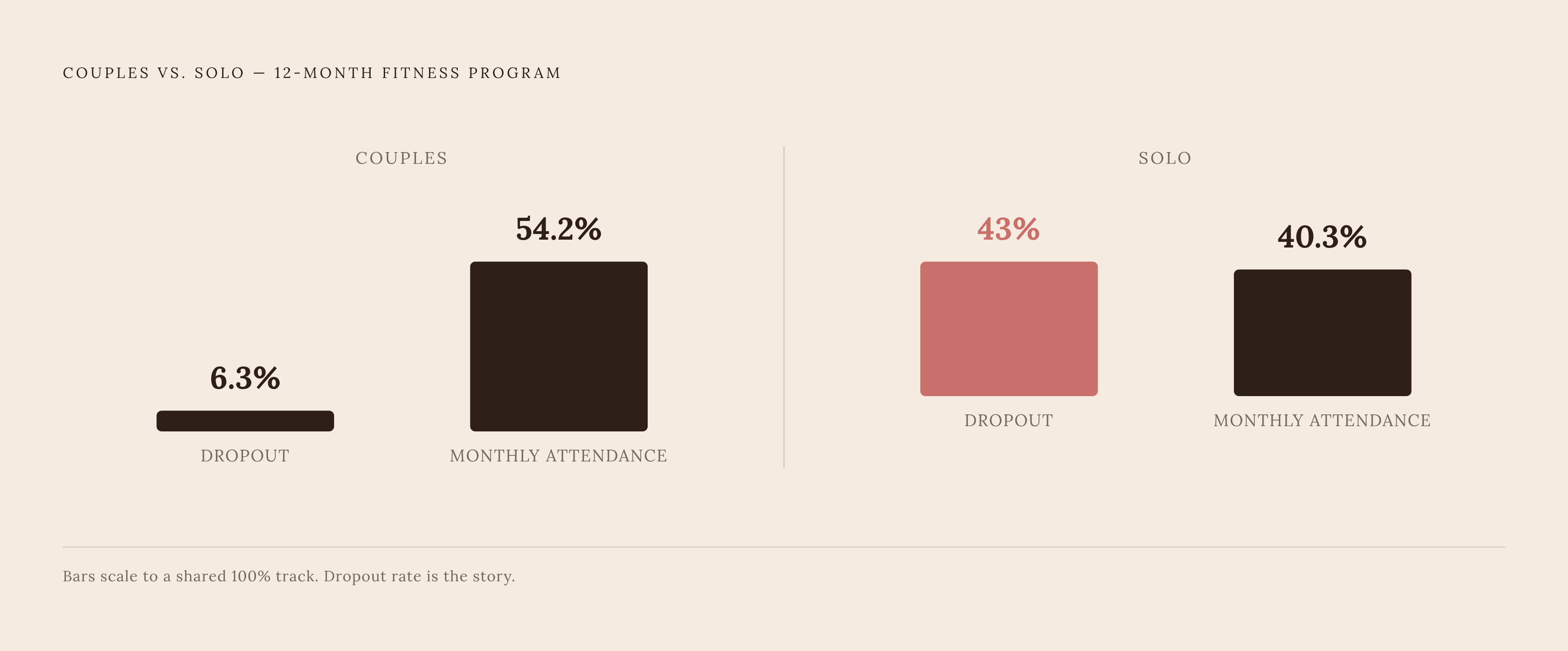
Here's the number that matters most for planning purposes. A study tracked married couples who joined a fitness program together against married individuals who joined alone. Over 12 months, only 6.3% of the couples dropped out. Solo joiners dropped out at 43%. Monthly attendance told the same story: 54.2% for couples versus 40.3% for solo participants. Stretch that gap across a full wedding year and you get two different people at the altar: one who built something real, and one who quit weeks ago and hasn't admitted it yet.
There's a relationship payoff too. Research on couples who work out together points to better mood during the workout, better mood for the rest of the day, and higher relationship satisfaction. Wedding planning is a year-long stress test on its own, so that mood boost isn't a nice-to-have. It's the thing keeping the whole operation from tipping over.
Research on couples who shared physical activity points to stronger communication, better conflict resolution, and lower marital stress. Evidence suggests somewhat larger benefits for couples exercising together versus separately, though that gap isn't definitively established. So shared activity helps. Doing it together might help a little more, but the data isn't shouting that part yet, and there's no reason to oversell it.
Here's what should make this whole plan feel less like a second job: walking is consistently one of the most accessible ways couples exercise together. No equipment, no membership, no fancy gear. Two people and a sidewalk.
How to set realistic shared goals before the first workout happens
Trainers who work weddings for a living cite something close to an 80/20 split. Roughly 80% of how you look on the day comes down to nutrition and hydration, and only about 20% comes from the gym. Say that out loud to each other before month one starts. It heads off the letdown that shows up when someone trains hard for eight months and the mirror still doesn't get the memo.
On weight loss, don't reinvent anything. The CDC and Harvard Health both point to 1 to 2 pounds a week as the pace that protects muscle and keeps your metabolism from stalling. Run that math over 12 months and each partner could realistically lose somewhere between 26 and 52 pounds, no crash dieting involved.
Weight is the easy number to point at, but it's not the most useful one. Better shared goals sound like this: can we dance for four hours straight? Do we stand up straight in photos? Do we have the energy left at 11 p.m. to actually enjoy our own party? Those goals also bend around the outfit. A backless gown means training leans into upper back and shoulders. A fitted suit means core and posture carry more of the load. The goals can differ between partners; the calendar and the accountability don't have to.
Sports science has a term for this kind of long build: a macrocycle, broken into phases (preparation, strength building, peaking, maintenance). A wedding date functions exactly like a competition day here, a fixed point you build toward in stages over the course of a year.
So before the first workout, write something down together. How many sessions a week. What rest days look like. What "showing up" means on the weeks that go sideways, because some weeks will. Missing a session should trigger a shrug and a plan for tomorrow, not a guilt spiral. Skip the spreadsheets with six decimal points of precision. A shared log or a photo thread does the job fine.
Months 12 through 9 — building the habit before worrying about the workout
Nothing about this phase is about transformation. The only job is making the workout non-negotiable before wedding planning shows up and starts eating your calendar whole.
Keep the bar low on purpose. Walks together, beginner strength training two or three times a week, some kind of weekend activity. That walking habit the BYU study flagged? This is exactly where it earns its keep.
Nutrition-wise, this phase is foundation work. Cut the processed food and refined sugar, put protein on the plate at every meal, get 7 to 9 hours of sleep. None of it is glamorous. All of it is what makes the next nine months possible.
Build in a deload week around month 10, following standard sports science guidance of a break every six to eight weeks, so neither of you is running on fumes before the harder training starts. Worth mentioning: roughly 14% of brides buy a dress a size or more too small, betting on future weight loss to make it fit later. That's a gamble dressed up as motivation. Twelve months of steady work is what turns that gamble into an ordinary fitting appointment.
The milestone at the end of this stretch isn't a before-and-after photo. It's a full month of consecutive workouts, logged together. Check in weekly, not daily, and skip the scale entirely. Celebrate the streak, not a number.
Months 8 through 5 — adding structure and building visible strength together
This is where the real strength gains show up. Research on periodized training shows this middle stretch, the mesocycle, produces bigger gains in strength and body composition than plans without structured phases.
Aim for three to four strength sessions a week, plus a daily step target of 8,000 to 10,000. Training that hits posture, core, arms, back, and legs pulls double duty here: it's what makes clothes fit better and photos look sharper, and it's what keeps you upright and functional on a 12-hour wedding day.
You don't need to be in the same room for any of this to count. The research backs separate workouts producing the same relational benefit, as long as the commitment stays shared. One partner hits the gym at 6 a.m., the other runs at 7 p.m., and a quick check-in photo or app log keeps both people honest without forcing identical schedules.
Nutrition stays boring on purpose here: enough protein to support the muscle you're building, water, consistent sleep. This isn't the phase for aggressive calorie cutting. Save that impulse. You won't need it, and you'll thank yourself later for not spending it early.
The milestone is a full month at your target session count, and that's worth an actual celebration. Dinner out, a lazy Sunday, something that isn't a protein shake. Slot the second deload week around month 6, the midpoint of the whole journey. Both of you will want the reset by then.
Months 4 and 3 — aligning the body to the garment, not the other way around
Everything up to now has been building toward one moment: the first dress or suit fitting. If the last seven months went reasonably well, you should be close enough to your wedding-day shape that alterations stay minor and predictable instead of a last-minute scramble.
After the fitting, the advice from people who do this for a living is consistent: hold steady. Maintaining your current weight is what keeps the garment fitting the way it's supposed to on the actual day, without a panicked call to the tailor two weeks out.
Training shifts too. Less heavy lifting, more toning, mobility work, Pilates-style sessions that support posture and cut injury risk right when you can least afford to tweak something. There's been a real shift toward functional mobility alongside pure aesthetics lately, and this is exactly where that pays off. Can you both dance for hours without your knees or lower back filing a formal complaint? That's the actual test. Not how you look holding a plank.
Stress piles up for real in this window. Vendor decisions, seating charts, whichever relative has opinions about the flowers. Wedding planning involves an enormous number of decisions along the way, and decision fatigue at that volume is exactly what erodes workout motivation fastest. This is where training together stops being just exercise and starts being an exit ramp, a scheduled hour where the only decision left is which direction to walk.
The milestone: go to that first fitting together, if you can swing it. Make it something you experience side by side instead of a private anxiety spiral in a dressing room.
Months 2 and 1 — protecting what both partners have built from the stress spike
Cortisol, the hormone your body releases under stress and sleep deprivation, is the main driver behind the bloating, breakouts, and water retention that show up in this final stretch. That's just biology responding to a genuinely stressful few weeks, not a personal failing.
The pressure doesn't ease up here either. It often gets worse. About 33% of brides-to-be report feeling pushed to lose weight by other people, most often family, sometimes friends, sometimes the future spouse. That pressure lands right when you have the least internal reserve left to absorb it.
So the training goal shifts. Forget new gains. The job now is managing stress hormones, not chasing a personal record.
That means leaning into Zone 2 cardio: steady walks, easy bike rides, the kind of movement that lifts mood without dumping more cortisol into an already full tank. Pilates and yoga earn their spot here too, for mobility and for the mental reset. Sleep stays at 7 to 9 hours, full stop, because skimping on it undercuts both the weight side and the skin side of this equation.
Skip high-intensity workouts entirely in the final days before the ceremony. A flushed face, sore muscles, or a tweaked ankle isn't worth whatever marginal gain you think you're chasing. This is exactly where having a partner pays off most: when one of you is drowning in seating chart logistics, the other gets to say, let's just go for a walk, which happens to be the same low-effort activity the BYU study found couples default to anyway.
The milestone for this phase is quiet. Finishing the last week of intentional movement before the wedding. Not a transformation. Just proof the habit held under pressure.
Wedding week and the day itself — what showing up has looked like for a full year
The wedding day reflects twelve months of showing up, not whatever session got squeezed in that morning.
Wedding week calls for gentle movement only: walks, light stretching, maybe yoga, nothing that leaves you sore or drained. Hydration and sleep matter more than anything else in the final 72 hours. This is not the week to try a new smoothie recipe or cut carbs. Whatever nutrition habits carried you through the last year are the ones that need to carry you through this one too.
On the day itself, skip the structured workout entirely. Save the energy for the ceremony, the photos, and a full night on the dance floor, which happens to be the exact functional test the last several months of training were quietly preparing you for.
What won't show up in any of the photos: a shared habit built over a year, a working communication pattern around health, a track record of showing up for each other through something genuinely hard. That's worth more than the fitting ever was.
The rebound risk is real, not a scare tactic. Research shows an average gain of about 2 kg by six months post-wedding. Training as a couple is the structural hedge against that outcome. Not a guarantee, but a real advantage.
Why the habits built in this year are worth carrying past the wedding day
Post-wedding rebound happens when fitness gets treated as a countdown instead of a routine, and the countdown just ran out. That's the whole mechanism, and it's a simple one.
Couples who built this together have something solo dieters don't: a partner who expects them to show up, and twelve months of proof that they will. That 6.3% dropout rate for couples, against 43% for solo joiners, doesn't come with an expiration date stamped on the wedding invitation. The advantage sticks around exactly as long as both people keep treating the habit as shared property instead of an individual chore.
The BYU finding applies even more after the wedding than during it, if anything. Communication and conflict-resolution benefits from shared exercise build up over time, and the months right after a wedding are their own adjustment period: new routines, maybe a new house, maybe a new last name. Odd time to drop the one habit that's been quietly making the relationship easier to run.
Keep it simple. Keep the weekly check-in. Keep the shared log or the photo thread going, and set the first post-wedding goal before you even leave for the honeymoon, even if it's as small as three walks a week.
There are tools built for exactly this stage, ways for couples to stay connected around fitness without turning it into a spreadsheet project. Sweatmates, a shared fitness accountability app for couples that keeps both partners honest through workout check-ins, photo logs, and team streaks, is one of them. The best system is whichever one you both actually keep coming back to, not the one with the most features.