Exercise for Couples at Different Fitness Levels
Couples who exercise together stick with workouts, but fitness gaps require careful navigation.

Half of U.S. adults don't hit the CDC's basic aerobic activity guidelines (47.2% per the 2024 National Health Interview Survey, split 52.3% for men and 42.4% for women). So if you and your partner are at different fitness levels, you're not broken, just statistically normal, and the math was always going to shake out this way.
What the research actually shows about couples who exercise together
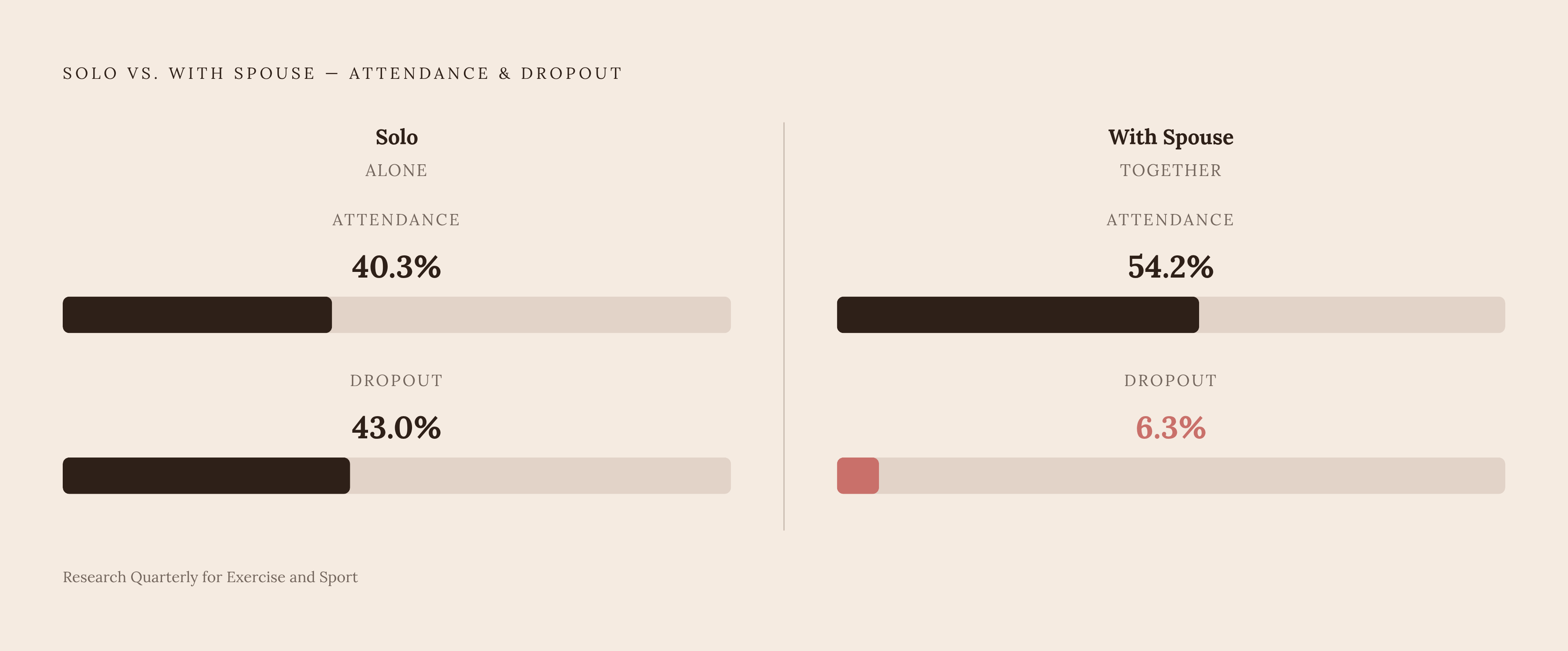
Start with attendance, because the numbers here don't leave much room for argument. A study in Research Quarterly for Exercise and Sport tracked married people who joined fitness programs, some with a spouse, some solo. Couples showed up 54.2% of the time, while solo spouses managed only 40.3%. The dropout numbers are where it really splits open: 6.3% for couples versus 43.0% for people going it alone.
Half the people who quit blamed family responsibilities or lack of spousal support, and the pattern is hard to miss. Translation: if you're not showing up together, you're a lot more likely to just stop showing up.
Research on couples who trained together has found they reported better mood during the workout, better mood after it, and higher relationship satisfaction overall. Separately, a study of 234 married couples found pairs who exercised together landed on more similar health outcomes over time, fewer problems across the board. Then there's a pilot program called "Exercising Together©," built around partnered strength training for prostate cancer patients and their spouses. Sixty-four couples went through it, and retention hit 100%, with fitness, mood, and affection all moving in the right direction. The workout itself became a relationship activity, something the pair built, not something one person dragged the other through.
Psychologists call the underlying mechanism the shared experience effect. Research has found that couples report feeling more satisfied, more in love, after doing something physically hard together. None of this is magic, and it only holds if the relationship and the workout were reasonably compatible going in, because skipping that condition makes things fall apart fast.
How the fitness gap can quietly damage a workout and a relationship
There are two failure modes, pulling in opposite directions. The less fit partner starts feeling ashamed, dragged along, like extra cargo on someone else's hike. Therapist Justin Dodson put it plainly in a 2026 HuffPost piece: shame doesn't hold up as motivation, and it works for about a week before it curdles.
The fitter partner has a different trap waiting. They start feeling held back, or worse, start assuming the other person just isn't trying hard enough. That resentment doesn't stay on the gym floor; it rides home in the car with you.
There's a physical cost too. Trainer James Stirling warns against pushing past your limits to keep pace with someone stronger, since running too fast too soon raises injury risk and turns the whole thing miserable. People stick with things they enjoy, and nobody keeps showing up for something that hurts.
One study of 36 couples already in marital distress found exercising together made things worse, not better. So the benefits everyone likes to quote aren't automatic, and they depend on the health of the relationship walking in the door. A shaky marriage doesn't get fixed by a shared gym membership; it just gets a new stage to perform its problems on, sweatier and worse lit.
The gap itself was never the villain here. What matters is whether it breeds contempt, isolation, or quiet pressure to be someone you're not.
The Köhler effect: why being the less fit partner can work in your favor
Here's the part that surprises people. There's a documented phenomenon called the Köhler Motivation Gain Effect: pair a weaker performer with a stronger one on a task where both outcomes are linked, and the weaker person outperforms their own solo baseline. It's got nothing to do with ego or getting shown up; it's about mattering, since knowing your effort decides the outcome, with a stronger partner right next to you, pushes effort up on its own.
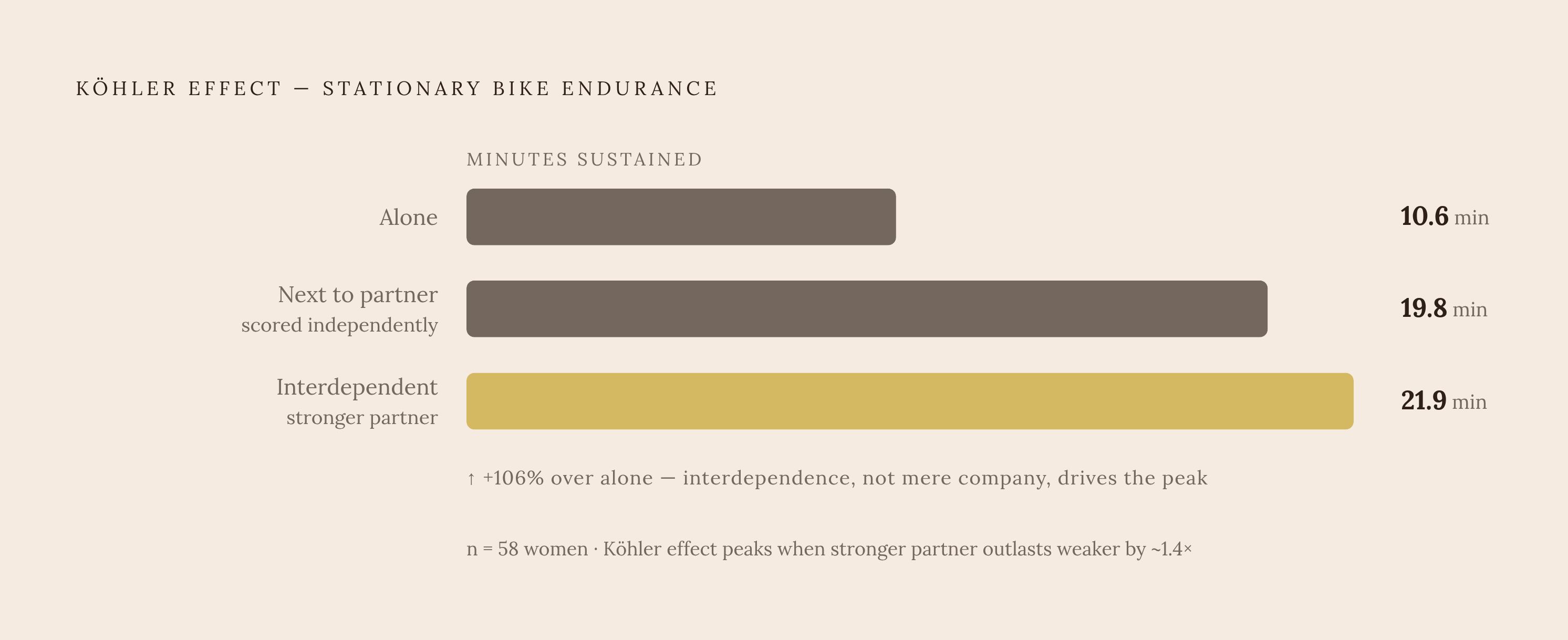
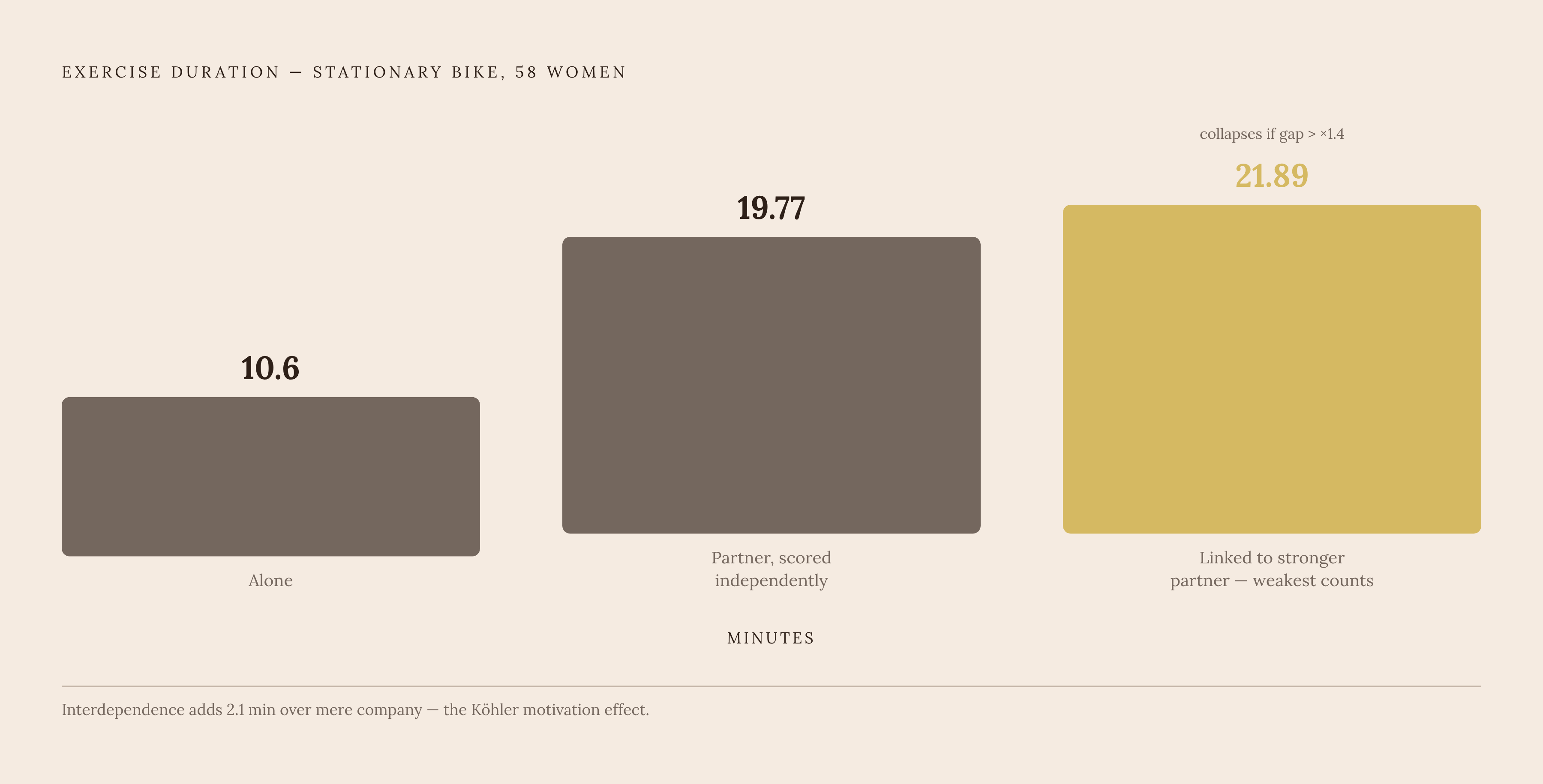
A stationary bike study makes this concrete, and a little strange if you think about it too long. Researchers put 58 women through different setups. Alone, they lasted about 10.6 minutes on average, and next to a partner, scored independently, that jumped to 19.77 minutes. But when the outcome depended on whichever partner quit first, and that partner was stronger, the average climbed to 21.89 minutes. Interdependence did more work than company alone ever could.
A preregistered meta-analysis covering 19 peer-reviewed studies and nearly 1,900 participants backs this up across different partnered setups. It's not a one-off finding from one weird bike lab.
There's a ceiling on it, though. The effect peaks when one partner can outlast the other by roughly 1.4 times. Push the gap wider than that, and the whole thing collapses, because the weaker partner starts feeling like the comparison quit being fair a while ago. Couples don't need to be evenly matched; they need to be close enough that the gap feels worth closing.
Workout formats that keep both partners challenged without splitting them apart
The rule is simple: match effort, not output. Nobody has to lift the same weight or hit the same pace to be doing "the same" workout, since what matters is whether both people are working near their own edge.
Cycling handles this well, spin class or outdoor ride, since each person sets their own resistance while riding side by side. No pacing conflict, just company. Circuit training works too, letting each partner pick exercises scaled to their level while moving through the same structure. Suspension training (TRX straps, that kind of setup) scales difficulty just by changing body angle, so one movement serves two very different fitness levels at once. Partner bodyweight drills, push-ups from the knees versus feet elevated, let each person work their own threshold inside the same exercise.
Running or hiking works fine too, once you stop trying to move at the same speed. The fitter partner takes the longer route, the steeper trail, maybe some extra weight, and meets the other person at a checkpoint instead of doubling back to wait around looking smug about it. Same finish line, different paths there.
What doesn't work is fixed group pace: race-pace running clubs, most competitive fitness classes, anything where slowing down means falling out entirely. Built for one speed, someone always gets left behind in that format.
Worth remembering too: people exercise more when a partner offers encouragement instead of enforcement. Showing up warm beats showing up like a drill sergeant, every time.
Building a shared fitness life that doesn't require every workout to be together
The biggest mistake couples make is assuming shared fitness means doing the identical exercise at the identical moment. That assumption falls apart the second interests or goals diverge, and eventually, they will.
Build a shared physical life instead of a shared workout schedule. Some sessions happen together, and some don't, and that's fine. The connection lives in how the couple talks about fitness, not in whether they're standing in the same room doing the same set of squats. Partners training separately can stay close through quick check-ins, shared goals, and actually cheering each other's wins instead of just nodding along absentmindedly.
Research backs this up: couples pursuing shared goals report higher satisfaction and commitment, even when the path to the goal looks nothing alike for each person. The goal is the shared part; the training doesn't have to be.
Watch for passive proximity, sitting in the same room without actually engaging with each other. Even a low-key walk beats that, since it swaps sitting side by side for being present side by side, which isn't the same thing at all.
Apps built for partner accountability can bridge separate workouts, letting couples trade check-ins, photos, friendly challenges, without training in the same place. Sweatmates, a shared fitness tracking app for partners that connects two people through photo check-ins, weekly goals, and friendly wagers without telling either person what to do, is one option built specifically around that use case. A little research goes a long way toward finding which tools actually deliver on that and which just add another notification to swipe away. Underneath all of it sits one idea: fitness works when it strengthens the relationship instead of becoming one more chore to negotiate over.
How the fitter partner's attitude shapes whether this works
The fitter partner holds more sway here than they probably realize. Tone, patience, expectations, all of it sets the emotional weather for the entire workout, whether they mean it to or not.
Treat the fitness gap as a starting line, not a flaw waiting to be corrected. Celebrate consistency, the fact that your partner showed up again this week, instead of fixating on pace or weight lifted. Let the less fit partner set the tempo in shared sessions, especially early on, since the Köhler effect only fires when the push comes from inside, not from being nagged into it. Offer encouragement in the moment instead of correcting form nobody asked about. Trying to be coach and partner at the same time rarely works for either job, and it usually just annoys everyone involved.
Coercion dressed up as concern wrecks this fastest. "I just want you to be healthy," said enough times, starts sounding like judgment, and that 2026 HuffPost piece notes judgment repeated often enough curdles into resentment. Holding your partner to your own intensity standard doesn't help either, and neither does using fitness as a stand-in for some other complaint you haven't said out loud yet.
A missed workout should get a shrug and a "we'll go tomorrow," not a lecture. Handled badly, one skipped session costs the relationship more than the workout itself was ever worth.
Success was never about both partners reaching the same fitness level. It comes down to whether the routine you build together is one you both actually want to come back to.