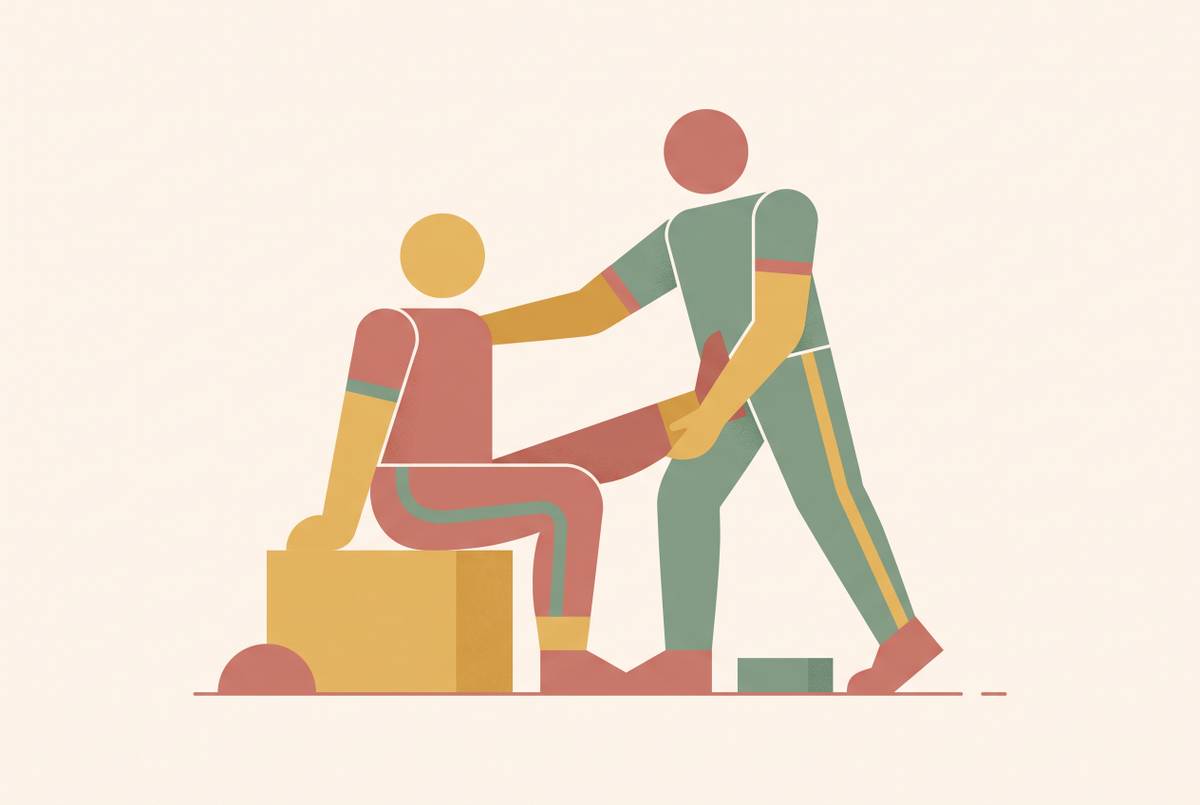
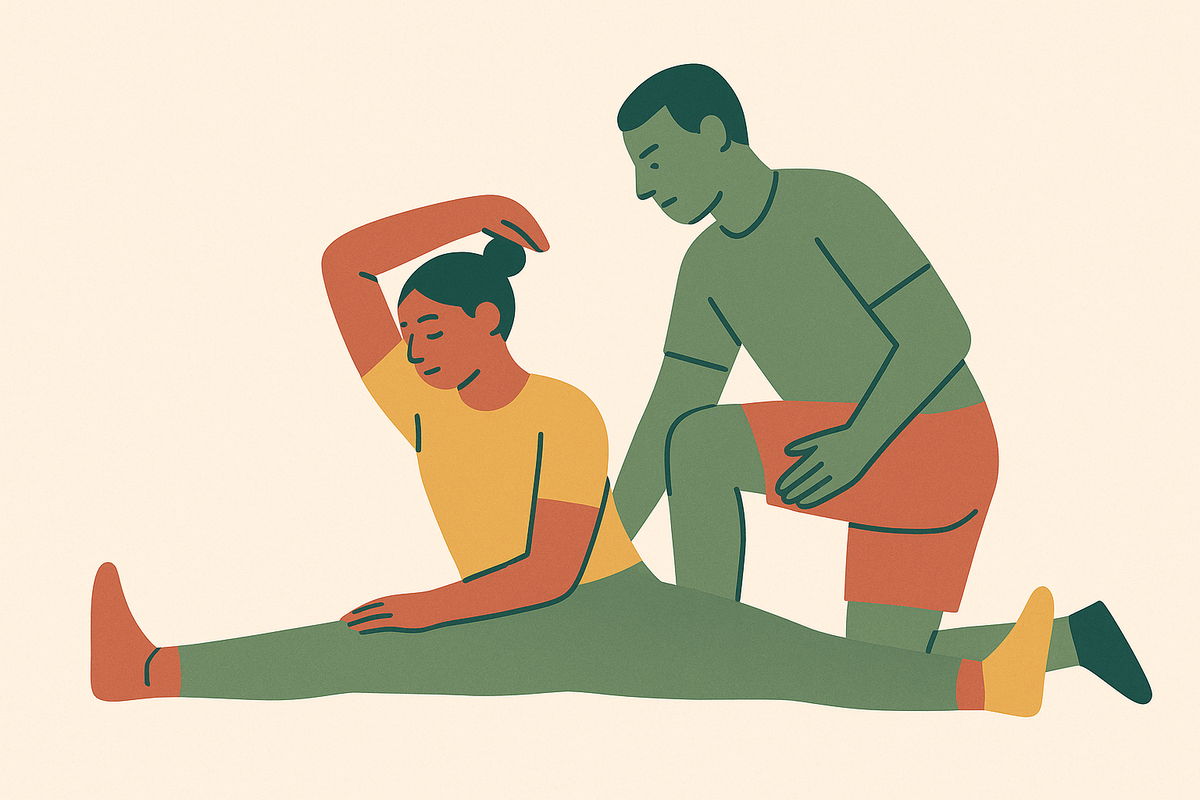
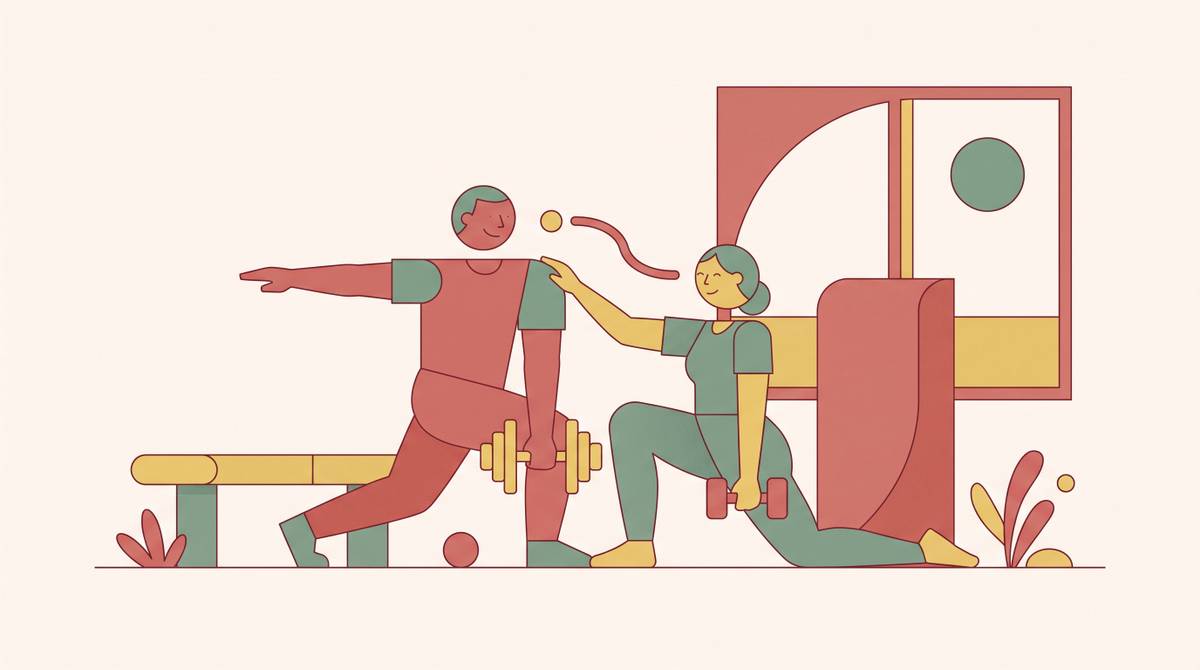
Beginner and Advanced Partner Strength Workouts
Training partners push harder and stick longer when their movements become interdependent.
Partner strength training isn't a gimmick for people who like matching gym outfits. It's a structure that keeps two people showing up, and the research backs it up: OHSU's Knight Cancer Institute ran a pilot with 64 couples in its Exercising Together program and hit 100% retention, with real gains in fitness, mood, and how affectionate people felt toward each other. Michigan State University researchers found training partners pushed workout duration and intensity up by as much as 200% compared to going solo. The question this piece answers is simple: how do you build that kind of training at a beginner level and an advanced level without losing the thing that makes it work in the first place?
What actually changes between beginner and advanced partner training
The real variable isn't weight on the bar. It's coordination.
At the beginner level, movements tend to run parallel, both partners doing the same thing side by side, or loosely cooperative: passing something back and forth, spotting, mirroring. At the advanced level, that relationship tightens up. One partner's effort starts directly loading or enabling the other's, whether that's an eccentric bench press where the spotter controls half the lift, or a wheelbarrow walk where one person's grip is the only thing keeping the other off the floor.
Accountability structure stays the same across both levels. Someone's watching. Someone's waiting. The rhythm of work and rest, done together, creates a social loop that reinforces itself session after session.
A fitness gap between partners is worth naming plainly here, because it comes up constantly: a partner who's meaningfully fitter is usually an asset, not a liability, as long as the gap stays challenging without being unreachable. Where it breaks down is when goals and styles mismatch badly enough that one partner starts to feel like a training obstacle rather than a training partner. Readers can start at either level below; these aren't sequential steps, they're two parallel paths depending on where two people actually are.
Beginner partner strength workouts: exercises that build the habit first
Every exercise here does one of two jobs: it forces coordination, or it introduces the spotting relationship that becomes non-negotiable later on.
Partner Squats. Lower together, side by side. The shared timing alone creates a built-in cue to stay consistent. Hits quads, glutes, and core, and scales easily: shallow squats to cut load, single-leg squats to add it.
Plank High-Fives. Face off in plank position, alternate high-fives every few seconds. Three sets of 30 seconds gets the job done. It tests core stability, sure, but the real value is the back-and-forth rhythm that shows up again in harder partner moves down the line.
Partner Sit-Up Pass. Feet touching, one partner holding a ball. Sit up, pass at the top, repeat. This one only works if both people stay in sync; drift out of rhythm and the pass falls apart. Good for upper and lower abs.
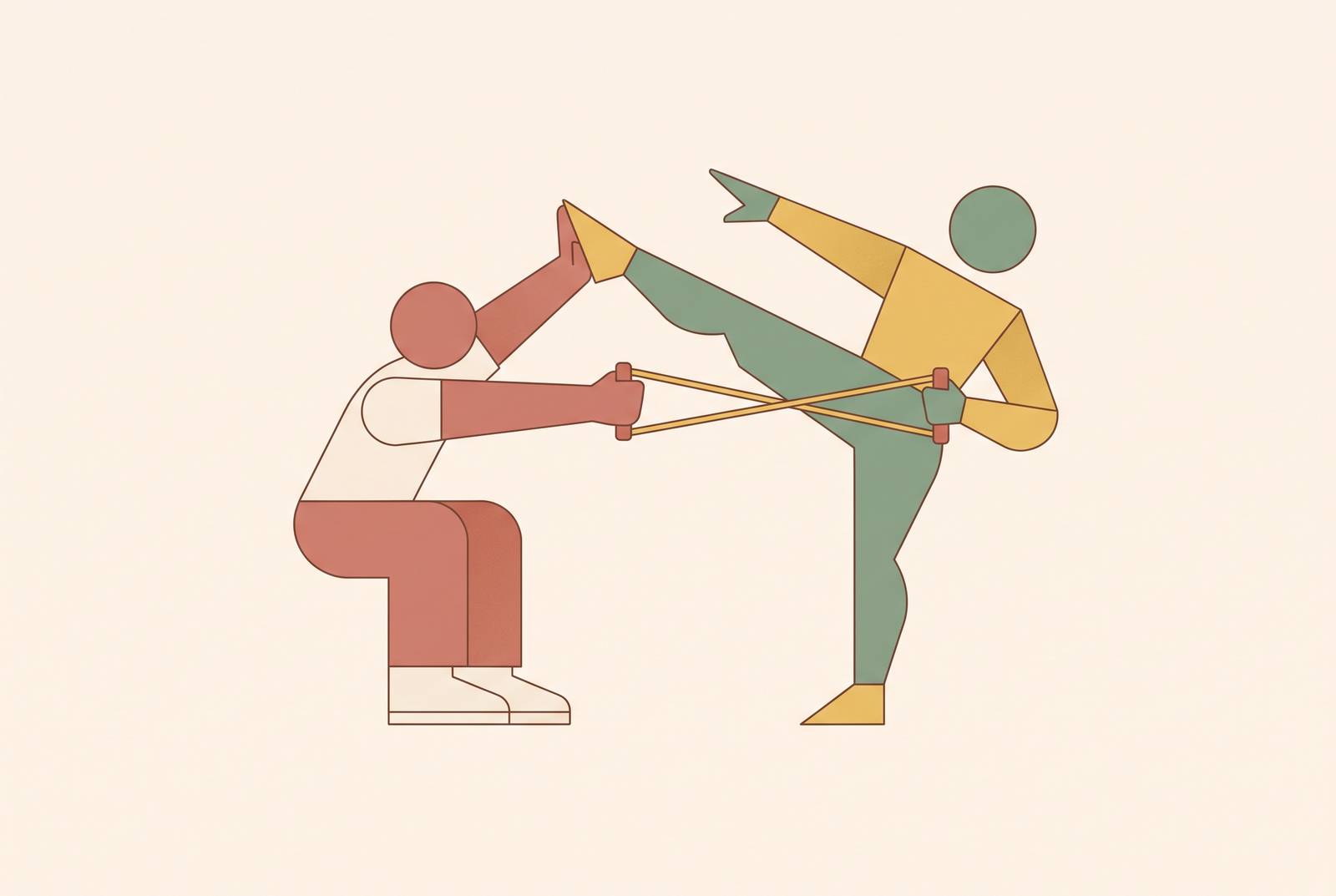
Resistance Band Rows. Face each other holding the same band. One pulls, the other holds steady as the anchor. Builds upper back strength and posture, which pairs well if either partner is also doing pressing work elsewhere in the week. Tricep extensions follow a similar band setup: lunge stance, elbows pinned to the sides, arms extending back. Progress by stepping farther apart or moving up to a thicker band.
Partner Bench Press with Spotting. Three sets of eight. One partner presses, the other spots and calls out form cues. The weight is low enough here that the stakes are low too, which is exactly the point: this is where the spotter role gets built before it matters more later.
Squat-to-Toss with a Medicine Ball. Stand about three paces apart, squat down, drive through the heels, toss at the top. Full-body movement, but it's really building the communication pattern between two people more than it's building raw strength.
Run these as a circuit, three rounds, and the whole session fits under an hour. A 40-seconds-on, 20-seconds-off interval format works just as well. Keep it simple at this stage; the goal is making the habit repeatable, not fine-tuning variables nobody's tracking yet.
Advanced partner strength techniques: using each other as load
Here's the shift: the partner stops being someone next to you and becomes part of the exercise's physics.
Forced Reps. After the athlete hits failure, the spotter helps them squeeze out a few extra reps, giving just enough assistance to finish the movement and no more. Spotting technique changes by exercise: assist from the bar on upper-body barbell presses, from the wrists on dumbbell presses, through the torso for pull-ups, dips, and squats (that last one takes practice to do safely). It's brutally fatiguing, useful for busting through a plateau, but a bad idea to schedule near the tail end of a high-volume training block. A 2025 NSCA review of advanced resistance training methods named forced reps, alongside supersets, drop sets, and rest-pause training, as techniques with real evidence behind them for building muscle through mechanical tension and metabolic stress.
Eccentric (Negative) Training with Partner Assist. The partner handles the concentric, or lifting, portion. The athlete owns the eccentric, or lowering, portion, typically stretched out over 5 to 10 seconds. This works because muscles can handle more force lowering a weight than lifting it; Hollander and colleagues found eccentric force running 20 to 60% higher than concentric force in young men back in 2007, and Kelly and colleagues in 2015 documented increases as high as 120%. For bench press negatives, set the load between 105 and 120% of one-rep max, with the spotter lifting the bar off the chest at the bottom of each rep. Cap negative-focused sessions at once or twice a week per muscle group, since the muscle damage involved needs 5 to 7 days to fully resolve. This is the technique where trust matters most: the athlete is handling weight they physically cannot move without help.
Assisted Single-Leg Squat (Pistol Squat). Stand side by side, hold hands, lower into a single-leg squat together using each other for the lightest possible counterbalance. The real goal is pulling less over time as each partner's unilateral strength catches up. Targets quads, hamstrings, and hip stability.
Wheelbarrow Walks and Push-Ups. Partner one gets into push-up position, partner two grabs their ankles. Partner one walks 10 yards on hands, drops for five push-ups, repeats until they hit 50 yards, then switches. Core and upper body take the brunt of it, and the asymmetric setup demands full-body tension the entire time.
Partner Reaction Lunges. One partner gives a forward push; the other catches themselves in a lunge, using core and legs to absorb it. No weights involved, but the demand on reactive stability is high. It counts as advanced because the load is unpredictable, and that unpredictability is exactly what makes it useful.
Row and Rest Intervals. One partner rows 250 meters while the other rests, then switches, four rounds total, times tracked throughout. The back-and-forth means the resting partner is always watching, always encouraging; the wait itself becomes the accountability. Turning it into a friendly bet on times is optional, but it works.
Advanced Band Circuit. Each partner runs through 10 squat jumps, three 5-yard bear crawls, five broad jumps, and a 20-yard sprint per round. The elite version: as many rounds as possible in 15 minutes. Nobody's idle in this structure; one partner's pace sets the bar for the other.
Keeping competition supportive rather than counterproductive
Competition between training partners carries real risk, and it's worth stating plainly instead of dancing around it. Competitive framing pulls focus away from technique and controlled movement, which raises injury risk, and that risk gets sharper at the advanced level where loads are sitting at or above one-rep max.
Cutting out competition altogether isn't the fix. Pointing it at the right target is: consistency, times, rounds finished, not ego-driven jumps in load. Forced reps and negative training carry the highest stakes on this front, since the spotter's entire job is enabling the lift, not tempting the athlete into a rep nobody can control.
Friendly wagers work fine when the metric is showing up. Betting on who completes more sessions in a month builds the habit; betting on who lifts more in a single set builds a hospital visit. If someone misses a session, that should open a conversation, not start a scoreboard. The whole accountability loop only holds up as long as it feels supportive rather than judged.
Same goes for mismatched fitness levels. A real gap between partners can work in everyone's favor when it's treated as pacing rather than judgment, one partner setting the tempo, the other chasing a concrete target just out of reach. Things fall apart the moment either person starts to feel graded instead of paced.
How tools and tracking can support the partnership without overcomplicating it
At the beginner level, tracking should stay almost boring. Did both people show up? How did the session feel? Did it get finished? That's the whole list, and adding more than that just adds friction nobody asked for.
The advanced level is where specific numbers start earning their place: one-rep max for calculating eccentric load, split times on row intervals, rounds finished in a band circuit. These aren't vanity numbers for a screenshot; they're direct inputs into how the next session gets programmed.
A photo from a workout, shared between two people, does something a chart never will. It marks a moment instead of a data point. Some fitness apps let partners log their sessions separately while still seeing each other's progress, and that setup captures the part that actually keeps people training together: feeling tied to someone else's effort even on the days schedules don't line up. Tools like Sweatmates, a shared fitness accountability app for couples built around workout check-ins, photo proof, and weekly goals each partner sets for themselves, are designed specifically to hold that connection across separate sessions.
Simple weekly goals beat detailed periodization plans for most training pairs, mostly because a plan only works if people actually stick with it, and complexity is usually the first thing to get skipped. The number worth watching isn't total volume lifted or personal records set. It's this: how many weeks in a row did both people get at least one session in together? That streak is the whole game.