Cardio Workouts for Couples with Different Endurance Levels
How to train together when one partner outpaces the other.

One partner runs 5Ks for fun, while the other gets winded on a subway staircase. Both of them can still train together four or five days a week without one of them faking a smile through it, and the numbers on how to pull that off are a lot more specific than most people expect.
What the dropout data says about couples who exercise together versus apart
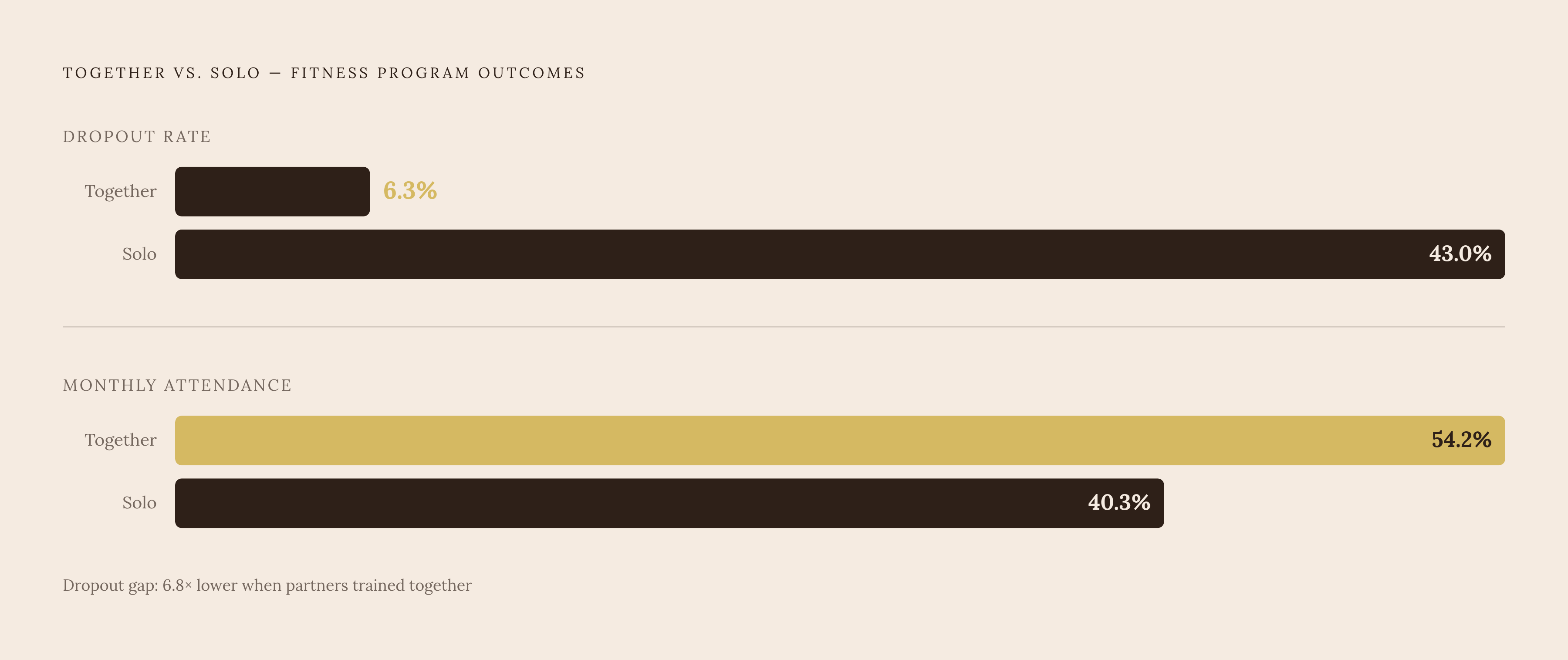
Start with the number that should end this debate for good. In a study tracking married adults who joined fitness programs, pairs who joined together had a dropout rate of 6.3%, while solo joiners dropped out at 43.0%. That's not a small edge, roughly a six-fold gap between who quits and who sticks around.
Monthly attendance tells the same story from a different angle. Couples training together showed up 54.2% of the time, versus 40.3% for solo joiners. Researchers pinned the gap on spousal support, not on who had more willpower walking through the door. Motivation didn't separate the two groups; having someone waiting for you at the gym did.
There's a second finding worth sitting with, and it's the one people skip past. Combining physical activity with actual conversation, not just parallel sweating, produced a life satisfaction effect size of 0.31, while physical activity alone landed at 0.23 and communication alone came in at 0.15. Add them together and the total beats either piece alone, which means the couple talking through a hike is stacking a benefit the couple doing separate solo sessions never even touches.
Splitting into "his workout" and "her workout" doesn't just cost a missed rep or a shorter run. It costs the accountability structure, and the relationship payoff goes down with it.
The Köhler effect — why the less-fit partner often performs better working alongside someone stronger
Here's a concept that sounds like a psych-textbook footnote but plays out constantly on a gym floor: the Köhler effect. The weaker performer in a pair, working next to someone stronger, tends to push harder than they would alone. The gap itself turns into fuel instead of friction.
This is a documented motivation-gain effect in exercise research, not a poster on a locker room wall. It comes with a catch, though: it only works around a moderate gap, roughly a 40% performance discrepancy in the research that established it. Too small a gap and there's nothing to chase; too big, and the less-fit partner stops feeling inspired and starts feeling like they wandered into someone else's sport.
There's a second catch that matters just as much. Always trailing wears the effect down over time, and the less-fit partner needs moments of being ahead, not behind — which is exactly what formats like dance, swimming technique, or flexibility work are good for. They scramble the hierarchy. Suddenly the "fitter" partner has two left feet, and the other one is teaching the drill.
A moderate endurance gap isn't a problem to fix before the workout starts. Run it through the right format and it stops being a liability, and starts acting like free equipment.
Using heart rate zones instead of matching pace or distance
Working out together doesn't mean moving at the same speed. It means working at the same relative effort, and that's a different thing entirely. Heart rate zones are what make the difference visible instead of theoretical.
The zones break down like this:
- Zone 1 (50–60% max heart rate): low intensity, recovery pace
- Zone 2 (60–70% max heart rate): moderate effort, the zone that actually builds endurance
- Zone 3 (70–80% max heart rate): harder, starts to burn
Polar's training guidance puts roughly 80% of endurance work in Zones 1 and 2. Going harder isn't automatically better; a lot of the time it's just more tiring for no extra payoff.
Picture a walk/run outing. One partner jogs, the other power-walks, and on paper that looks unequal. But if both sit in Zone 2, both are getting exactly the workout their body needs, and nobody's behind, because there's no shared finish line to be behind on. A cheap wearable or a phone app shows this in real time, and it quietly kills a second problem too: the fitter partner doesn't need to play coach, because the numbers do the talking instead.
Interval and circuit structures that give each partner a different intensity without splitting up
Intervals fix the "one person's warmed up, one person's dying" problem by design. One partner works at high intensity, the other does active recovery, then they swap, and the fitter partner's rest period becomes the less-fit partner's work period. Neither one stands around waiting, which is usually where the resentment sneaks in.
A treadmill-and-floor combo works well here. One partner runs, the other does bodyweight or resistance moves next to the machine, then they trade. Pairing treadmill cardio with resistance-based floor work outperforms cardio alone, so this isn't just a scheduling trick, but a better workout for both people, full stop.
For HIIT, drop the shared pace and use a shared effort ceiling instead: both partners work at an "8 out of 10" during intervals. The fitter partner covers more ground, the less-fit partner covers less, but both are genuinely maxed out relative to their own capacity. That sidesteps a real risk the research flags: higher intensities hurt adherence and mood in less-active adults when the pace comes from outside rather than from how the effort actually feels.
The payoff matters most in that early stretch when the less-fit partner is quietly deciding whether this becomes a habit or fades into a phase.
Some formats bend to fit two different fitness levels without anyone redesigning the workout. A few worth knowing:
Hiking. Terrain does the differentiating for you. One partner jogs a flatter stretch or detours up a steep section while the other holds a steady pace on the main trail. Progress by adding time before adding difficulty, a rule both partners can follow at their own rate. Conversation is usually still possible mid-hike, which keeps the relational side intact.
Cycling. The fitter partner can peel off for a harder loop and circle back, so nobody's held back and nobody's abandoned. It's low-impact, which lowers the barrier for the partner just getting started, and it teaches a practical kind of teamwork: adjust pace, wait a beat, sync back up.
Swimming. Lane swimming is self-paced by nature, and both partners can be in the water at wildly different speeds with zero friction. It burns somewhere between 400 and 700 calories an hour, and it's joint-friendly enough to double as a recovery day that still counts as real cardio. Stroke technique often levels the playing field, sometimes flipping who's actually "better" at it.
Dance-based cardio. Salsa class, Zumba in the living room, freestyle to a playlist, doesn't matter which. Both partners move to the same music while regulating their own effort. The shared novelty is the point, not who nails the choreography.
Racquet sports. Tennis, badminton, squash: rallies shorten on their own once one partner tires, so intensity self-corrects without a word said. Add a small wager, loser buys coffee, and a casual hit-around turns into something people look forward to on a Tuesday.
Partner bodyweight circuits. Scalable by design. One partner does a full burpee, the other does a modified step-back version, and both finish the same move on their own terms. Burpee high-fives or jump squats with a hand-tap keep the physical connection alive while letting effort differ, with no equipment, no membership, no excuse.
Why the fitter partner benefits from staying together too
There's a quiet assumption running under all of this: that the fitter partner is the one sacrificing, slowing down, being generous. That framing curdles into resentment faster than most people think.
Flip the dropout numbers around, and the accountability effect isn't one-directional; the fitter partner quits less often too when training alongside someone else. Zone 2 training, the exact zone most of these formats naturally land in, is chronically underused by recreational exercisers who default to going harder than they need to. Hiking together, cycling at a shared effort, swimming laps side by side: these keep the fitter partner in exactly the zone that builds aerobic base most efficiently, not less efficiently.
Research on couples trying new physical activities together also shows a satisfaction bump for both people, not just the one playing catch-up. Novelty and shared challenge move the needle on attraction and relationship satisfaction across the board.
One more thing worth saying plainly: coaching backfires, since research on health-related social control between partners shows unsolicited advice and correction hurts adherence rather than helping it. The fitter partner's job isn't trainer, it's teammate. Nobody's chained to joint workouts every single day either; three or four sessions together a week still leaves room for solo sessions at full throttle when someone wants one.
Setting goals and tracking progress in a way that works for both partners
Skip the performance metrics at first. "Three workouts together this week" holds up a lot better over time than "match my pace" ever will, because one's a shared habit and the other's a standing competition nobody signed up for.
Progress just needs to be visible to both people, and it doesn't need to be fancy. A shared log, a basic app, even a phone photo from the trailhead, anything that marks the week as a win regardless of who moved faster. When a week falls apart, and it will, the fix is a quick conversation about what got in the way, not a guilt trip. The goal is getting back out there, not auditing what got lost.
Some tools let both partners log separate activities on separate days while still seeing each other's effort, which keeps the shared momentum alive even when the actual workouts don't overlap, and Sweatmates, a fitness accountability app for couples built around shared workout tracking, photo check-ins, and team streaks, is one option designed around exactly that dynamic. The best system is whichever one both people actually keep coming back to. A photo, a small bet, a simple weekly streak: these do more work than another dashboard full of numbers nobody checks.
Because in the end, the couples who stick with this aren't the ones with the smallest fitness gap between them. They're the ones who built a habit around moving together, whatever that looks like on any given Tuesday.