Synced At-Home Workouts for Long Distance Couples
Working out together remotely doubles motivation and relationship satisfaction.
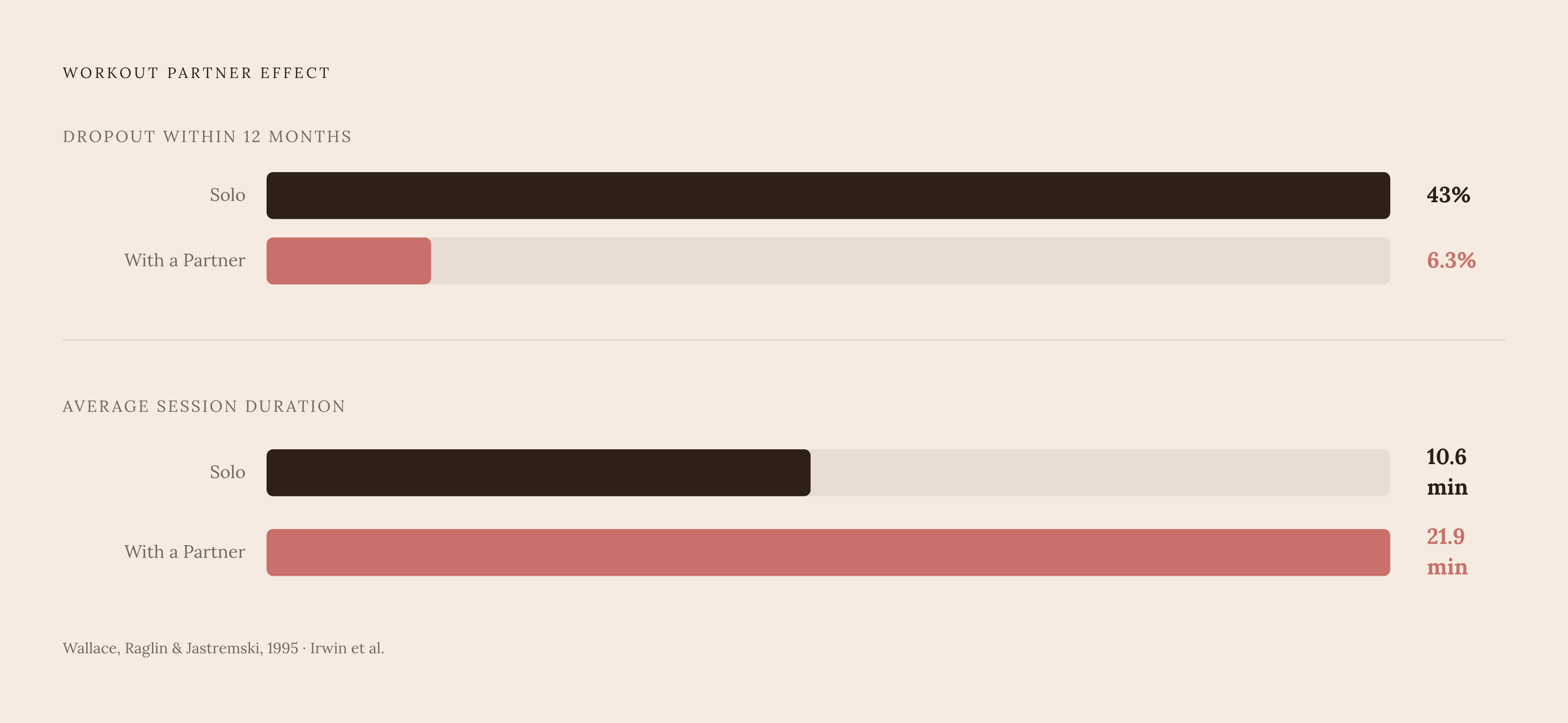
Start with the dropout numbers, because they're almost comically lopsided. In a 1995 study published in the Journal of Sports Medicine and Physical Fitness, Wallace, Raglin, and Jastremski found that only 6.3% of people who exercised with a partner quit within 12 months, compared to 43% of solo exercisers. That's the difference between a habit and a false start.
The duration numbers back it up. Research from Irwin and colleagues, published in Annals of Behavioral Medicine, found people exercise 106% longer with a partner present: 21.89 minutes versus 10.6 minutes alone. Double the time, same body, same treadmill.
Sackett-Fox, Gere, and Updegraff tracked 95 adults over two weeks and found something quieter but just as useful. On days couples worked out together, mood was better during and after, and relationship satisfaction ticked up too. The workout itself wasn't harder or more impressive. Someone else was simply there.
There's a name for part of this: the Köhler effect. Put two people on a team and the weaker one works harder, not out of ego, but because someone's grinding next to them and quitting first feels lousy. It's peer pressure, minus the pressure part.
This isn't about turning anyone into an athlete. It's about showing up more often and feeling better once you do, and that happens to be exactly the problem long-distance couples are trying to solve. Most people assume the partner effect is about competition, about pushing each other to lift more or run faster, but the data points somewhere quieter: presence seems to carry more weight than rivalry.
The virtual partner effect — distance doesn't cancel the benefits
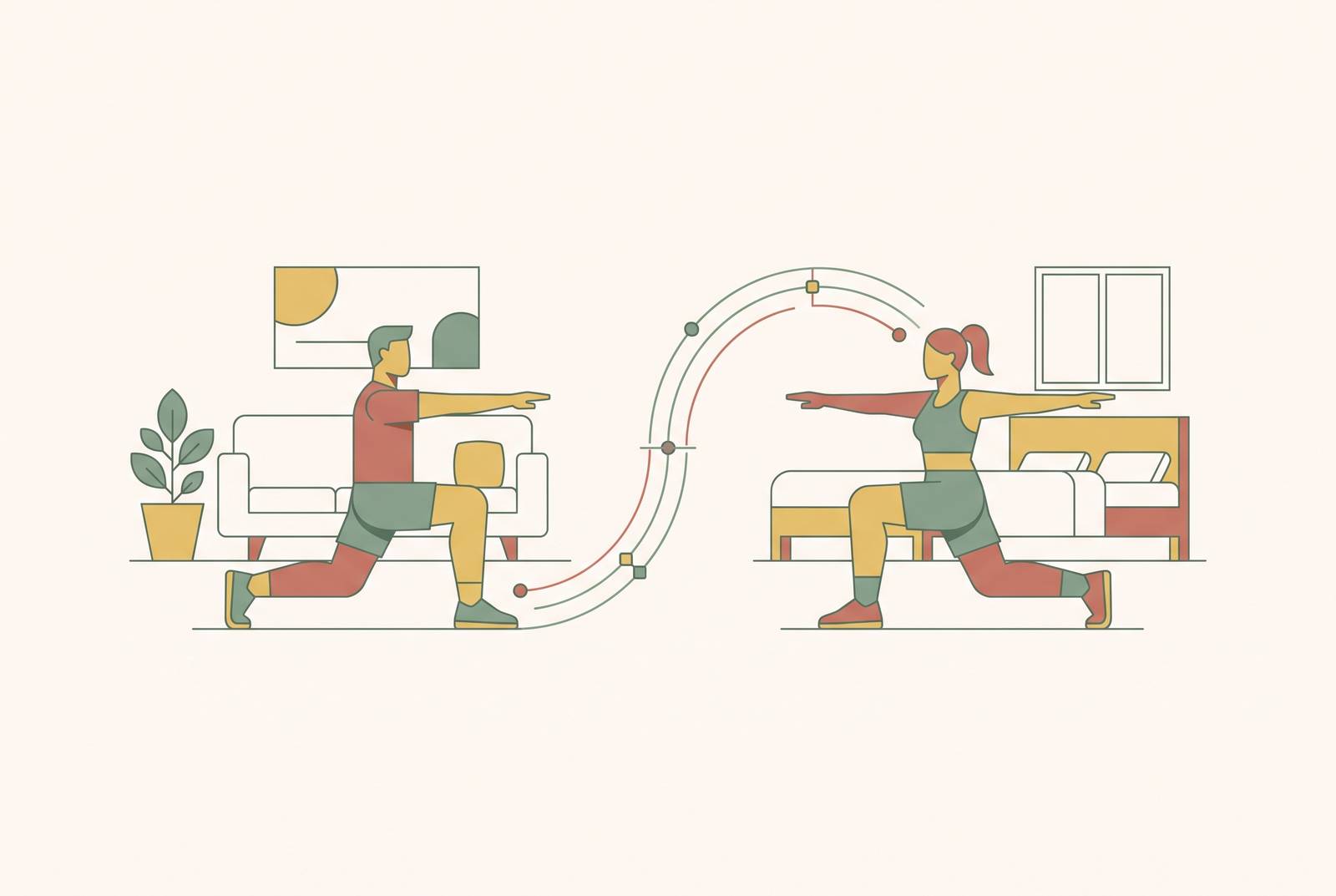
Here's the part that matters for anyone reading this from two time zones away from their partner: none of the above requires a shared room. Presence, it turns out, doesn't need a body attached to it.
Michigan State University researchers found that a virtual cycling partner boosted motivation by as much as 100%. Women paired with a virtual partner cycled an average of 22 minutes, compared to 11 minutes solo, and motivation held steady across sessions for the paired group while it declined for everyone riding alone.
MIT researchers analyzed five years of daily running data from more than one million people in a global social network and found the same pattern at scale. Social effort travels through a feed just fine, without needing eye contact.
Then there's the stranger mechanism: misattribution of arousal. A racing heart and heavy breathing from a workout can get subconsciously filed under "attraction" instead of "cardio." Adults who exercised for 15 minutes reported feeling more attracted to pictures of the opposite sex afterward compared to those who didn't. The body doesn't always know the difference between a sprint and a crush, and that confusion is apparently worth putting to use.
Novelty helps too. Couples who try new activities together, even from two different zip codes, get a dopamine hit tied to bonding. Roughly 90 minutes a week of shared novel activity connects to measurably higher relationship satisfaction in the research on this.
Put it together and the mechanism turns out to be simultaneity, shared effort, and someone watching, more than plain proximity. All three survive a few thousand miles just fine. Distance kills a lot of things in a relationship. This appears to be one of the exceptions.
The three obstacles that actually derail LDR workout routines
Three problems kill these routines, consistently, and none of them are about motivation. Couples blame willpower when the real issue is logistics, which is a little like blaming the weather for a flight delay when the actual problem was the connecting gate.
Time zones. Synchronous workouts need both people free at the same moment, which is already hard, and gets worse fast when one partner's day starts at 5 a.m. and the other's starts at noon. Asynchronous workouts solve the scheduling but require a mental shift: you're not sweating together, you're sweating in sequence, like a relay with a very long baton pass.
Fitness gaps. One partner runs marathons, the other runs late. Within a few weeks, the shared plan is too easy for one and too brutal for the other, and it dies quietly, without a fight, the way most abandoned New Year's resolutions do. Trying to match fitness levels is the wrong fix, since nobody's calibrating their VO2 max on command. The better move is picking a shared structure where both people do the same movement, scaled to their own difficulty.
Equipment mismatch. One partner's got a connected bike and a squat rack, while the other's got a yoga mat and a single resistance band from 2019. Routines built around minimal equipment sidestep this completely. The more gear a plan requires, the more likely someone gets quietly locked out of it, and quietly locked out is how these things end: not a conversation, just a missed week that turns into three.
All three are logistics problems dressed up as motivation problems. Couples who name them early tend to find a workaround before the whole thing collapses under its own scheduling.
How to structure a shared routine that actually holds across distance
Skip the elaborate program. A color-coded calendar is the fastest way to kill this. Start with a number instead, three workouts a week, say. Numbers are easy to protect and easy to restart after a bad week, while calendars tend to make you feel guilty when you fall off them, and guilt is not a training plan.
Pick a shared structure, something like a push-pull-legs split, so both people are doing the same categories of movement even at different intensities. This matters more than it sounds like it should, because "how did your deadlifts feel" is a real conversation, while "did you work out" is a status check.
For the synchronous option: one live session a week, over FaceTime, Zoom, whatever. Treat it like a standing date, not a task on a list. Twenty minutes of bodyweight work over video counts, and here's the useful bit: canceling a date feels worse than skipping a solo workout. That guilt is doing you a favor, for once.
For the asynchronous option: one partner sends a short clip or a photo, the other watches it before their own session. Marco Polo handles big time-zone gaps well for this. A photo is enough, honestly, and it doesn't need to be a performance, just a way of saying "I did the thing."
Aim the whole routine at something ahead of you, not around you. Training for a race you'll run together at the reunion, a hike, a physical challenge with a date attached, reframes the workout as movement toward the relationship's future instead of a distraction from its present absence.
Reward the week, not the rep. A completed week beats a personal record, because consistency is the number that actually predicts whether this becomes a habit or a memory. And when someone misses a session, don't make it a courtroom; ask what made the week harder instead. Shame kills habits, while curiosity restarts them.
Apps and platforms worth using — what each one is actually good for
Different couples need different tools, and most fitness apps are overbuilt for what a long-distance couple actually needs. Skip the ones with leaderboards, macros trackers, and seventeen tabs. The thing that actually solves the problem is proof of life, more than proof of performance.
For photo-based accountability, look at tools built around a simple weekly goal and a photo log your partner sees the moment you post it, sometimes with light stakes attached, a bet, a dinner on the line. This model works because it's low friction and it's human. You're looking at your partner sweaty and done, not parsing a bar chart.
For couples who want an actual curriculum instead of picking their own workouts, FitWithLove (launched in 2024, iOS and Android) runs day-by-day guided routines built for two people, no equipment required, with streak tracking and badges. Good fit for couples who'd rather follow a plan than build one.
For live synchronized classes, Peloton's Invite Friends and Sessions feature lets partners join the same live or on-demand class at the same time, same music, same cues, same pacing. It comes close to sharing a gym without sharing a zip code. Peloton's Teams feature, expanded to groups as large as 50,000, also lets couples build a private space around shared goals. Works best when at least one partner already has the hardware or the subscription; it's a weak pick if neither does.
Sometimes the right tool isn't a fitness app at all. FaceTime or Zoom for synchronous sessions, Marco Polo for the asynchronous, time-zone-proof version, gets the job done without asking anyone to learn a new interface.
The best app is the one both people actually open. Complexity is the enemy here, and a downloaded app that nobody opens after week two is worse than no app at all.
Why this habit does more than keep both people in shape
A shared workout gives long-distance couples something most rituals can't: a reason to talk that isn't "just checking in." "How did your run feel" is a conversation with content, and it goes somewhere. "How's it going" doesn't.
Over time, the habit turns into an identity. "We're the couple that works out together" becomes part of how two people describe the relationship, and that identity doesn't need a shared address to survive.
It also points forward. Every logged workout is a step toward something specific: a reunion race, a hiking trip, a version of each person the other is quietly helping build. That's a different emotional register than counting days until you're in the same room again, and it matters more than people give it credit for.
Roughly 58% of long-distance relationships make it; the rest don't. The gap isn't really about how often couples talk, and it's tempting to think it is. It seems to hinge more on whether they've built rituals that create closeness despite the distance, rather than just narrating it from opposite ends of a phone call.
A shared workout won't replace being in the same room, and nobody's claiming that. But it makes the distance feel like it's doing something instead of just subtracting something: one session a week, a photo, a number to hit. Low bar, high return.