Partner Stretching and Mobility Routines for Mixed Fitness Levels
Tailor each person's range instead of forcing both into an identical stretch.
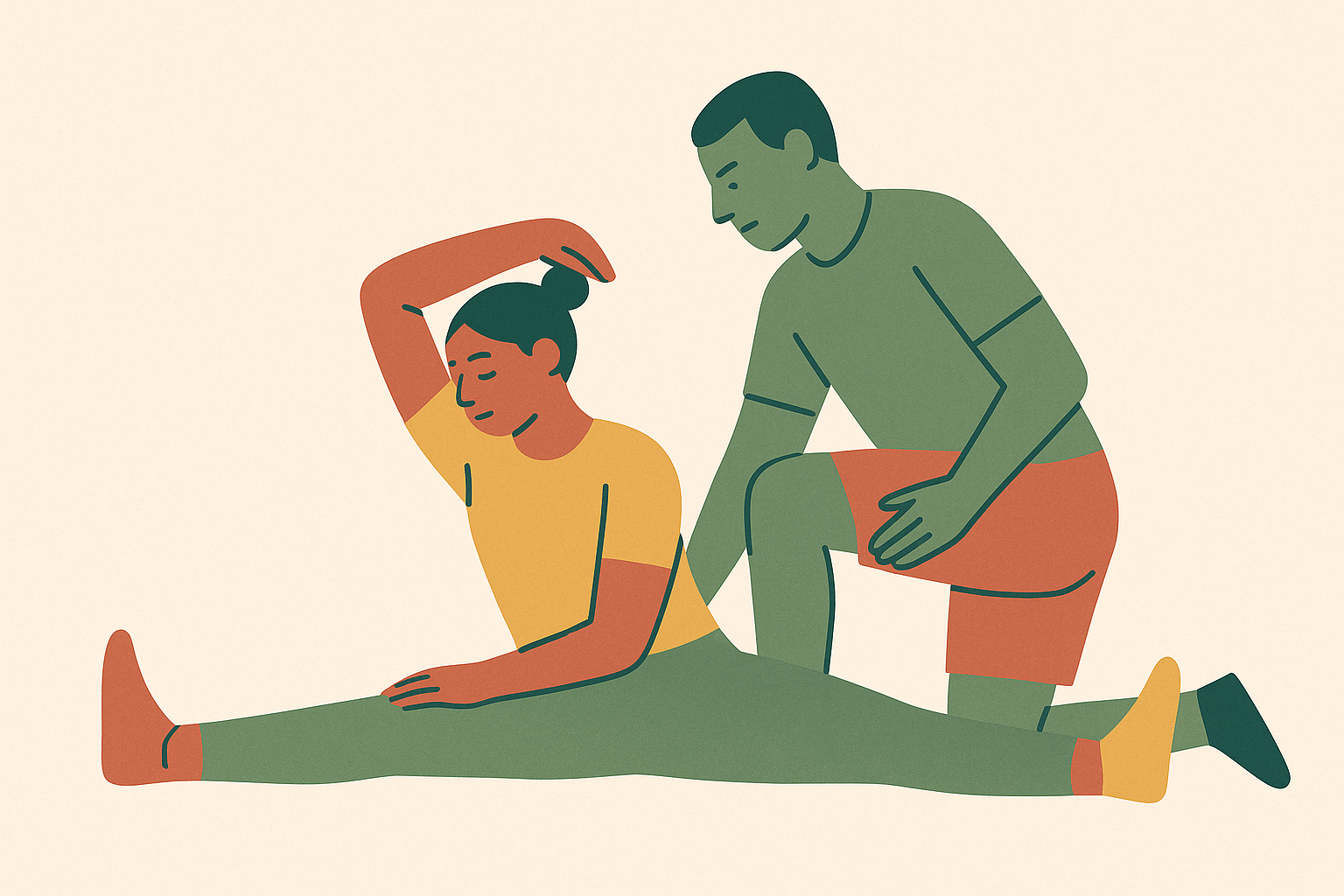
Partner stretching only works when both people actually get something out of it. Not when one person calls the shots and the other tags along. Mixed fitness levels don't wreck this. What wrecks it is the fix most pairs reach for by instinct: matching depth, matching pace, treating "equal" like it means "identical." It doesn't. The real fix is letting each person's current range set the target for that person, full stop, with the more mobile partner assisting instead of dragging everyone toward a shared standard that never existed in the first place.
The demand for this is real and growing fast. Assisted stretching was a $2.4 billion market in 2025, on track to hit $4.2 billion by 2034 at a 7.8% annual clip. Over 58% of gym-goers had a structured stretching routine in 2025, up from 41% in 2020. Some of that jump is just desk jobs and screens catching up with people: nobody's chasing a new deadlift max so much as they're chasing a neck that turns and hips that don't feel like rusted hinges.
Franchise stretch studios noticed first. StretchLab hit 500 locations across North America by October 2024. Stretch Zone announced its 400th location in June 2025, with 250 of those opening in the prior three years alone. People already know a second set of hands changes what's possible. The catch is cost and scheduling, which is exactly why the home version, done with a little structure behind it, is the one anyone can actually run.
What partner stretching actually involves, and the three techniques that matter
Assisted stretching, per the Cleveland Clinic, is passive stretching: something outside your own body (a partner, a strap, a prop) moves the muscle further than you'd get on your own. Three techniques carry the weight here, and mixed fitness levels change how each one plays out.
Static stretching is the simple one. Hold a position, keep gentle tension on the muscle, stop at "this is something" rather than "this hurts." A partner holds the limb in place. This is where anyone starts, no exceptions needed.
Dynamic stretching moves through a range instead of parking in one spot. A 2024 systematic review in the Journal of Sports Sciences tied dynamic stretching to small, short-term gains in power, sprint speed, jumping, and balance. It works as a shared warm-up no matter where either partner's fitness sits, because nobody's holding anyone back from a range they don't have yet.
PNF (proprioceptive neuromuscular facilitation) is the technical one, and skipping it means skipping the real gains. It works by triggering a short isometric contraction that overrides the body's stretch reflex, then easing into deeper range right after. Joe Clark, dynamic personal training leader and stretch specialist at Life Time, calls it one of the fastest, safest ways to build range of motion. It also demands the most from both people: clear signals, a little practice, patience before anyone gets ambitious. A 2025 Delphi consensus in the Journal of Sport and Health Science points out that PNF usually needs a partner or machine to function at all. That's exactly why it's the technique worth building the whole session around, not an advanced add-on for later.
The order that actually makes sense: static work is the entry point, dynamic work bends around whatever range either person walks in with, and PNF pays out the biggest gains, but only once the other two are boring and automatic. Nobody should rush toward PNF in week one. Plenty of pairs spend weeks, sometimes months, doing nothing but static and dynamic work and still see real change.
What a partner can do that a strap or foam roller cannot
A strap, a wall, a foam roller: all of them apply force in exactly one direction, straight down or straight back against whatever's pressing on them. That's the entire toolkit. A partner presses down and forward at once, corrects a lean mid-stretch, changes direction based on what they're actually seeing and hearing. No foam roller has ever noticed a hip rotating the wrong way, and it never will.
Resistance also adjusts mid-conversation, which is the part no prop can touch. The person stretching says "more" or "back off," and the response is immediate, not mechanical.
That matters most in PNF work specifically. The partner loads the position to help the stretchee sink deeper, then eases off right after the isometric hold so the new range settles in without a fight. That's a job for someone reacting in real time, not a static object bolted to the floor.
Ben Kuharik, an exercise specialist at the Cleveland Clinic, keeps the goal simple: not a ton of resistance, just a few degrees deeper each stretch. Most beginners walk in bracing for a shove past their limit, when the actual job is closer to a nudge. A good partner also catches bad form before it turns into a pulled muscle: a hip rotated slightly wrong, a shoulder hiking up, the stuff that's invisible from across the room but obvious from six inches away.
And the traits that make someone good at this (paying attention, adjusting without being asked, actually saying something when it matters) are the same traits that make someone worth training with, period.
Why mixed fitness levels create a specific problem in partner stretching, and why the common fix makes it worse
Here's what happens almost automatically when two people at different fitness levels stretch together: the more capable partner sets the pace without ever meaning to. They push toward their own comfortable depth, not their partner's, because their own comfortable depth is the only one they can feel. That's not malice. It's just what happens when one person's normal is another person's edge.
That gap is exactly why this gets risky without guardrails. The risk is straightforward: using each other to force deeper stretches can cause the very injury the whole routine was supposed to prevent.
The mechanics explain why so clearly. A partner doesn't feel what the stretchee feels, and there's a lag between "that's enough" and the pressure actually releasing. At the far end of a stretch, that lag is exactly where things tear. That lag matters most for older partners or anyone with balance issues, who also happen to often be the less flexible one in the pair.
The instinctive fix is splitting into two separate routines. Wrong move. That solves the safety problem and kills the entire reason to do this together. The better move is admitting that unequal roles aren't a compromise pairs settle for, they're the actual structure that works: the less flexible partner sets the depth, the more flexible partner assists rather than matches. Once a pair accepts that division, mixed-level stretching stops being a workaround and becomes the plan itself.
How to structure a session that works for both people from the start
Start with dynamic stretching, together, each person moving through their own range. Nobody's applying pressure yet, so the stakes stay low, and moving through the same patterns side by side builds the working relationship before any assisting starts.
From there, static assisted work. The less mobile partner goes first as the stretchee, so the more mobile partner learns their partner's range before it's their own turn under someone's hands. PNF comes last, once both people are comfortable with static work and have agreed on a few words: "more," "hold," "release."
On frequency: a leading sports medicine organization recommends stretching two to three times a week at minimum, daily if that's realistic. Thirty-second holds work well for hamstrings specifically. Total volume matters more than any single hold, though: 180 seconds per muscle group, three times a week, improves hip flexion whether it's delivered in 15-, 30-, or 45-second chunks. Pick an interval that's actually doable and repeat it.
Frequency beats duration every time. Going from zero sessions to even two short ones a week beats one heroic 45-minute session done once and never touched again. A five-minute shared routine, run consistently, is a genuinely sustainable starting point for two people who aren't starting from the same place.
Props aren't optional for beginners. Bolsters, yoga blocks, folded blankets: these let the less mobile partner reach a position without forcing range they don't have. The more mobile partner usually skips them. And both people need to stretch by the session's end, not just one facilitating the other the whole time. Swapping roles is what keeps this feeling mutual instead of turning into one person's unpaid physical therapy shift.
Consistency protects the gains. Chronic improvements in range of motion fade without continued practice, so a pair sharing a fixed schedule is simply more likely to keep showing up for it than two people relying on motivation alone.
Three partner stretches that adapt naturally to different starting ranges
Assisted hamstring stretch (PNF-based, supine). Demonstrated by Joe Clark at a fitness center location. Partner 1 lies on their back and raises one leg toward the ceiling as far as it goes without pain. Partner 2 applies gentle pressure to help hold the raised leg in position while keeping Partner 1's other leg stable. After a passive hold of about ten seconds, Partner 1 pushes back isometrically against Partner 2's hand for roughly five seconds, exhales, and lets go. Repeat two to three times per side, aiming for a touch more range each pass. If the leg only reaches 45 degrees, that's where the assist starts, no exceptions. The goal is more than last time, not some fixed angle pulled off a chart. Clark says this stretch builds flexibility, eases low-back pain, improves balance, and cuts muscle fatigue.
Assisted hip flexor / psoas stretch (PNF-based, at the edge of a table). Also from Clark. Partner 1 scoots to the edge of a table or sofa, one leg hanging off, the other pulled toward the chest. Partner 2 presses down on the hanging thigh and leans gently into the raised foot. Partner 1 gives the go-ahead when it's enough, then contracts to press the hanging thigh up into Partner 2's hand for about five seconds before releasing. Repeat two to three times each side. Depth here is set entirely by what the stretchee reports; Partner 2 never presses past that line. Clark credits this one with cutting low back pain, building hip flexor range, and improving movement and balance.
Assisted chest / pectoral stretch (PNF-based, seated). Clark again. Partner 1 sits tall with arms positioned to allow the chest to open. Partner 2 takes a position behind, and gently draws the elbows backward. After the passive hold, Partner 1 presses the elbows forward into Partner 2's hands for around five seconds, then relaxes. Repeat two to three times. Someone with tight shoulders will have a short range here, and that's correct for them, not a problem to fix. Clark credits this stretch with better posture, more shoulder range, lower injury risk, and even improved breathing.
Across all three: ease off if the stretchee is especially tight, and lean on props where they help, per guidance from Welltech. All three work fine for beginners as long as pressure gets calibrated to the person in front of you, not to the move on paper.
Communication is the technique that makes everything else work
The assisting partner cannot feel what the other person feels. That single fact is why communication isn't a nice extra here. It's the actual mechanism keeping the whole thing safe.
Kuharik's core point is worth repeating: aim for a few degrees deeper each stretch, never a dramatic leap, and keep talking throughout. Before starting, agree on simple words for "more pressure," "hold here," and "release now." That last one matters most, since the lag at the end of a stretch is precisely where strain happens.
The less mobile partner sets the vocabulary, because they're the one reporting what they actually feel. The more mobile partner's job is to listen and adjust, not to lead. State it plainly: the less flexible person is the authority on how deep the session goes. That flips the usual assumption on its head. What looks like a limitation is actually the thing steering the whole session.
For couples, these habits (asking before pressing further, adjusting on feedback, noticing small wins) are the same habits that keep any shared fitness routine alive past month two. And if a session comes up shorter on range some day, stress, bad sleep, and plain fatigue all shrink flexibility temporarily, that's not a setback worth stewing over. The value sits in showing up again, not in hitting a new personal best every single time.
How to keep a shared routine going when progress looks different for each person
Flexibility gains fade without upkeep. Range-of-motion improvements from stretch training require continued practice to maintain, so this was never a program with a finish line. It's a habit that needs feeding on a schedule.
Progress won't match between two people, and it shouldn't. One partner might see hamstring gains show up fast. The other might notice more movement in the shoulders and chest first. These aren't competing scoreboards. They're two separate things happening in the same session.
Simple, visible markers help without turning stretching into a spreadsheet. Note the angle of a raised leg. Notice how far the elbows draw back this month versus last. Track whether the hip flexor stretch still needs a prop underneath it. None of it needs numbers attached, just noticing.
Shared workouts where both people follow the same structure but calibrate depth to their own level (same time, same format, different range) are a documented, sustainable way for couples at different fitness levels to train side by side, according to fitness guidance on the subject. There's a real accountability effect too: partner stretching creates a real accountability effect that makes people more likely toskip cooldowns and recovery work, because someone else is standing there waiting for their turn.
The more mobile partner isn't stuck waiting around for the other one to catch up, either. Playing facilitator builds its own skill: a sharper sense of body awareness and feel for movement that solo stretching never teaches. The whole thing works when both people leave having gotten something real out of it. Not the same thing. Something connected all the same.
Sources
- Full article: Application of mobility training methods in sporting populations: A systematic review of performance adaptations
- Practical recommendations on stretching exercise: A Delphi consensus statement of international research experts - ScienceDirect
- Why You Should Try Assisted Stretching
- 8 Partner Stretches For Full-Body Tension Relief - Welltech
- experiencelife.lifetime.life