Low-Impact Partner Workouts for Injury or Mobility Differences
The less mobile partner often pushes harder when exercising as a matched pair.
More than 1 in 4 U.S. adults between 18 and 64 has a disability. Chances are, you or someone you work out with is dealing with a real physical limit, and when that's true, the usual setup falls apart fast: one person sets the pace, the other tries to keep up or just gets left behind.
Physical inactivity among adults with a disability sits between 42.9% and 52.5%, compared to 24.3% to 26.2% for adults without one. That gap gets worse the moment someone exercises alone, because alone is exactly where the urge to skip a session wins the argument. Mismatched fitness levels usually end the same way: the more mobile partner goes ahead, the other one falls off after one bad session, sometimes after none at all.
A survey of Australian adults found 62% of people with disability named poor health or injury as their main barrier to exercise, well ahead of laziness or disinterest. Fear of getting hurt weighed heavily, along with the total absence of a workout built for the body they actually have. Missed sessions aren't the only cost, either. There's the slow fade of a shared habit, "our Tuesday walk" quietly turning into "my Tuesday walk," which eventually turns into nothing at all.
Build one session that works for both bodies at once, rather than tucking the injured partner's version off in a corner while the other person does their own thing next to them.
What low-impact movement actually does for an injured or mobility-limited body
Mobility and flexibility get used like synonyms, though they mean different things. Flexibility is how far a muscle stretches, while mobility is the whole system: joint structure, connective tissue, nerve control, the fluid inside the joint itself. Lots of moving parts, but here's the good news: it's trainable, not fixed for life.
Adults lose about 0.5% to 1% of joint range of motion per year after age 30. That sounds like bad news, until you hear the rest: up to 80% of that loss can be prevented or reversed with the right training. Decline turns into something two people can push back on together, on a mat, in a living room.
Research on mobility training suggests the gains tend to show up biggest in people who start with the most limitations. The partner who seems hardest to include, the one you're tempted to let sit this one out, is often the one who gets the most out of showing up.
Low-impact movement also puts less strain on knees, hips, ankles, and the spine while still producing real change in the body. Gait speed, balance, stair-climbing endurance all show measurable improvement within 6 to 8 weeks of sticking with it.
Both partners end up doing something different here, and often something that holds up better long-term than whatever high-impact routine got abandoned last January.
Why exercising with someone you care about changes what you're willing to do
Research has found that picking up a new exercise companion increased how often people worked out, and the social dimension of that connection plays a real role in keeping the habit going.
A 2021 study in the Journal of Social and Personal Relationships, 95 participants, found that on days romantic partners exercised together, both people felt better during the workout and reported higher satisfaction with the relationship overall.
The mechanism isn't really accountability, though that's in there somewhere. The workout stops being a chore bolted onto the day and starts being part of the relationship itself, the way a shared meal is, or a show you watch together every week.
About 10% of gym members pay for a personal trainer, while a well-matched workout partner gives you supervision and social motivation for free. Research on training partners from 2014 found something close to exhilaration in shared sessions, a lift that keeps people coming back that a solo workout on a rubber mat almost never produces.
None of this needs grand gestures, just a workout photo, a small high-five after a session, a dumb bet about who can hold a wall sit longer. Small stuff does more work than it looks like it's doing.
The Köhler effect: why the less mobile partner often pushes harder, not less
There's a finding that cuts against every assumption people make about pairing up with someone less able-bodied. It's called the Köhler effect, and it shows up in what researchers call a conjunctive task, where the pair succeeds or fails together. In that setup, the weaker partner works harder than they would alone, driven by feeling indispensable and by comparing themselves to someone just slightly more capable.
The effect peaks at a moderate gap, around the point where one partner can hold out about 1.4 times longer than the other. That maps almost perfectly onto a lot of injury and mobility situations, where a real, workable difference drives it, not two wildly different fitness levels.
A meta-analysis covering 19 peer-reviewed studies and 1,912 participants confirmed this holds across exercise types. A plank study with 240 participants found every partnered condition beat the solo control by a wide margin, and the less mobile partner is a real reason the session works for both people.
One caution worth flagging: training next to someone perceived as more capable can push effort up by as much as 200% by some estimates. For someone managing an injury, that's not automatically good news; it needs structure, or ambition turns into a setback fast. Good session design channels the Köhler effect through shared tasks and shared pacing, where both people finishing is the actual point.
How to structure a session so both partners are doing the same workout, not parallel ones
Here's a rule that's simple but easy to skip: pick tasks where both people contribute, instead of two sets of independent reps that just happen to share a room.
Roles should match in effort, not in movement. A partner counting reps or holding a position while the other moves still has a job, and that job completes the task. Resistance band pulls work the same way: one partner anchors, the other extends, both working, neither one just standing there watching. Timing-based circuits where both people rest when either needs it, and both restart when both are ready, do this too.
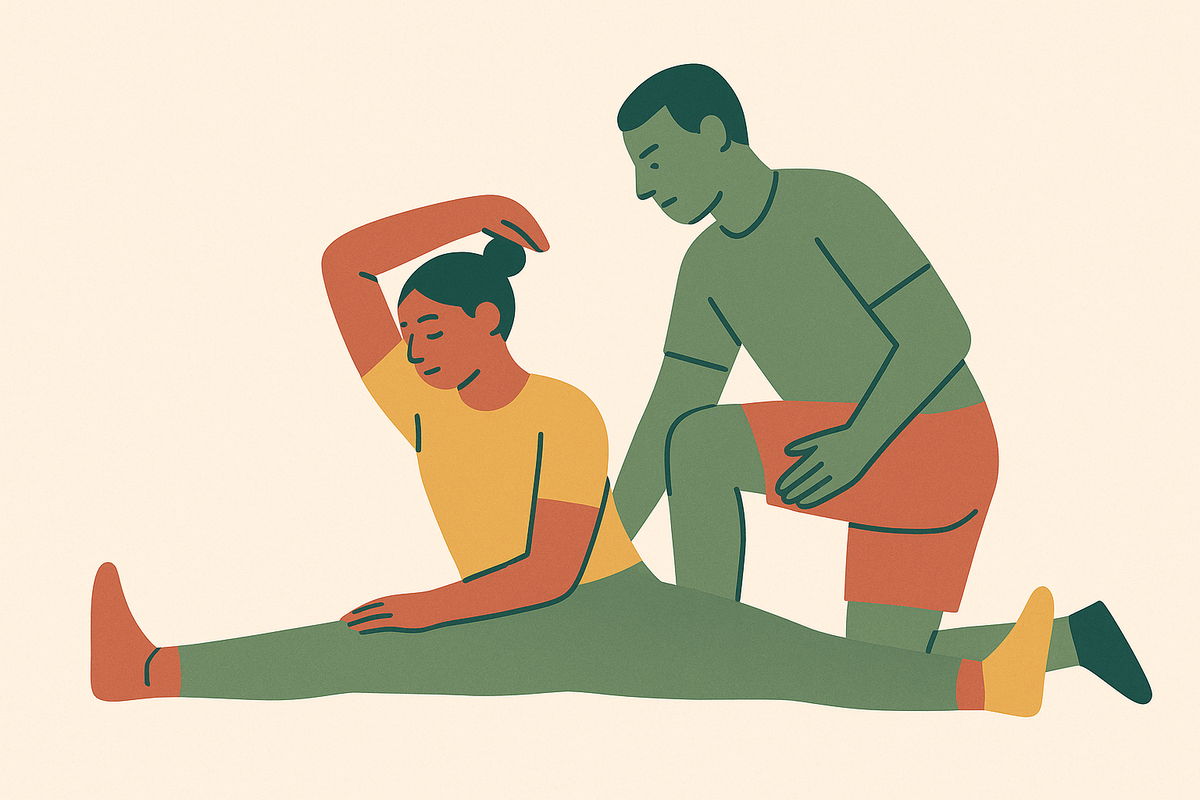
Pace the session to the session, not to whoever's faster. If the more mobile partner needs more of a challenge, cut their rest time or add a balance component, rather than reaching for a higher-impact move that leaves the other person behind.
Range-of-motion changes shouldn't get flagged as the lesser version of anything. Partial squats, wall push-ups, seated presses, these are the shared format, and language matters more than people expect here, since "we're doing seated rows today" lands completely differently than "I'll stand, you sit." One session, one format.
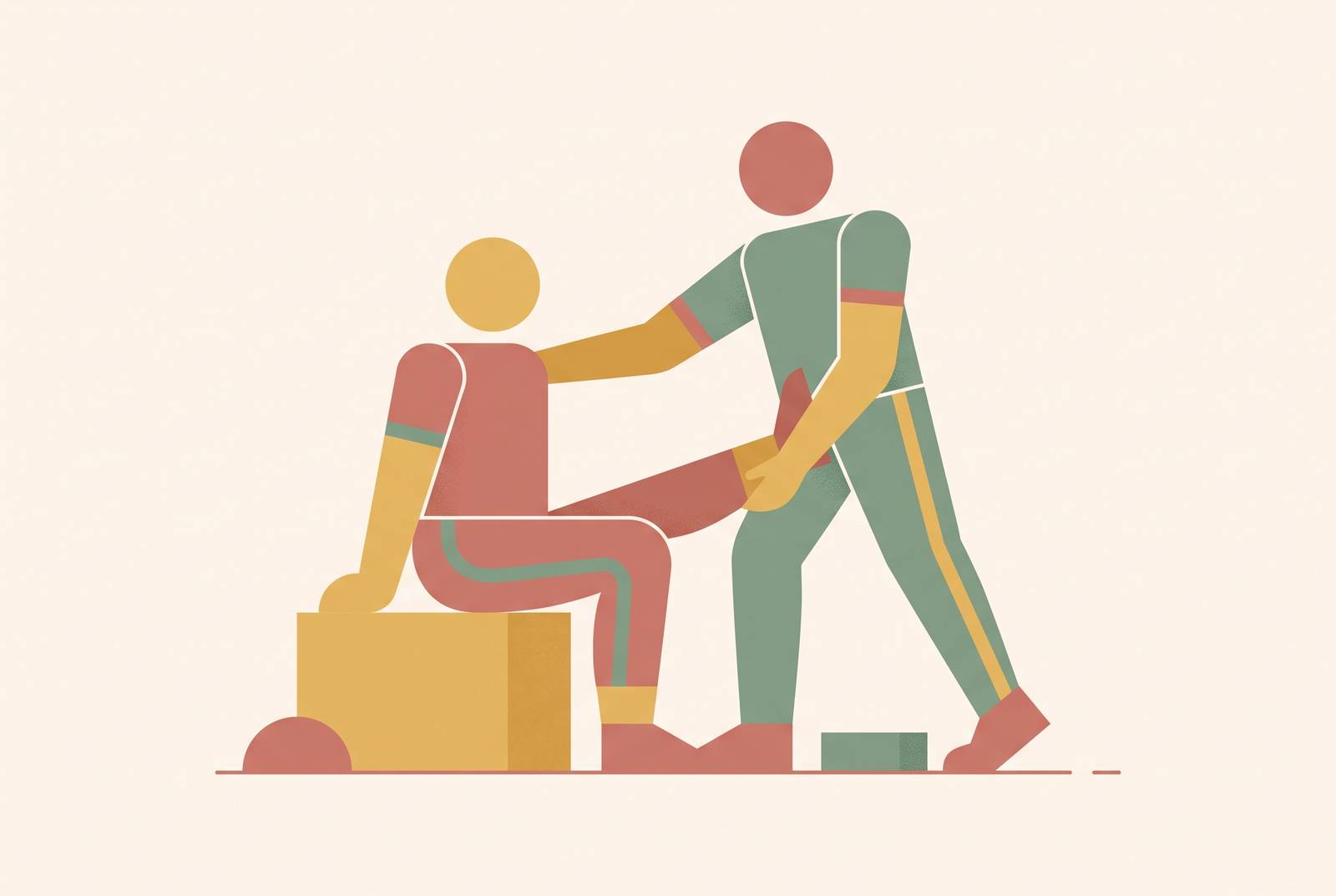
For any real injury risk, the evidence supports bringing in a trainer or physical therapist to help design the shared framework. For any real injury risk, bringing in a trainer or physical therapist to help design the shared framework is worth the cost, even if they're not standing there for every single session.
Movement formats that naturally accommodate two different bodies
Some formats build the equalizing in on their own, so you don't have to fight the format to keep two people on the same page.
Aquatic exercise. Water buoyancy cuts joint load while still giving resistance, so both people get the same forgiving environment regardless of where they started. A 2023 meta-analysis of 32 randomized controlled trials, 2,200 participants total, found real short-term benefit for chronic musculoskeletal pain, and for knee osteoarthritis specifically, the benefit held for at least three months after the program ended. A pool is one of the only places the more mobile partner physically cannot just speed ahead, since the water does the equalizing for you.
Tai chi and slow-flow movement. Slow, connected sequences build balance, flexibility, and joint health, with no floor work and no impact. Both partners follow the same sequence; the less mobile partner adjusts range, not the movement itself. Especially useful when balance or a lower-body limitation is the main concern.
Resistance band circuits. Load is fully adjustable, can be done seated or standing, and bands go easy on joints by design. Paired work, partner-anchored rows, a shared band stretch, builds the conjunctive structure in automatically. A repeatable shared setup looks like shoulder presses, bicep curls, tricep extensions, two to three sets of 8 to 12 reps.
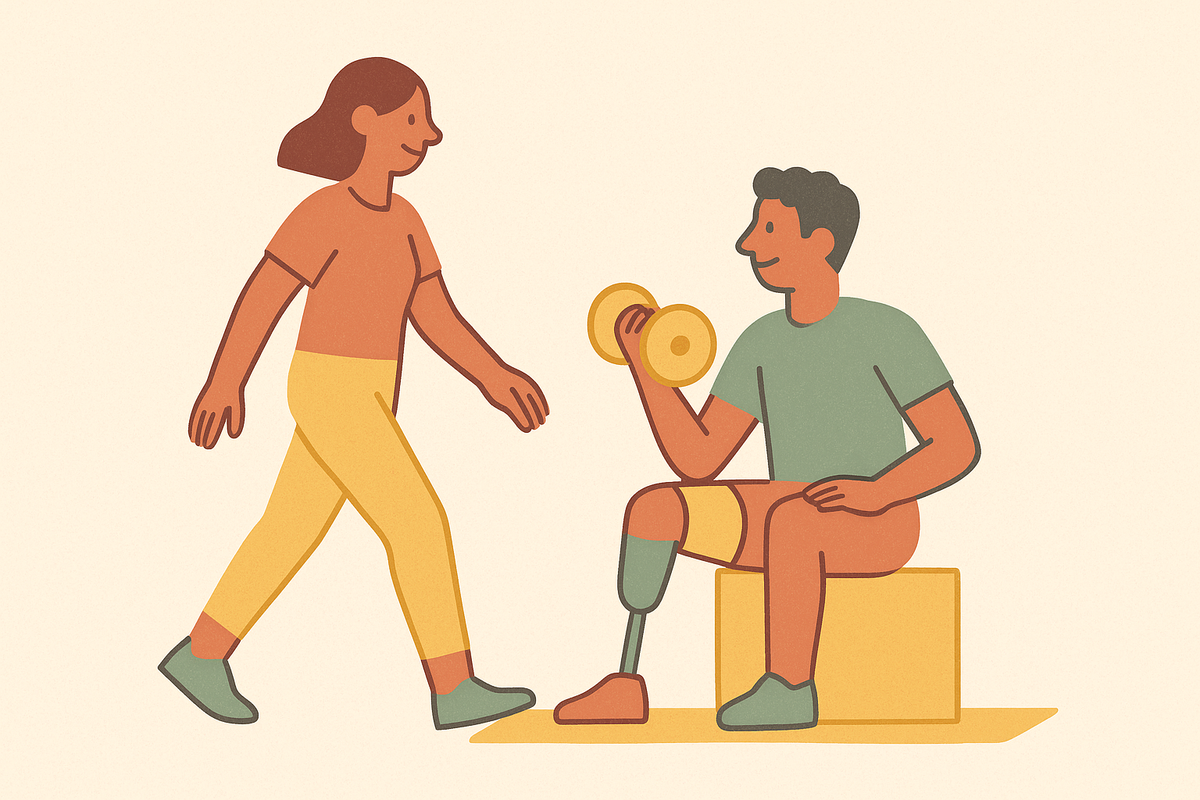
Chair-based and seated upper-body work. Seated arm curls, chair yoga, seated leg lifts, all doable with limited mobility or balance trouble. The more mobile partner does the same movements with more resistance or a slower tempo, so it's the same exercise with a different load.
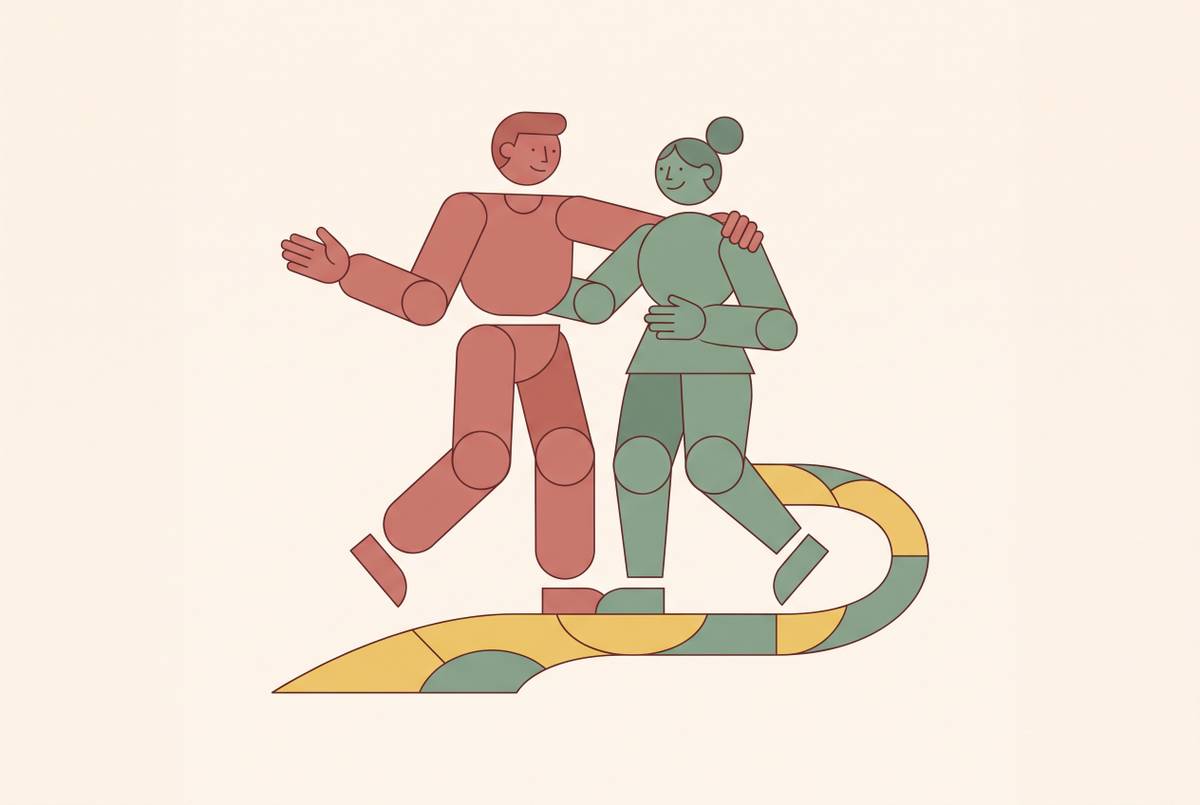
Walking at a shared pace. Costs nothing, adapts to almost anything, and works best when the partner with less mobility sets pace and route. Buddy-system walking is widely recognized as a real driver of activity for adults with disabilities. The mobile partner's whole job here is to show up and not walk ahead.
What the more mobile partner actually contributes by slowing down
Slowing down feels like giving something up, but it functions instead as the design choice that keeps both people showing up next week.
Research on disability and exercise consistently finds social support is one of the biggest drivers of whether someone with a disability stays active. The partner's presence matters more than any detail of the program itself.
The mobile partner gets something back too: session consistency, the pull of a shared goal, and that relationship payoff from the 2021 JSPR study mentioned earlier, where both partners reported higher satisfaction on shared workout days.
Staying challenged without breaking the shared format usually comes down to small additions rather than separate exercises. Add a balance element to any standing move the other partner is doing seated. Slow the tempo down, since controlled, slower reps increase time under tension without changing the movement at all. Take the anchor position in band work, which demands sustained effort the whole time through.
Same pool class, same walking loop, same band circuit, side by side. These are rituals, the kind that hold a relationship together in ways a personal record never will. The best workout plan is the one both people actually keep doing. A session the fitter partner finds almost too easy but sticks with beats the perfect solo program that got quietly abandoned six weeks in, every time.
Keeping the habit going when progress looks different for each person
Progress won't match up between two people, and that's fine to accept from the start. The less mobile partner might see real, measurable gains within that 6 to 8 week window mentioned earlier, while the more mobile partner started from a higher baseline, so their curve looks flatter by comparison. Celebrate both anyway, since comparing them is a losing game for everyone involved.
Setbacks are structural, not personal failures. A flare-up, a follow-up appointment after surgery, a rough pain week, plan for these ahead of time so they don't become the moment the whole habit collapses.
Simple goals beat detailed tracking almost every time. "We showed up three times this week" is a target both people can hit, regardless of what either person's actual session looked like. A photo after each workout, a shared log, some small reward for a streak, these reinforce the partnership, not the performance.
The Köhler effect doesn't switch off after week one, either. As the less mobile partner improves, the gap narrows, and the session shifts with it. The target stays the same though: one shared format, adjusted as both people change, not two separate programs slowly drifting apart from each other.
Missing a session calls for a short conversation, not a whole ordeal: what got in the way, what changes next time. That keeps the pair looking toward the next session instead of stewing over the one that got missed. Plenty of simple tracking tools let each partner log their own workout while still seeing the other's consistency, and the connection is what keeps the whole thing running, more than the numbers on the screen.