Best Apps for Couples to Track Workouts and Hold Each Other Accountable for Fitness Goals
Shared accountability keeps couples showing up for workouts that solo trackers can't.
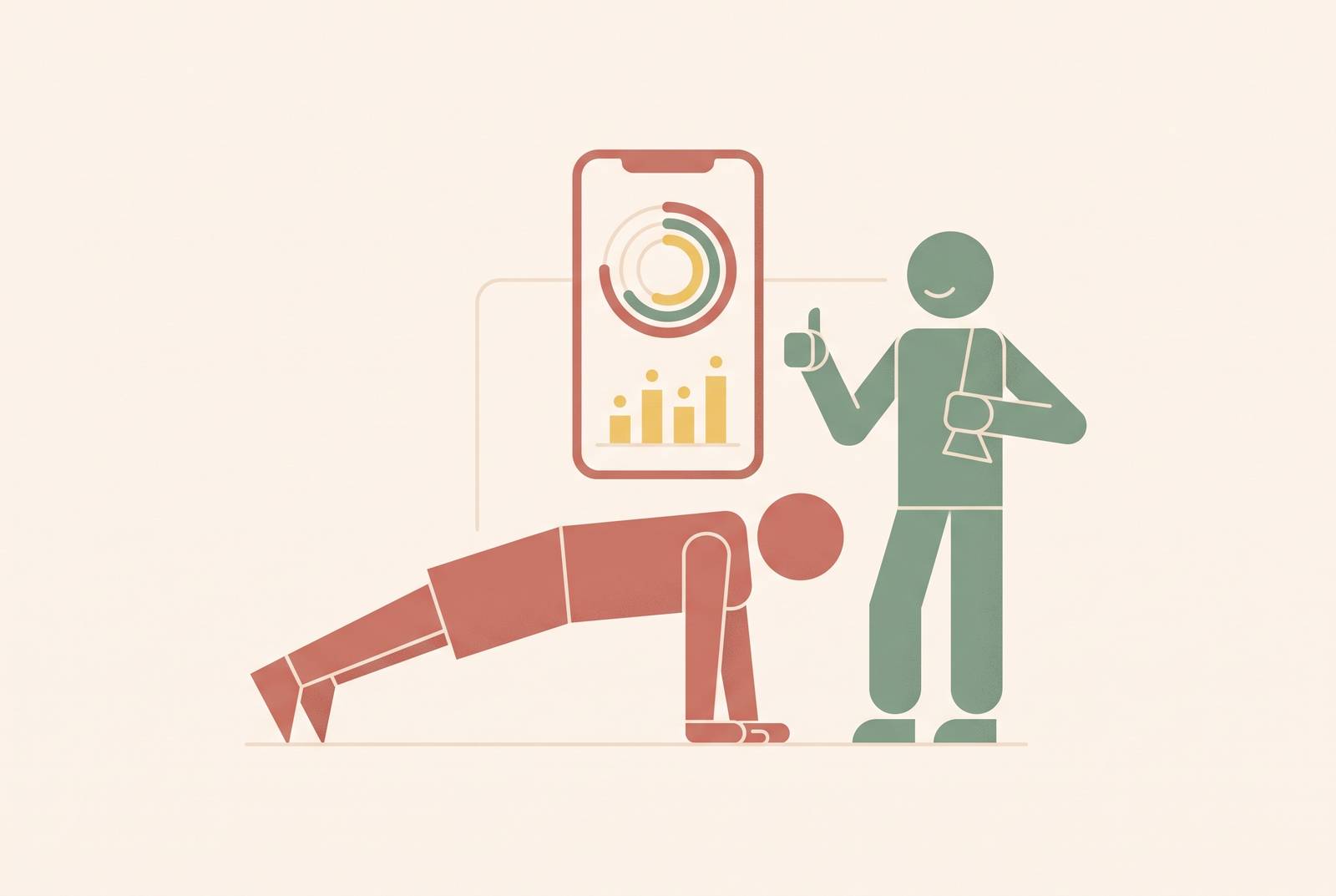
The best fitness app for couples right now is Sweatmates, built around weekly goals, photo-based check-ins, and light stakes like dinner duty or a chore if you miss your target. It's rated 4.8 stars on Google Play. Fitness Pact, Hevy, Habit Huddle, and HabitShare round out the field, along with a competition-based app for couples who want a scoreboard, each solving a different reason couples stop showing up for each other at the gym. Picking the right one depends less on features and more on diagnosing why your workouts fall apart.
Why couples who exercise together stay consistent
Couples who train together stick with it longer than people who go it alone, and that's not about one partner cheering the other on from the sidelines. It's structural. Once a workout involves another person, skipping it becomes a social matter rather than a private one, since a partner can notice.
Three things are doing the work here. First, visibility: when your partner can actually see whether you showed up, you tend to show up more, because effort becomes visible the moment it happens. Second, skipping gets expensive in a social sense. A missed workout used to just be a missed workout. Now it's a missed workout your partner noticed. Third, light stakes beat vague intentions every time. Behavioral research calls this loss aversion. People work harder to avoid a small, defined penalty (say, you owe your partner dinner) than they ever will to chase a fuzzy goal like "try to be better about the gym." Putting a chore on the line makes Tuesday's workout no longer optional.
Shared visibility, the social cost of skipping, and light stakes. Those are the three levers a good couples fitness app is built to pull.
Why most fitness apps fail couples
Most fitness apps were built for one person at a time. The social features got added later, bolted on top of a tool designed for a solo runner or lifter logging sets for themselves. The accountability piece gets built in as an afterthought once the social features are bolted on.
A typical tracking app hands you charts, streaks, personal records, your own little dashboard of self-improvement. Your partner gets a summary if they bother to follow you, not a real-time signal of whether you actually got off the couch today. That's a problem, because a weekly recap has no teeth. If your partner finds out on Sunday that you skipped Tuesday, Tuesday already happened. The social cost arrived five days too late to change anything.
This has split the market into two camps. One kind of app asks a simple question, did you show up today, and makes the answer visible immediately. The other kind tracks performance in detail and tacks on a social feed as a bonus. Neither approach is wrong, but they solve different problems. A couple that skips workouts because they have no structure needs programming and coaching. A couple that skips because nobody's paying attention needs visibility. Picking the wrong one is like bringing a treadmill to a sword fight: the tool works fine, but it's not built for what's happening.
Sweatmates: built around the three mechanisms that keep couples consistent
Sweatmates takes the three mechanisms above, shared visibility, the social cost of skipping, light stakes, and builds the whole app around them.
The mechanics are simple on purpose. Partners set a weekly goal together, choosing how many days a week they want to work out. Every workout gets logged with a photo through a feature called SweatCam, so the other partner sees it the moment it happens, not at the end of the week. Both people watch the week unfold together in real time, as it happens. Missing the weekly goal puts a small wager on the line, buying dinner, doing a chore, something light enough to sting a little without turning fitness into a punishment.
The photo logging is the detail that makes the whole thing click. A picture of your partner mid-workout carries more weight than a number on a chart, because it turns "they probably worked out" into "there they are, sweating, at 6 a.m." That's a different kind of proof. The weekly goal structure also doesn't demand identical routines, the same gym, or the same fitness level. One partner can run, the other can lift, and the system still works, because the goal is showing up, not matching stats. The wager stays small and a little playful by design. It's meant to produce a shrug and a laugh, not a fight about who let the team down.
A few Google Play reviews mention a subscription requirement that only appears after setup is finished, so it's worth checking before committing. Beyond that, Sweatmates holds a 4.8-star rating on Google Play, and the simplicity isn't a limitation so much as the entire point: fewer settings to fuss over means less room to hide from the goal.
Fitness Pact: when couples want explicit, agreed-upon consequences baked into the app
Fitness Pact is built for couples who want the stakes written down in plain language before the week even starts. Each person picks their own workout and frequency, independent of the other, and both sides agree on a payoff or punishment if either one fails to follow through. The app keeps the record, so nobody's relying on memory or an honor system.
According to its App Store listing, partners don't need to do the same workouts, train in the same place, or even live in the same city. The app builds a group feed automatically, so there's somewhere to check in, celebrate, or rib each other a little after each logged session. It's fun-first by design. The focus sits on tracking the pact itself, keeping statistics to a minimum.
Fitness Pact suits couples who want a defined, time-bound commitment with a specific consequence attached, rather than an open-ended weekly habit that just keeps rolling. Compared to Sweatmates, the stakes run heavier and more explicit, which some couples find motivating and others find stressful. It also only runs on iOS, so a mixed-device couple needs to check compatibility before getting attached to the idea.
GymRats: when couples want time-boxed competition with a scoring system
GymRats turns fitness into a contest with a start date, an end date, and a scoreboard. One partner sets up a challenge and chooses how it's scored, by workout count, minutes, miles, calories, steps, or a custom point system, and both partners post their sessions to a shared feed for the length of the challenge.
Photos sit at the center of that feed, much like Sweatmates's SweatCam feature, wrapped in a competitive frame. The six-week challenge format with a built-in end date works well for couples who respond better to "we're competing until this date" than to a habit that never technically finishes.
The trade-off is the same one that comes with any competition: a scoreboard that motivates one partner can demoralize the other. If one person pulls ahead early, the leaderboard stops feeling like a game and starts feeling like a scoreboard for who's winning the relationship, which is not a fun dynamic. Scoring by effort (sessions or minutes) keeps things fairer across different fitness levels than scoring by raw performance (miles or calories), since a beginner and a marathoner logging the same minutes look a lot more equal than a beginner and a marathoner logging the same miles. Check platform availability before signing up, since some configurations are iPhone only.
Hevy: for couples whose shared fitness is built around strength training and training logs
Hevy is built for couples who lift, and who want their partner to see the actual training, not just a thumbs-up that a workout happened. Each partner can follow the other, share full workout logs, and see what weights and reps the other one is hitting.
JEFIT's 2026 review of workout apps points out that Hevy pairs serious logging with a social layer most lifting apps skip entirely, letting users follow training partners and see what they're lifting session by session. The free tier works but comes capped: four routines, seven custom exercises, three months of history. A paid upgrade unlocks more, available as a monthly plan, an annual plan, or a one-time lifetime purchase, and the app runs on both iOS and Android.
The accountability here comes from transparency about the actual training, not just a check-in. Knowing your partner can see your full session log creates a different kind of pressure than a quick photo does. Hevy fits couples who already run their own lifting programs and want a real training partner, not just someone keeping score on attendance. Compared to Sweatmates, Hevy goes deeper on training data and narrower on scope. It's a strong fit for strength training specifically, and it only works as accountability if both partners actually log in and use it.
Habit Huddle and HabitShare: when couples want shared accountability around fitness as one habit among several
Some couples don't want a dedicated workout app. They want one shared system that holds the gym habit alongside reading more, drinking water, or whatever else they're trying to keep up with together. Habit Huddle and HabitShare both serve that need, though they're being developed at different speeds.
Habit Huddle runs on iOS, Android, web, and even Discord. Each huddle tracks one habit, with one check-in a day and a shared Checkin Chain everyone in the huddle can see. Every habit gets a Floor, the bare minimum that still counts on a rough day, and a Ceiling, the stretch version for a good one. A day where you barely cleared the Floor still counts as showing up, which fits the idea that a missed goal should prompt a shrug and a reset, not a guilt trip.
Both apps lean on a shared, live tracker where partners see each other's check-ins as they happen, which works well for short challenges and couples who genuinely want that visibility. Neither app is built specifically for fitness, and that's the trade-off. The accountability sits at the habit level, did you check in today, rather than the workout level, here's a photo from the gym floor. That's enough detail for some couples and not nearly enough for others. HabitShare is the more stable, free option of the two, though it isn't picking up new features anytime soon, while Habit Huddle is still actively being built out and comes with a gentler way of handling missed days.
Matching the App to Why Your Couple Skips Workouts
The best app is the one aimed at the actual reason your workouts keep falling apart, and that reason is different for every couple.
A couple that skips because the habit never feels like it counts, because nobody's checking, does best with something like Sweatmates, where a quick workout photo makes effort visible the moment it happens and the stakes stay light enough to feel like a nudge instead of a scolding. A couple that needs a signed contract with a specific consequence attached does better with Fitness Pact, where the terms get set before the week starts (keeping in mind it's iOS only, so check compatibility first). A couple that needs a scoreboard and a finish line to stay engaged should look at a competition-based app, setting the scoring method to something effort-based, like sessions or minutes, so the competition stays fair even when fitness levels don't match. A couple where one partner can't actually see what the other is training does better with Hevy, where the shared training log gives a real window into the work, not just a confirmation that it happened. And a couple juggling fitness as one habit among several, alongside drinking more water or reading before bed, fits better with Habit Huddle for ongoing development and a kinder approach to missed days, or HabitShare for a free, stable option that isn't likely to add much more than it already offers.
Every one of these tools, regardless of which failure mode it's solving for, works the same basic trick: it gives your partner some signal, in real time, that you actually showed up today. Not a weekly summary. Not a vague sense that things are probably fine. A visible, immediate answer to the one question that actually keeps people consistent: did you do the thing?