Building a Shared Fitness Routine Across Different Time Zones
Partners who sync their fitness matter less than partners who sync their system.

Working out with a partner across time zones is not a scheduling puzzle. It is a design problem: you're trying to build one shared habit out of two separate bodies, two separate clocks, and roughly zero overlap on a bad week. The couples who pull this off don't share a workout time. They share a system.
That distinction matters more than it sounds like it should. Physical distance alone is manageable, plenty of long-distance relationships prove that. What breaks people is physical distance stacked on top of temporal distance: one partner is buzzing with post-coffee energy while the other is three sentences from falling asleep mid-text. Add in the emotional lopsidedness (one person wants a shared sweat session, the other has ten minutes and a Slack notification) and a missed workout invite starts to feel less like a scheduling miss and more like a shrug. Silence that would be nothing in the same city starts to read as distance in a long-distance one.
And this isn't a niche problem anymore. Remote and hybrid work turned "different time zones, same relationship" from an edge case into a Tuesday. Gallup's 2025 hybrid work analysis found that among remote-capable U.S. workers, 28% are fully remote and 51% are hybrid, meaning most people with the option to work from anywhere are, at least partly, doing exactly that. That's a lot of couples negotiating fitness across a gap that didn't exist for their parents' generation.
It's also not just a relationship problem. It's a body problem. A 2025 systematic review found that working from home adds more than half an hour of daily sitting time and cuts step counts by over 2,500 steps a day. That's the sedentary drift a shared routine is supposed to interrupt, except the routine is exactly the thing time zones make hardest to hold onto. And the stakes go beyond fitness: Gallup's 2025 State of the Global Workplace report found 25% of fully remote workers report daily loneliness, compared to 16% of on-site workers. A shared workout isn't just about steps. It's one of the few remaining excuses to feel like a team.
What the research actually shows about working out with a partner
Here's the part that should change how anyone thinks about this. A 1995 study in the Journal of Sports Medicine and Physical Fitness tracked married couples who joined a fitness program together against people who joined solo. Over 12 months, only 6.3% of the couples dropped out. Solo joiners dropped out at a rate of 43%. That's not a small edge. That's the difference between a habit and a New Year's resolution.
More recent research backs this up with better instrumentation. The BE FIT randomized clinical trial, published by Patel and colleagues in JAMA Internal Medicine in 2017, put 200 adults across 94 families into a gamified team step challenge. The gamified group hit their daily step goals on 53% of days. The control group managed 32%. That gap translated to roughly 1,000 more steps a day than baseline, just from turning movement into something shared and scored.
Then there's the Köhler Effect, studied at Michigan State University by Deborah Feltz, which might be the most useful finding in this whole conversation. Working out with a partner, even a virtual one who is nowhere near you physically, boosts motivation. The less capable partner in a pairing tends to outperform their own solo baseline, driven by the social dynamics of feeling accountable to someone else and being part of a team. Nobody needs to be in the room for that mechanism to fire. They just need to feel like they matter to the outcome.
A 2025 workplace wellness study found that 49% of employees identify peer encouragement as the primary driver of their engagement with wellness initiatives. The app matters less than the person checking in on you.
None of this research depended on co-located gyms. Virtual formats have produced meaningful adherence bumps and motivation lifts in the research reviewed. Which means the mechanism that makes partner fitness work was never "be in the same room." It was always visibility, shared stakes, and a structure where both people's effort actually counts toward something. Time zones don't break that mechanism. They just mean you have to build it on purpose instead of getting it for free.
The synchronous-versus-asynchronous choice most partners never consciously make
Most pairs never actually decide how they want to train together. They just default into synchronous, because that's what "working out together" sounds like, and then wonder why it's falling apart by week three.
Synchronous workouts, both people live on a call, same class, same start time, have real upside. There's immediate accountability. There's a shared experience instead of two parallel ones. It doubles as relationship time. But it needs a usable overlap window, and for some pairs that window is thin, unpredictable, or basically theatrical. Sydney and Toronto, for instance, don't have a convenient overlap no matter how creatively you juggle the calendar. Force it anyway and you get the familiar failure mode: one partner sets a 6 a.m. alarm to catch the other's evening session, feels heroic for about two weeks, then quietly stops setting the alarm. Nobody announces the surrender. It just happens.
Asynchronous workouts flip the model. Each person trains whenever their day actually allows it, and the connection lives in what gets shared afterward rather than in simultaneous sweating. Team-based fitness challenges tend to have strong participation among distributed groups precisely because of this: one partner logs a sunrise run, the other logs an evening walk, and both feed the same shared goal without ever syncing clocks. Sending a recorded session for a form check or a quick "look what I did" is asynchronous by nature and doesn't care what time zone anyone's in.
Most pairs land somewhere in the middle, and that's probably the right call: one or two live sessions a week when the overlap genuinely exists, with daily asynchronous touchpoints filling in the rest. What ties it together, sync or async, is shared programming. Following the identical plan gives both people the same reference points, the same inside jokes about leg day, even if they never train at the same hour. The couples who struggle aren't the ones who chose asynchronous. They're the ones who never chose anything, and ended up oscillating between forced 6 a.m. calls and weeks of total silence.
Finding the overlap window, and what to do when it barely exists
Before assuming there's no overlap, map both full days, not just the 9-to-5. Sleep, commute, family duties, the hour after work when one partner is a puddle and the other is finally alert: all of it shapes which windows are actually usable versus technically available on paper.
Being awake is not the same as being present. A window where both people are conscious but too fried to connect doesn't count. What you're hunting for is a slot where both people have something left in the tank.
For a lot of pairs, that slot is small. An hour on weekday evenings, maybe. More room on weekends. Nothing at all on certain days. Naming that precisely, out loud, in a shared doc or a two-minute conversation, does more good than it sounds like it should. Vague expectations are what make silence feel like rejection. Specific expectations turn silence into "oh right, they're at work."
Rather than chasing daily synchrony, protect one or two anchor moments a week: a predictable midweek check-in and something a bit longer on the weekend. That's enough to keep the relationship from feeling like it runs entirely on hope. Structure, in this context, isn't the enemy of spontaneity. It's what makes spontaneity survivable, because when both people know the next real session is locked in, the gaps between don't feel like withdrawal, they just feel like Tuesday.
A shared calendar or a basic time-zone overlap tool takes the recurring "wait, what time is it for you again?" negotiation off the table. And when the overlap is genuinely close to nothing, the honest move is accepting that asynchronous is the main event and synchronous is the bonus round, not the other way around. The weekly workout session, notably, makes a great first anchor to schedule. It has a clear start, a clear finish, and an automatic topic of conversation the moment it's over.
Asynchronous rituals that make separate workouts feel like a shared project
The single most useful asynchronous tool is embarrassingly simple: a photo. A sweaty, post-workout, no-filter photo sent right after a session collapses hours of time difference into one moment of "I see you, you did the thing." The sender gets accountability the second they hit send. The receiver gets proof of effort, even if they open it eight hours later over coffee.
Voice notes do something text can't. Hearing an actual voice, groggy in the morning or wired after a run, carries more warmth than a paragraph of typing, and it needs zero coordination to send or receive.
Shared training logs add a layer of low-effort commentary. Apps built for logging lifts or runs let both partners see each other's sessions and drop a comment or a reaction whenever they get to it, which does the same social work a shared gym used to do, just spread across time zones instead of squares of rubber flooring.
Monthly challenges built around consistency (most sessions completed, longest streak, total miles) give the relationship a shared scoreboard. The specific metric barely matters. What matters is that individual effort suddenly counts toward something joint. Pair that with a low-stakes wager (loser buys dinner, loser does the dishes for a week) and accountability gets a bit of teeth without turning into surveillance. The bet settles at the end of the week no matter when each person actually trained.
A running shared album or a simple shared notes doc, where photos and small wins pile up over months, turns into an accidental diary. Revisiting it later is its own kind of motivation. And a collaborative playlist, one partner building it for the other to use mid-workout, is presence without needing to be present. Milestones deserve the same asynchronous treatment as daily check-ins: a personal record or a finished training block is worth celebrating even if the message arrives six hours late. The design rule underneath all of it: make the ritual cheap to complete and loud in its visibility. Low effort to send, impossible to miss on the other end.
Running the same programme when you cannot run at the same time
Following the exact same training plan, same push-pull-legs split, same running schedule, gives two people who never train together a shared vocabulary anyway. Both know what day three of the block felt like. Both know which lift had a sticking point this week. Both know why Tuesday's session was somehow harder than Monday's, even though it looked easier on paper.
That shared vocabulary solves a problem that sneaks up on distance relationships: running out of things to talk about that aren't logistics or complaints. Fitness gives an evergreen topic. Comparing form, discussing a plateau, celebrating a finished week, none of it needs real-time delivery, and all of it lands better when both people are actually doing the same programme.
Pairing that with a forward-looking goal, a race to run together eventually, a strength number to hit before the next visit, a plan to finish by a set date, keeps the relationship pointed at something ahead instead of dwelling on the gap right now.
The real risk with shared programming is mismatch. One partner finds the plan laughably easy. The other is barely surviving it. Within a couple of weeks, someone feels guilty, someone feels condescended to, and the whole plan dies quietly. That's not a motivation failure. That's a design failure, and it's fixable: programmes that keep the same movement pattern but scale the load or intensity per person let both people train "the same workout" while actually training at their own level. Apps that adjust each session automatically based on individual strength and experience can put two very different athletes on the same plan without either one carrying the other. Same conversation, different weights on the bar.
Tools that support cross-timezone fitness without demanding perfect timing
No single app solves this on its own, but a few categories of tools make the asynchronous model easier to actually run day to day.
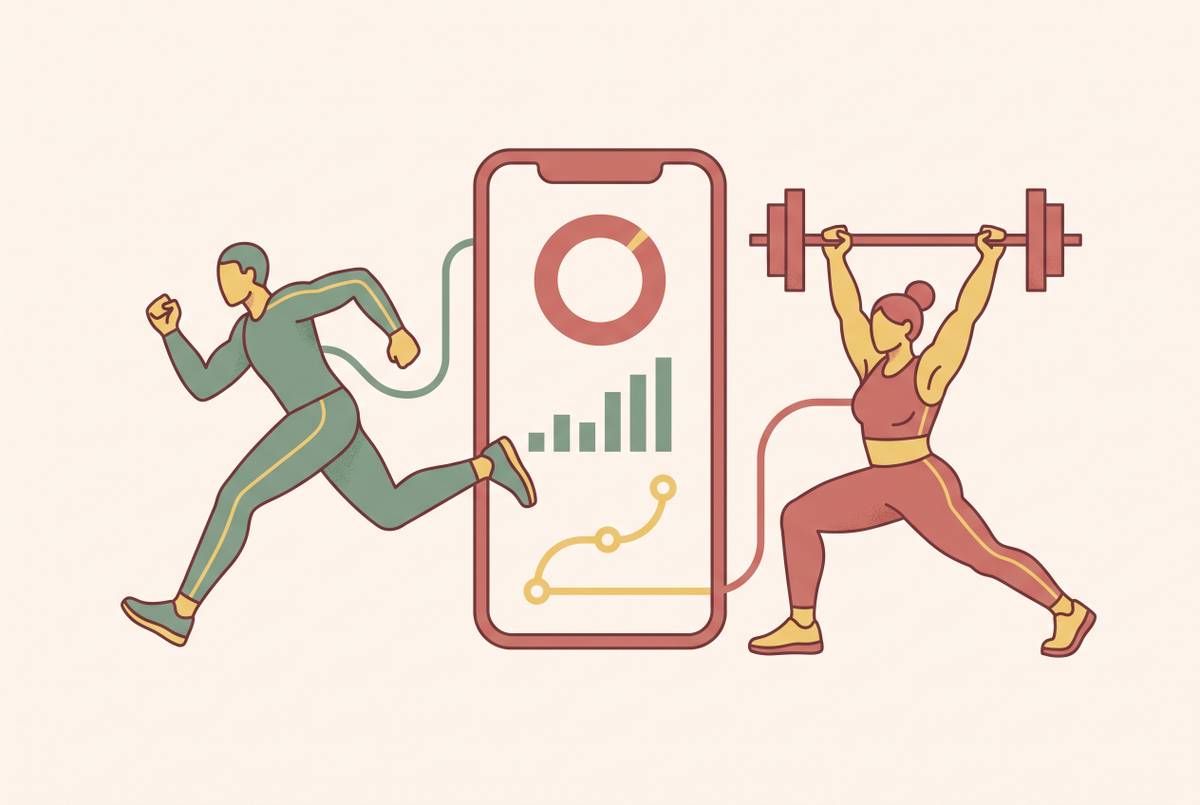
Purpose-built partner fitness apps skip the broad social network entirely and design around the two-person relationship from the start. Photo-based check-ins, where a workout gets logged alongside a picture the partner can see, create exactly the kind of visibility the older adherence research points to. Weekly goal structures (three sessions, one shared check-in, a photo per training day) tend to survive real life better than dense metric dashboards nobody has time to read. Light wagers, a small forfeit for missing the weekly goal, add just enough accountability without turning the relationship into a surveillance project. Sweatmates, a fitness accountability app for couples built around shared workout tracking, photo check-ins, and weekly goals with optional wagers, is one example of this model. The whole point of tools like this is that two people can train at completely separate hours and still feel like they showed up for each other.
Strength-logging apps that track sets, reps, and load in detail give partners on the same programme a way to compare notes without needing to compare schedules. One person logs Tuesday's session at 6 a.m., the other logs the same session at 9 p.m., and the comparison happens whenever both get a free minute.
For pairs who'd rather not add another app to the pile, a shared notes document works fine. Each partner logs a quick line, "20-minute walk, done" or "finished week three", whenever their day allows it. Updating on your own schedule isn't a workaround here. It's the actual feature.
Asynchronous video messaging tools fill the gap text can't reach. A short video recorded after a workout, watched by the partner when they wake up hours later, carries more warmth than a text and doubles as a coaching tool: record a lift, send it, get feedback on form once the other person's awake. Whatever tool gets picked, the deciding factor isn't feature depth. It's whether both people will actually keep opening it. A simple app used daily beats a powerful one used once.
Habit formation timelines and why the first two months are the riskiest
New habits start taking shape within weeks, but full automaticity, the point where a workout feels less like a decision and more like brushing your teeth, usually takes somewhere between two and five months, sometimes longer. Knowing that upfront matters, because a rough first month gets misread constantly as proof the whole arrangement doesn't work, when really it's just what month one always feels like.
Three things drive whether a habit sticks: repetition, environmental stability, and whether the person actually enjoys doing it. All three take a hit across time zones, which is exactly why the rituals and shared programming from earlier sections aren't just nice extras. They're load-bearing.
The first few weeks carry the highest dropout risk by a wide margin. Everything is still new, the rituals still feel like effort instead of instinct, and any disruption, a work trip, a rough week, a cold, can snap the chain before it's had time to become automatic. The real danger isn't the missed session itself. It's the guilt spiral that follows it, the one where a single skipped Tuesday turns into "well, I already ruined the week" and then quietly turns into ruining the month. One missed workout is a rounding error. The story someone tells themselves about it is what actually does the damage.
Simple weekly goals, three sessions logged, one live check-in, a photo on training days, bounce back from disruption far more easily than elaborate tracking systems, because there's less to rebuild after a bad week. And predictability itself acts as a stabilizer: when both partners already know the rhythm, one rough week doesn't spiral into doubt about whether the whole thing is still on. It just becomes the week they get back to it next Monday.