How Fitness Becomes a Stress Outlet for Couples During Engagement
Shared workouts offer couples a stress-free zone where wedding pressure dissolves.
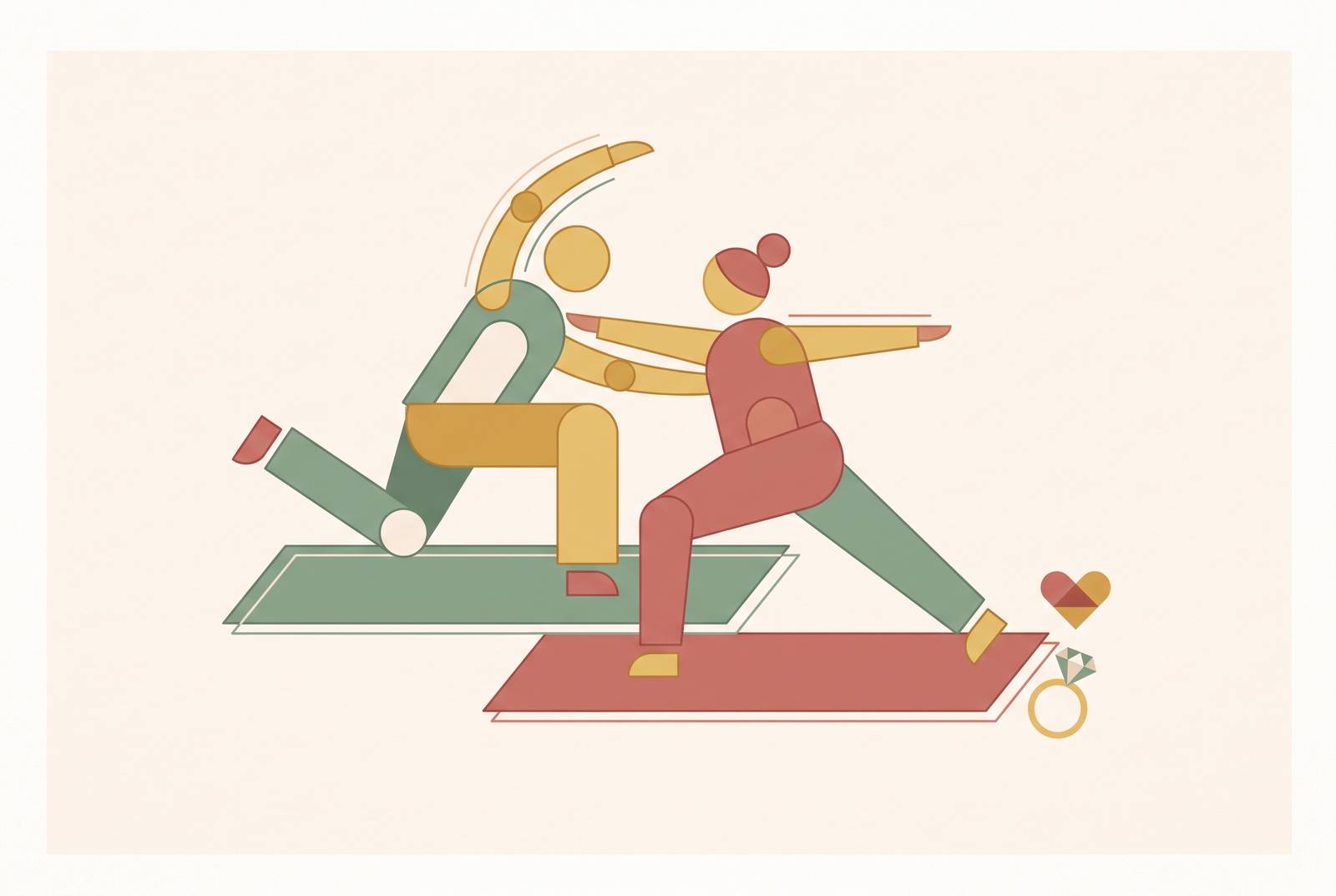
Wedding planning is stressful. Not "a little tense," not "occasionally overwhelming," but stressful in a way that's now well documented and nearly universal. Zola's survey put it plainly: 96% of couples called planning stressful, and 40% said extremely so. The fix that keeps showing up in the data doesn't require hiring anyone or spending a dime: working out together, on purpose, on a schedule that survives contact with real life.
Forty-three percent of couples in that same Zola survey said planning strained their relationship. That's basically half of engaged couples in the country admitting the process is chipping away at the thing it's supposed to celebrate.
The stress doesn't stay in the abstract, either. It shows up as insomnia, mood swings, a lower sex drive, headaches that won't quit. These are physical symptoms, not just emotional ones, and they land in daily life together, not in some private diary only one partner reads.
Time makes it worse. A 2026 real weddings study, based on 10,474 couples married in 2025, found the average engagement now runs 15 months. That's over a year of sustained planning, a part-time job nobody applied for, layered on top of actual jobs, families, and whatever social life survives the guest-list spreadsheet. Add in the average wedding cost of $33,000 (Zola, 2024) and every decision gets a financial subplot attached to it.
None of this is a character flaw. Nobody's "bad at planning" because a florist ghosted them or an aunt weighed in uninvited on the seating chart. The stress is structural. It comes with the calendar and the price tag, and it builds up in the relationship whether a couple names it or not.
What chronic engagement stress does to a couple's connection if it goes unaddressed
Stress doesn't stay inside one person's head. It leaks into how partners talk to each other, shortening fuses and shrinking patience reserves that used to feel bottomless.
Decision fatigue is the quiet culprit. Vendor calls, family opinions, budget math, none of it stops, and it bleeds into conversations that have nothing to do with the wedding. Someone snaps about dishes. Someone goes quiet during dinner. Neither of those things is really about dishes or dinner.
The season built to celebrate a relationship is, more often than not, the season most likely to wear it down. Relationship counselors flag this regularly, and they're not talking about looking good in photos. They're talking about protecting the connection itself during a stretch with unusually high attrition risk.
Here's where most couples get it backwards: they treat stress as something each partner should manage on their own time, quietly, so it doesn't become "a whole thing." If one partner starts scrolling for hours and the other starts working late just to dodge the seating chart conversation, that's two people coping separately in the same house. Two solo coping mechanisms running in parallel don't add up to relief. They add up to distance. Engagement needs one thing both people show up for, together, on purpose, or the stress just finds two separate outlets instead of one shared one.
Why exercise is one of the most reliable tools for processing stress at the physiological level
The mechanism is straightforward. Exercise lowers adrenaline and cortisol while raising endorphin production, and per Harvard Health, those endorphins act as the body's own painkillers and mood lifters. That's chemistry, not a metaphor.
Exercise is itself a stressor, worth sitting with for a second. Heart rate spikes, muscles strain, the body registers exertion as a threat in the short term. The net effect over time runs the other direction, though: regular exercisers show cortisol responses to stressful events that run 20 to 30% lower than sedentary people's, a kind of built-up armor against whatever the day throws next.
A 2026 clinical trial out of the University of Pittsburgh and AdventHealth backs this with something sturdier than correlation. Participants doing 150 minutes of moderate to vigorous aerobic activity weekly, sustained over a full year, showed a real, measurable drop in long-term cortisol levels. That's causal evidence, not a hunch dressed up in a lab coat.
Yoga deserves a specific callout, since it's often the entry point for couples who've never worked out together before. A 2025 systematic review and network meta-analysis, covering 44 studies out of Wuhan Sports University and Beijing Sport University, found yoga produced the largest cortisol-reduction effect of any exercise type studied (SMD of -0.59, SUCRA of 93%), ahead of running, weightlifting, and everything else on the list. A clinical psychologist told a publication that cardiovascular exercise "raises the threshold of reactivity to a social stressor." Translated: a body that exercises regularly doesn't go straight to panic when a caterer cancels three weeks out.
What research says about couples who work out together specifically
A university study published in a family relations journal in August 2026, drawing on 1,693 couples across the country, found that couples who exercise together show stronger ties to good marital communication and lower conflict than couples who exercise apart. The fine print matters here, though: the gap between exercising together and exercising separately wasn't statistically significant. The correlation holds, but nobody's proven the togetherness itself is doing the causing, and that distinction is worth keeping straight instead of rounding up to something tidier.
Walking won top billing as the exercise couples actually choose to do together, according to that same release, which is a fairly unglamorous winner. No membership required, no equipment, no elaborate gear. Just two people and a sidewalk, and somehow that beats every fancier option on the list.
An earlier study (Sackett-Fox et al., 2021, Journal of Social and Personal Relationships, 95 undergraduates) found that working out with a partner tracked with better mood during the workout, better mood for the rest of the day, and higher relationship satisfaction overall. The sample skews young and narrow, college students mostly, so treat it as a data point, not gospel.
There's a neurochemical layer too. Shared physical activity raises oxytocin, the so-called bonding hormone, and a jointly raised heart rate mimics the physical state the body enters during emotional closeness. Lab research on "nonverbal mimicry" (matching pace on a walk, passing a medicine ball back and forth) shows synchronized movement builds emotional attunement. Couples who do it report feeling more in love and more satisfied afterward. The real story here is about facing stress together." It's rebuilding the sense of being on the same team, which is a different mechanism entirely, and the one actually worth chasing.
How fitness creates a protected space inside engagement that planning can't touch
Call it the wedding-free zone. A scheduled workout is one of the only blocks on the calendar that belongs to the couple, not to the vendors, the guest list, or the group chat with two mothers-in-law arguing about centerpieces.
Bespoke Bride documented one bride, in August 2026, who started walking her fiancé's dog with him every evening for exactly one reason: twenty minutes with zero spreadsheet talk. She called it the calmest part of her whole engagement, which says something when you weigh it against everything else competing for that title.
The mental break isn't just a nice feeling. Stepping away from planning and coming back with a clearer head beats grinding through the fatigue until something snaps. Research in the Journal of Sport and Exercise Psychology backs the accountability angle too: people stick with exercise longer when a partner is counting on them. Canceling on yourself is easy. Canceling on someone waiting at the door with their sneakers on is a lot harder.
Fitness also hands couples a goal that has nothing to do with the wedding, something they're building together that belongs only to the relationship. The Journal of Personality and Social Psychology backs this up more broadly: couples pursuing shared goals report higher satisfaction and commitment. This is about nurturing the relationship like a genuine priority rather than a spreadsheet line item. It's about protecting it during a season engineered to strain it, and a shared workout is one of the few tools built for exactly that job.
What a realistic shared fitness routine looks like during engagement
Timing matters more than most couples think. Six to nine months out from the wedding gives a routine room to become a habit instead of a scramble. Couples who overhaul everything cold turkey at the six-month mark tend to burn out well before the finish line.
Volume matters too, and less is genuinely more here. Per Bespoke Bride's 2026 guidance, four 25-minute sessions a week consistently outlasts a five-day, hour-long bootcamp that collapses right around week three, which, not coincidentally, is usually when final vendor payments start landing. Thirty minutes a day is also a documented effective threshold (per 9Round and related fitness research), and short sessions matter because "I don't have time" is the single biggest excuse during a planning-heavy week.
A simple weekly shape, per Bespoke Bride's 2026 framework:
- Two to three strength sessions, full-body, scaled to whatever fitness level each partner is actually at
- Two cardio sessions: brisk walks, cycling, swimming, a dance class, low-impact intervals, whatever's repeatable rather than impressive
- One mobility or yoga session, useful for the tension that planning tends to lodge in hips, shoulders, and necks
- One or two recovery days, light walking or stretching, counted as part of the plan, not a failure of it
Partners don't need matching workouts, and chasing identical routines is where a lot of this falls apart. Shared rhythm beats identical output every time. One person running while the other walks still counts as moving together, as long as the clock says the same thing for both.
The Bespoke Bride principle worth repeating: couples who stuck with it kept things "boring on purpose." Same two strength days. Same Sunday walk. Week after week, nothing flashy about it. For couples whose schedules rarely line up, shared-goal apps built around visible progress and light check-ins can keep both partners accountable without requiring them to be in the same room, let alone the same gym. Sweatmates, a fitness accountability app for couples that connects two partners through shared workout tracking, photo check-ins, and weekly goals, sits in that category.
The shift away from "sweating for the wedding" and what it means for how couples start
The old model was bridal bootcamps and "slim down for the gown," fitness sold as a countdown to a single photo op. That framing still exists in the market, and it's the wrong place to start. It treats the body as the project instead of the relationship, and it hands the whole exercise to one partner while the other stands on the sideline holding her water bottle.
The 2025 to 2026 shift moves from "shredding for the wedding" toward what's being called wellness over weight, with couples' challenges gaining ground as the format, fitness as a bonding activity instead of a body project. Refinery29's Kelsey Miller captured the pivot well: exercising during engagement to stay sane, not to become the thinnest version of yourself for a day. Stress relief as the honest reason, not the aesthetic dressed up to look like one.
Sophia's Bridal put it this way in 2025: fitness matters "beyond looking good in photos. It's about feeling strong, energized, and ready to celebrate one of life's biggest moments." Notice what's missing there: any mention of a dress size. That's language built for both partners, not just "the bride," and the old habit of cutting grooms and non-bride partners out of this conversation was always a little absurd, given that the stress doesn't check anyone's gender before it lands.
The current market reflects both ends of this spectrum. Victoria Fitness Coach's Bridal Bootcamp runs a 24-week coaching program for 2026 and 2027 brides, built around physique change without crash dieting. Siwicki Fitness offers a three-month virtual bootcamp pairing workouts and nutrition coaching with formal mindset coaching on wedding stress specifically. BST Lagree's Bridal Bootcamp leans into Instagram and TikTok marketing, a fitting choice given that 91% of couples say social media helps their planning and spend over an hour a day on it. Plenty of yoga studios now run dedicated bridal yoga classes built for engaged couples, not just solo brides.
None of these programs is the "right" one on paper. What matters is whatever both partners will realistically do next week, not the most optimized plan on a brochure.
Where couples go wrong and how to avoid the traps that end routines early
Wedding week is not the week to push hard. The final seven days should taper to light walks and stretching, since the worst possible time to pull a muscle or run yourself into exhaustion is the day before the ceremony.
The intensity trap catches a lot of couples early, and it's the single most predictable way these routines die. It looks like ambition on day one: hour-long bootcamps, five days a week, starting from a dead stop with no base fitness to speak of. It ends up as a routine skipped by week three, right when planning intensity is climbing and willpower is the one resource nobody has spare. Sustainable beats optimal, every time, in a season this long. Pick the boring version on purpose.
Crash dieting is a nastier trap than it looks. Extreme restriction during engagement drains the energy planning actually requires, sours mood, and adds stress instead of relieving it. Neither the research nor plain common sense backs restriction as a coping strategy here, and couples who reach for it are usually solving the wrong problem.
Competition is the quiet relationship killer, and it's the trap that does the most damage precisely because it looks like progress from the outside. If one partner progresses faster or shows up more motivated, fitness can curdle into a scoreboard instead of a shared outlet. The fix is framing: this is a pressure valve, not a performance metric. Treat it like the latter and a bonding activity turns into a new source of friction, which defeats the entire point of starting one.
Missing a session isn't a crisis, either. One skipped workout during a brutal vendor week is a Tuesday, not a failure, and treating it like a derailment is exactly how people talk themselves into quitting altogether. If a routine generates more stress than it absorbs, that's the actual signal something needs to change, not a signal to grit through it. The habits built now, during engagement, are the habits that walk down the aisle and straight into the marriage. Might as well make them ones worth keeping.
Sources
- 30-Min Wedding Workout Plan for Your Big Day
- The Unexpected Reason Why I
- Get Fit for Your Big Day: The Ultimate Wedding Workout Routine | Sophia's Bridal Tux & Prom
- How the Bride and Groom Can Get Fit for Their Wedding - Bespoke-Bride: Wedding Blog
- Exercise Mental Health Benefits Guide 2026
- Can you outrun stress hormones with exercise? New clues from a clinical trial
- psychologytoday.com
- helloprenup.com