How Calorie and Workout Sharing Apps Help Long Distance Couples Reach Their Wedding Weight Goals Together
Shared fitness apps help long-distance couples stay accountable before the wedding.
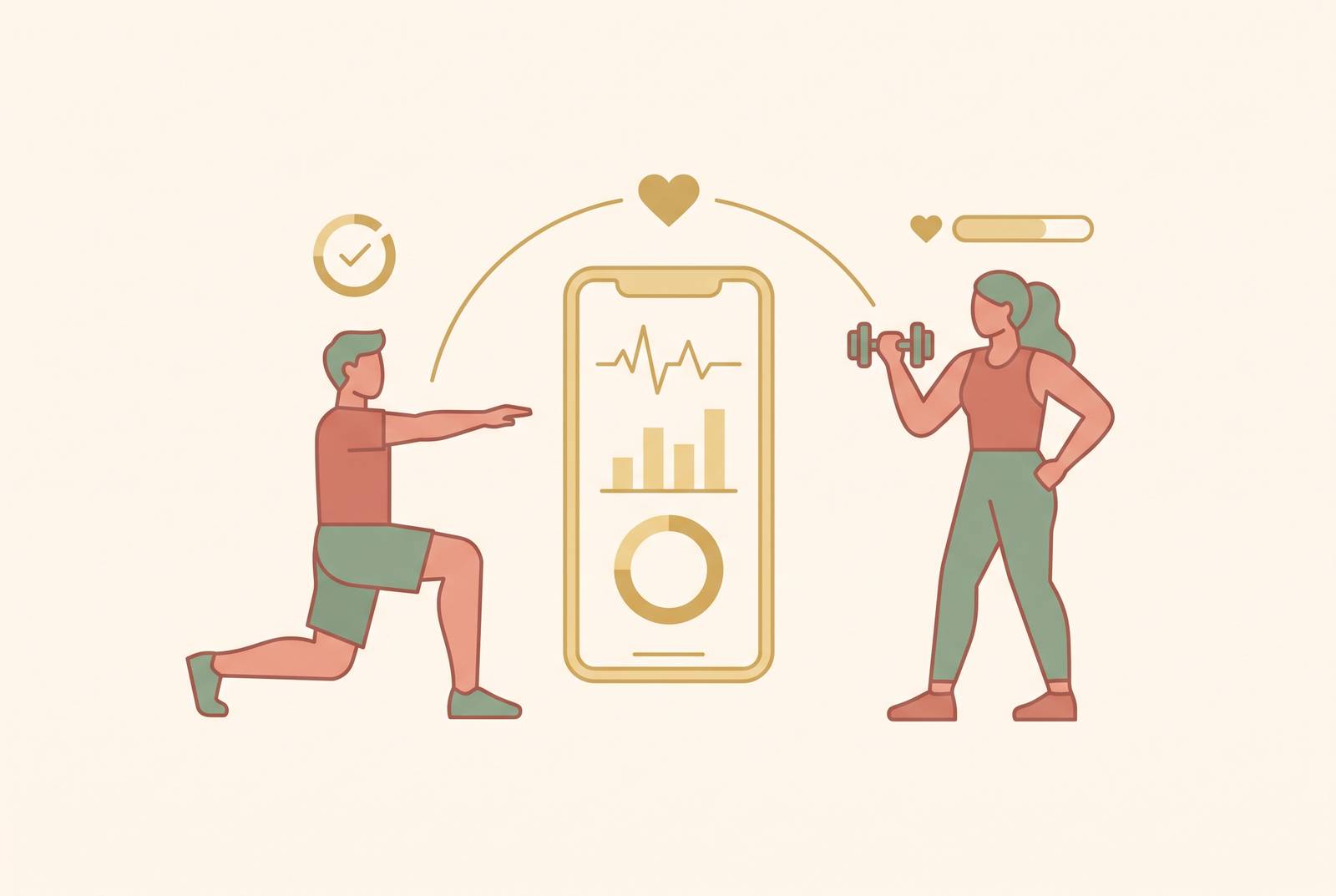
Calorie and workout sharing apps give long-distance couples a way to stay accountable to each other across cities, turning wedding fitness prep from two separate projects into one shared plan.
The accountability gap long-distance couples face on the road to a wedding
Two people living in two cities, planning one wedding, share a problem that has nothing to do with willpower. A wedding date sits on the calendar like a deadline no one can move, and the person whose opinion matters most about how you look and feel on that day is not in the room when you decide whether to go to the gym or order the salad.
A wedding date works differently than an ordinary fitness goal. FITPASS gives similar guidance: it suggests couples start a shared fitness plan three to six months before the wedding so progress stays gradual and sustainable.
What's missing for a long-distance couple is the person who notices. That daily witness is the simplest form of accountability there is, and long-distance couples don't get it by default. Both partners show up alone, every single day, to a goal they're supposed to be sharing. That's where the gap between good intentions and actual results opens up: what, exactly, is supposed to replace the presence that isn't there?
Fitness consistency in couples
Research on couples and exercise keeps turning up the same two forces: social support and the motivating pull of a partner's presence.
Social support from a partner improves long-term weight maintenance compared to dieting solo, and the effect is strongest when that support is active. A partner who takes on part of that role gets similar benefits, even without a certification.
Couples who work out together drop out far less often than people going it alone, and that's not just because it's more fun with company. Once a partner can track the pattern, missing a session carries weight that a missed phone notification never will.
There's also a separate effect, sometimes called the Kohler effect, where exercising alongside someone, even virtually, pushes people to put in more effort than they would alone. FITPASS cites research from the Journal of Behavioural Medicine: couples who exercise together release endorphins at the same time, and that strengthens emotional bonding along with motivation. That effect matters for the relationship itself, not just for whatever the scale says.
Setting individual wedding weight goals before an app can help
Before two partners link accounts or sync an app, each one needs their own plan, built around their own body, their own timeline, and their own goal.
Without that baseline, there's no way to tell real progress from the normal daily wobble everyone's weight does anyway.
Premier Fitness Camp puts the safe range for fat loss during wedding prep at one to two pounds a week, built on a daily deficit of 500 to 750 calories, high protein intake, resistance training, and a daily step target. Premier Fitness Camp notes that dieters who get enough sleep lose more than half their weight from fat, while dieters running short on sleep lose only about a quarter from fat, with the rest coming from muscle.
Men and women lose weight at different rates because of differences in baseline metabolism and lean mass, not because one partner is trying harder than the other.
Premier Fitness Camp frames the whole plan using SMART goals: a specific target, a measurable daily deficit, realistic protein and training commitments, and a timeline anchored to the actual wedding date. Premier Fitness Camp recommends scheduling the first fitting at six months out, and it notes that bridal sizing often runs larger than everyday clothing sizes, so factor that in before you set a body composition target based on a dress size alone.
Photo check-ins versus data dashboards
For a couple living apart, the strongest signal is a photo proving the other person actually showed up, sent to the one person whose opinion they actually care about, not a shared chart of numbers.
Being tracked publicly, where someone else can see it, pushes people harder than tracking privately, but who's watching changes the effect. Accountability to one person you love works differently than a public leaderboard full of strangers. Skipping a workout stops being a private decision the moment a partner can see the gap in the pattern, and that's why a photo check-in carries weight that an unfilled ring on a fitness dashboard simply doesn't.
Photo check-ins also lower the bar for getting started. A photo of a completed workout works just as well for someone who's never set foot in a gym as it does for someone who's trained for years. That matters most at the start of a long-distance wedding-prep plan, when the only goal worth measuring is whether both people showed up.
Habit formation also takes longer than most wedding fitness content lets on. A University of South Australia systematic review found the median time to build a fitness habit runs between 59 and 66 days, with averages stretching from 106 to 154 days, far past the "21 days" line repeated in so much wedding marketing. A 2026 study in Behavioral Sciences found that self-control was the only factor significantly tied to improvement in habit strength over time. found that self-control was the only factor significantly tied to improvement in habit strength over time. External accountability structures matter most for the partner with lower baseline self-control, which describes most people starting from zero.
The six-week mark is a well-documented danger zone in fitness adherence.
SweatCam builds its entire mechanic around this idea. Partners set weekly goals, photo check-ins serve as proof the workout happened, a streak visualization keeps the pattern visible to both people, and a "Pinky Promise" feature lets a partner who missed a session flag it to the other, who then decides whether it counts.
Nutrition tracking in a shared kitchen
Nutrition tracking presents long-distance couples with the opposite problem from workouts. Apart, tracking meals is easy because each person eats on their own. Together, during visits, motivation runs high but tracking gets messy fast, because two people sharing one pot of pasta usually need two different calorie and macro targets to hit their own goals.
Average caloric needs differ meaningfully between a moderately active man and a moderately active woman, based on the U.S. U.S.
Per-serving recipe tracking handles tracking a shared meal directly. Log the recipe once; each partner can then record their own actual portion against their own targets. Photo AI logging takes that a step further: each partner photographs their own plate, and the app estimates calories based on what's actually sitting in front of them, which removes the guesswork when portions don't match.
Nutrola itself came out on top in its own guide, rated best overall for couples, with photo AI that reads each partner's plate separately, an AI Diet Assistant that gives recommendations tailored to each person, a recipe database of over 500,000 entries with per-serving breakdowns, more than 1.8 million verified food entries, voice logging, barcode scanning, pricing starting at €2.50 a month per person, and a couple-friendliness score of 9.5 out of 10. MyFitnessPal carries the largest recipe database of the group, with more than 20 million crowdsourced entries, individual calorie and macro goals, a free tier with ads, and premium at $19.99 a month, though shared recipes have to be entered manually, landing it a 6 out of 10. Lose It! offers photo logging through its Snap It feature and individual goals, with a free ad-supported tier and premium priced at €6.67 a month (billed annually at $79.99, with no monthly option), also relying on manual entry for shared recipes, for a score of 6.5 out of 10. Cronometer leans into a lab-verified food database and strong micronutrient tracking, with photo AI logging limited to its Gold tier and no shared recipe support at all, priced at $4.99 a month billed annually or $10.99 month to month, scoring a 5 out of 10.
Workout accountability tools that add structure and stakes beyond the photo check-in
A photo and a supportive text message are enough for some couples. For others, what actually gets a workout done is a consequence agreed on ahead of time, and a handful of apps are built specifically around that psychology.
SweatCam's wager mechanic is the version of this built for two people who know each other well. Fitness Pact, confirmed active as of March 2026, takes a group approach built around consequences: partners agree on commitments, and missing one carries a forfeit the group itself decides on. StepBet applies financial accountability to step counts specifically. Each user places a bet, most commonly around $40 depending on the game, and the app sets two personalized weekly step goals based on each person's own historical data. Anyone who hits both goals splits the pot with the other winners.
What kind of pressure actually works on a given couple determines which of these tools fits best. Which mechanic fits best depends on how a couple already responds to accountability inside the relationship, so figure that out honestly before you pick a tool.
Beginners and experienced exercisers in shared apps
One partner training for a marathon, the other partner who hasn't worked out in two years: this is the normal starting point for long-distance couples heading into wedding prep, not the exception. The good news is that a shared accountability app serves both people well. It just works through different mechanisms for each.
For a true beginner, the most important thing a shared app does early on is remove the excuse not to start. A photo check-in needs no equipment, no prior knowledge, no performance benchmark, just proof that the person showed up. The McAlpine et al. FITPASS's advice lines up with this: if one partner is already active while the other is starting fresh, build the plan so both grow together, not so one chases the other's numbers.
For the more experienced partner, the app does a different job: it keeps intensity and consistency steady through a stretch of months that wedding planning tends to disrupt constantly. More experienced exercisers may get more out of pairing a photo check-in app with a calorie and macro tracking layer on top, since presence-logging and nutrition data are answering two separate questions. Premier Fitness Camp's wedding timeline also points out that progressive overload, gradually increasing weight or difficulty, is what keeps muscle intact during a calorie deficit. An experienced exerciser needs the app to confirm the training plan is actually being executed, not just that a gym visit happened.
App-guided programs sit in a documented middle zone of effectiveness: better than going it alone, not quite as strong as full in-person coaching, so a shared accountability app works well for long-distance couples who can't access or afford regular professional training together.
Structuring a shared wedding-prep fitness plan across a long-distance relationship, week by week
A long-distance couple working toward a wedding date needs a plan broken into phases, aligning individual goals, shared check-ins, and the calendar.
At six months out, the work is baseline and setup. Each partner builds an individual baseline on their own: average body weight across three mornings, measurements, and an honest look at current activity level, a method Premier Fitness Camp recommends. Agree on a wager before starting, one with stakes that feel meaningful but still light enough to stay fun for both people.
Months five and four are about building the habit baseline. The first six weeks are the highest-risk stretch for dropping off entirely, and the shared photo check-in streak is the main tool for getting through it intact. On the nutrition side, this phase is about locking in daily protein targets and step counts, and watching alcohol intake, which Premier Fitness Camp notes can disrupt gut health, add to bloating, and change how fitted clothes sit.
Months three and two bring rising intensity, but you still need to stay connected. Training frequency and intensity both step up, and recovery, sleep and stress management become just as important as the workouts themselves, Premier Fitness Camp notes. Each partner should compare their own numbers to their own baseline, not to each other, because the metabolic gap between partners is expected and says nothing about who's working harder. If one partner is on a GLP-1 medication like semaglutide or tirzepatide, Premier Fitness Camp notes that appetite suppression can make protein targets harder to hit, which raises the share of weight lost from muscle rather than fat, making a structured plan even more important in that case.
The final month is about consolidation. The focus shifts from losing fat to holding onto muscle and managing bloating. Premier Fitness Camp draws a clear line between actual fat loss and bloating, because water retention and gas can change how a garment fits on a given day without reflecting real body composition progress. The habits built over the whole process, protein targets, step counts, resistance training, weekly weigh-ins, are the same habits that keep weight from rebounding after the wedding. And the photo check-in ritual the couple built over six months doesn't stop at the altar. It becomes the shared habit that carries into the marriage, not a project with an end date but the start of a long-term fitness partnership.
How couples navigate friction in shared tracking
Shared fitness tracking isn't automatically a good thing for every couple. The same visibility that motivates one relationship can create pressure or comparison in another, so the friction points need naming before two people link their accounts.
The biggest knock against photo check-ins is that they prove someone showed up, not that they actually pushed themselves. A partner can complete the check-in while barely breaking a sweat, since the photo can't measure effort or intensity, and that can frustrate a more experienced exerciser over time. The fix is pairing check-ins with individual goal tracking: the photo proves consistency, the personal log tracks quality, and neither one replaces the other.
Comparison also works differently than support. Couples do better establishing early on that progress gets measured against each person's own baseline, not against each other, and apps that show only each person's own data, rather than a shared leaderboard, cut down on that risk.
Missing a goal should prompt a conversation, not shame. Couples using wager-based tools need to agree upfront that the stakes stay playful, and that one missed week is just a data point, not a verdict on how much either person cares. Couples who talk through these dynamics before they start tracking together end up better equipped to support each other, which was the point of all this from the beginning.