Couples Fitness Routines That Survive the Newlywed Transition
Couples who exercise together stay committed longer and resolve conflicts better.
Marriage measurably wears down cardiovascular fitness, and there's a body of research to prove it. A study tracking nearly 8,900 adults over several years, published in the American Journal of Epidemiology, found real drops in cardio fitness after people got married, measured the old-fashioned way: on a treadmill nbcnews.com. The read from the team behind it wasn't subtle either. Once people are married and off the market, so to speak, they tend to stop trying as hard. Dr. Francisco B nbcnews.com. Ortega of the Karolinska Institute said marriage counts as "an important social stimulus that can influence fitness," a polished way of saying the wedding ring doubles as an off-switch for some people.
It's not just cardiovascular endurance either. Anyone doing a victory lap for marital bliss should pause at research from Andrea L. Meltzer, then at Southern Methodist University, found that newlyweds who reported being more satisfied with their marriage were actually more likely to gain weight. Contentment, it turns out, is terrible for vigilance. When nobody's trying to impress anybody anymore, the treadmill starts collecting dust.
None of this means marriage is bad for you. It means the structure around fitness changes the day the wedding ends. Evening gym sessions as a single person quietly turn into evenings on the couch with a spouse, and that's a shift in social scaffolding, not a failure of willpower. Evening gym sessions as a single person quietly turn into evenings on the couch with a spouse, a shift in social scaffolding documented in the research. Which is really the whole point of what follows.
Why exercising together specifically (not just individually) protects both fitness and the relationship
Solo workouts help the person doing them. Joint workouts appear to do something solo workouts can't: they help the relationship itself. That's the core finding out of a BYU research team that analyzed data from 1,693 newly married couples as part of the CREATE (Couple Relationships and Transition Experiences) study, published in the journal Family Relations BYU / CREATE Study.
Couples who exercised together reported fewer conflicts, resolved the conflicts they did have more effectively, and described stronger communication overall, and this held up even after the researchers controlled for how much each partner exercised on their own BYU / CREATE Study. In other words, it wasn't just that fitter people communicate better. Something about training side by side seems to do the relational lifting. Lead researcher Jeremy Yorgason summed it up this way: "conjoint exercise facilitates, in a small but significant way, the ability to resolve conflict peacefully".
About 60% of husbands and wives in the study said they exercised at all, but only around a third of couples exercised together BYU / CREATE Study. Do the math and that means roughly half the people already putting in the work, lacing up shoes, showing up to a class, are doing it solo when a shared version of the same effort would pay a relationship dividend on top of the fitness one. That's not a small oversight. That's a free lunch sitting on the table, uneaten.
The mechanism behind it releases oxytocin and endorphins, the same chemical cocktail tied to bonding and attachment. Physical activity releases oxytocin and endorphins, the same chemical cocktail tied to bonding and attachment, and moving in sync with another person activates mirror neurons linked to empathy. Basically, the body doesn't fully distinguish between "we just finished a hard workout" and "we're bonding," which is either very convenient or very on the nose, depending on how you look at it.
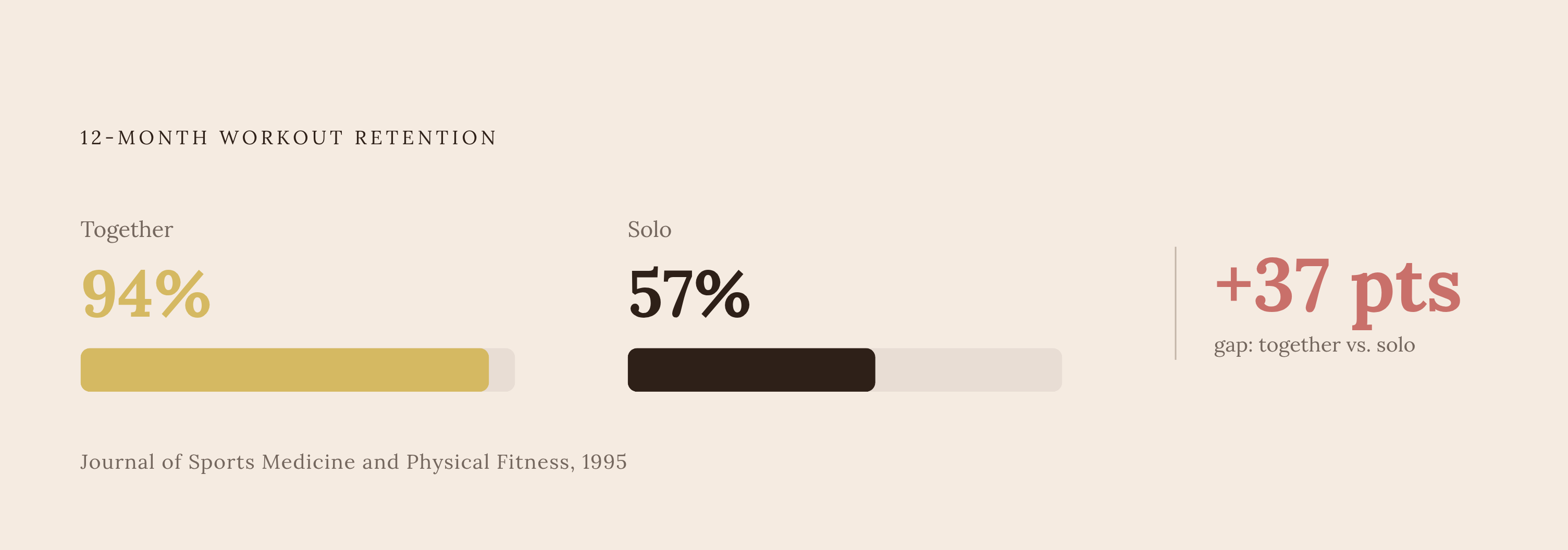
The retention numbers back this up too. A 1995 study in the Journal of Sports Medicine and Physical Fitness found a 94% retention rate over 12 months for couples who exercised together, compared to 57% for solo exercisers rollingout.com. Separate research puts people at 90% more likely to stick with a fitness habit when they have a workout partner Journal of Sports Medicine and Physical Fitness rollingout.com. Per the American Council on Exercise, 94% of couples who exercise together stick to their program Journal of Sports Medicine and Physical Fitness. And when researchers looked at combining physical activity with actual verbal communication, not just working out in the same room but talking through it, the effect size on life satisfaction jumped to 0.31, compared to 0.23 for physical activity alone and 0.15 for communication alone BYU / CREATE Study marriage.com.
A fair caveat belongs here. The CREATE study is cross-sectional: it captured a snapshot rather than tracking cause and effect over time, so it's entirely possible that happier couples are simply more likely to exercise together in the first place, rather than exercise making them happier BYU / CREATE Study. Both things are probably a little true. But even with that caveat, the data doesn't ask for heroics. Walking was the second most common joint activity, at 20% of joint exercisers, behind cardio at 33% and ahead of strength training at 15% BYU / CREATE Study. Nobody needs to train like they're prepping for a triathlon. They need to show up next to each other, regularly, doing something that counts as moving.
The two friction points that derail couples before any routine takes hold
Two problems kill most couples' fitness plans before they ever become a habit, and neither one is really about motivation. The first is mismatched fitness levels. One partner's warm-up pace is the other person's max effort, and that gap, appearing every session, makes the workout stop feeling shared and start feeling like a negotiation. If it's too easy for one person, they feel like they're wasting time. If it's too hard for the other, burnout or injury follows fast. A little competitive edge, which sounds harmless, can tip into one-upmanship that turns a bonding activity into a scoreboard nobody asked for.
The fix is restructuring the workout so the mismatch doesn't matter. Parallel play works: same room, different equipment, one person on the rower and one on the treadmill, present together without either one compromising their session. HIIT circuit swaps work too, where one partner goes hard on a move while the other does active recovery, then they trade, which keeps both people moving without forcing either to match the other's pace. And effort-based metrics, tracking minutes moved or sessions completed rather than pace or weight lifted, sidestep the need to compare partners' performance entirely. Nobody's keeping score on who ran faster. Everybody's just keeping score on who showed up.
The second friction point is scheduling, and it might be the more stubborn of the two. It's one of the most common reasons couples quit training together, and the newlywed year makes it worse: new shared logistics, a fresh wave of social obligations, sometimes a move to a new city, all landing at once. The fix here is accepting that not every session needs to be shared. It's accepting that not every session needs to be shared. Mixing individual workouts with joint ones lets each partner chase their own goals while still protecting time together.
What actually works, according to the BYU research, is two or three joint sessions a week, treated like fixed appointments rather than "we'll figure it out," even if each one only runs 20 to 30 minutes BYU / CREATE Study. Short and reliable beats long and aspirational. Some couples find mornings set the tone for the whole day; others use an evening session as a wind-down ritual. Neither is more correct than the other. The real enemy of a couples' fitness routine isn't laziness, it's perfectionism, the constant waiting for the perfect time slot or the perfectly matched fitness level before starting anything at all.
What joint routines look like when they stick
Start with the least glamorous option on the list, because it's also the most evidence-backed one: walking. It came in as the second most common joint activity in the BYU data, at 20% of joint exercisers, and it works for a reason that has nothing to do with calories burned BYU / CREATE Study. Walking side by side creates conversation naturally, and it feels far less confrontational than sitting across a table trying to hash out a disagreement face to face. A 15-minute walk after dinner counts BYU / CREATE Study. No gym membership, no equipment, no excuse.
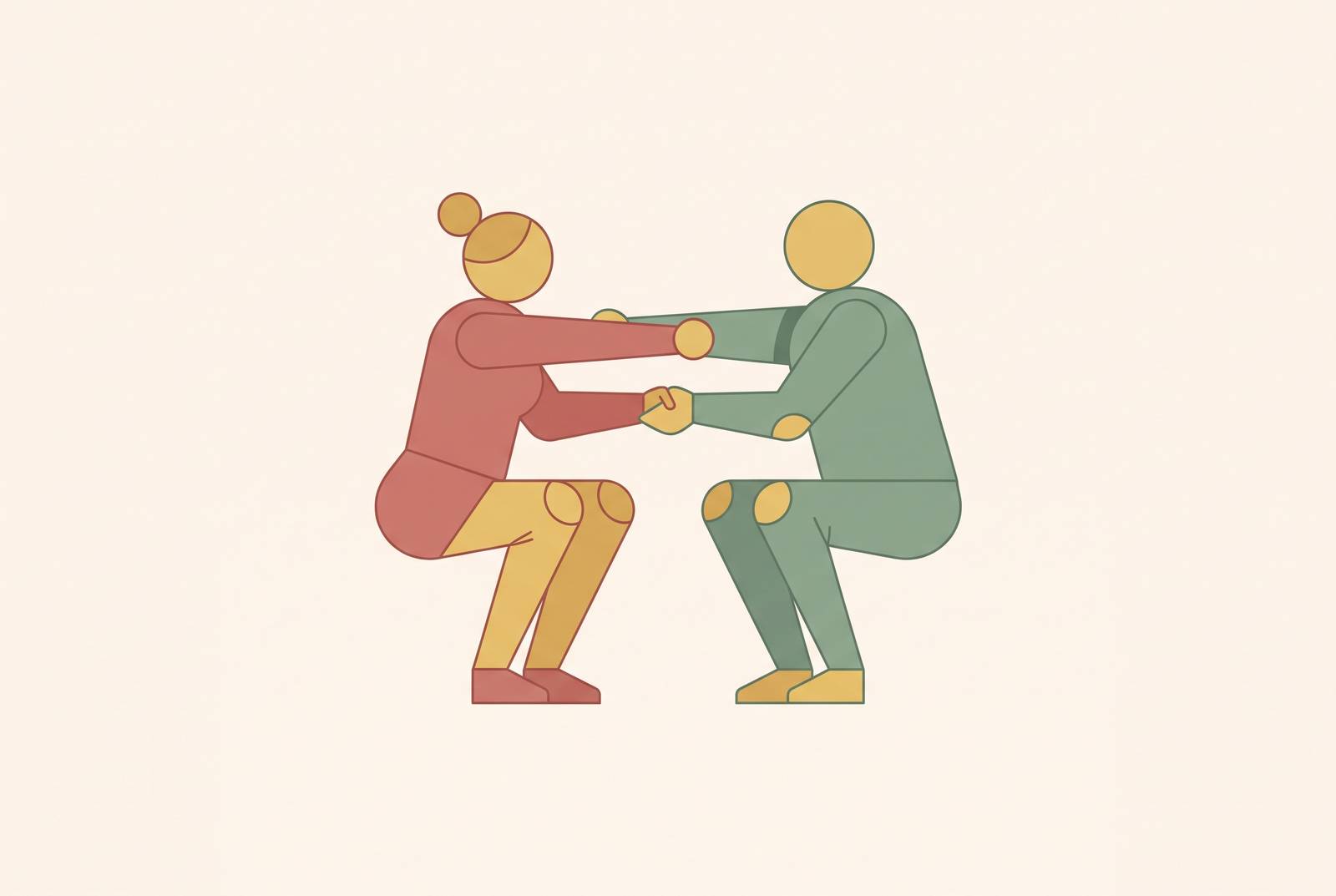
From there, a handful of low-barrier partner exercises scale across almost any fitness level. Partner squats, standing face to face and holding hands for balance while squatting together, improve form and add stability with zero equipment involved. Resistance band work, standing back to back with a band around both waists and taking alternating steps, builds leg strength and coordination at the same time, and it turns out to be a surprisingly good excuse to stand uncomfortably close to another adult in a gym.
Novelty adds something the routine can't. Research shows couples who try new, moderately challenging activities together, hiking a new trail, paddleboarding, cycling somewhere unfamiliar, dance fitness classes, report a real boost in relationship quality and romantic attraction on top of getting a solid workout in. The theory is that novelty triggers a similar neurochemical response to early-stage attraction, which is a fairly elegant way of saying new experiences remind the brain of the good kind of nervous.
The scheduling piece matters as much as the activity itself. Specific, recurring times, treated as fixed rather than "if we get to it," separate the couples who keep this up from the ones who don't. Some coaches call these sessions sacred time, not to be bumped by anything else on the calendar. Two to three sessions a week is a sustainable floor, and cramming in more doesn't necessarily help if it starts to feel like pressure instead of a habit. The format changes little for the outcome, since regularity is the actual engine here. The regularity is the actual engine here.
How to set shared goals that don't collapse when real life interrupts
Shared fitness doesn't mean identical fitness. Both partners still need room to chase their own goals alongside whatever they're building together, and trying to force one program onto two different bodies and two different schedules usually backfires. Simplicity wins during the transition year specifically, because life is already asking a lot of both people, and a fitness plan that adds its own layer of administrative overhead is a plan that gets abandoned fast.
Effort-based goals travel better than output-based ones here too, same principle as the friction-point fix, just applied to goal-setting instead of workout structure. Tracking sessions completed, streak days, or minutes moved is fairer across two different fitness levels than tracking pace or weight lifted, and fairness turns out to matter more for long-term stickiness than intensity does.
Visibility helps close the loop. Whether it's a shared app, a calendar taped to the fridge, or a shared notes doc, being able to see the other person's effort in some concrete form builds a shared identity around simply showing up. Small wins deserve actual acknowledgment too: a monthly progress photo, a streak hitting some round number, even just naming out loud that a short session still counts. These micro-celebrations are what keep the habit loop turning.
Missed sessions need a different frame than most people default to. A missed workout is information. The useful question isn't "why did we fail," it's "what made this week harder, and what would make next week easier." That's a maintenance conversation.
A little friendly wagering doesn't hurt either, so long as the framing stays light: small rewards, playful stakes, structured so both people win if both people show up, rather than one partner losing to the other. And the stakes of getting this right are higher than they might seem on paper. Up to 80% of people who start a new fitness habit drop it within a few months BYU / CREATE Study milehighfitness.com. The entire point of building shared, effort-based, low-friction goals during the newlywed year is putting the odds in favor of landing in the 20% that actually sticks BYU / CREATE Study.
Tools and apps that support couples who want to stay connected across separate sessions
The right tool fits into a messy, unpredictable life rather than demanding a clean one.
A few features separate tools that actually help couples from tools that just track one person's steps. Adaptive workouts that flex to different fitness levels matter, since a program calibrated for one partner's max heart rate is useless to the other. Shared progress tracking matters just as much, so one partner can see the other showed up even during a week when they trained separately, which preserves the sense of connection across sessions that don't happen side by side. Gamification, streaks, XP, small collectible rewards, can turn consistency into something closer to a shared game than a performance report card. Simple check-ins, even something as basic as a workout photo sent mid-day, tend to land better than another chart or graph, since a photo says "I showed up" in a way a data point doesn't. And competition built around effort rather than pace or output avoids importing the fitness mismatch straight into the app.
There isn't a single, fully confirmed roundup of couples fitness apps to hand over here, just a clear set of features worth checking for BYU / CREATE Study. Anyone shopping for a tool should run it through that checklist rather than assume the flashiest app on a store listing has actually solved for connection. Sites like Partner Fitness Review approach the category with that same philosophy front and center, connection over optimization, showing up over spreadsheets full of performance data, and that's a reasonable place to keep checking back in as new tools show up. The one thing worth steering away from is any app built entirely around an individual dashboard with no shared accountability feature at all. That design choice quietly defeats the whole premise of doing this together in the first place. Sweatmates, a fitness accountability app for couples that keeps both partners connected through shared workout tracking, photo check-ins, and joint goals, is one option built specifically around that shared layer rather than bolting it on as an afterthought.
What the transition year requires from both partners
When the treadmill studies and the app features are stripped away, the newlywed fitness dip is a social structure problem. It's a social structure problem. The habits that worked fine for two single people stop fitting the moment those two people are building one shared life, and no amount of individual willpower fixes a structural mismatch.
What replaces individual optimization is something closer to a shared fitness identity: small, visible, repeatable habits that reinforce the relationship while still leaving room for each person to be their own person. The most useful takeaway from the BYU research isn't that couples need to start exercising from zero BYU / CREATE Study. Roughly half of couples who are already exercising just aren't doing it together. That's not a fitness gap. That's a coordination gap, and it's a far easier one to close.
Accountability, done right here, looks supportive rather than controlling: checking in, noticing when the other person shows up, staying curious about what they need that week instead of enforcing a program on them. And the research on novelty offers one last, low-stakes nudge worth taking seriously: trying something neither person has done before, a new trail, a new class, a sport neither of them is any good at yet, works as both a fitness strategy and a relationship investment at the same time. It's playful by design.
None of this rewards the most efficient routine on paper. It rewards the one both people are still doing together in six months, when the wedding is old news and the schedules have gotten complicated again Flinders University. That's the actual bar, and it's a lower one than it sounds.