Group Fitness Challenges Involving Wedding Party Members
Wedding parties have built-in accountability that turns fitness into a bonding tool.
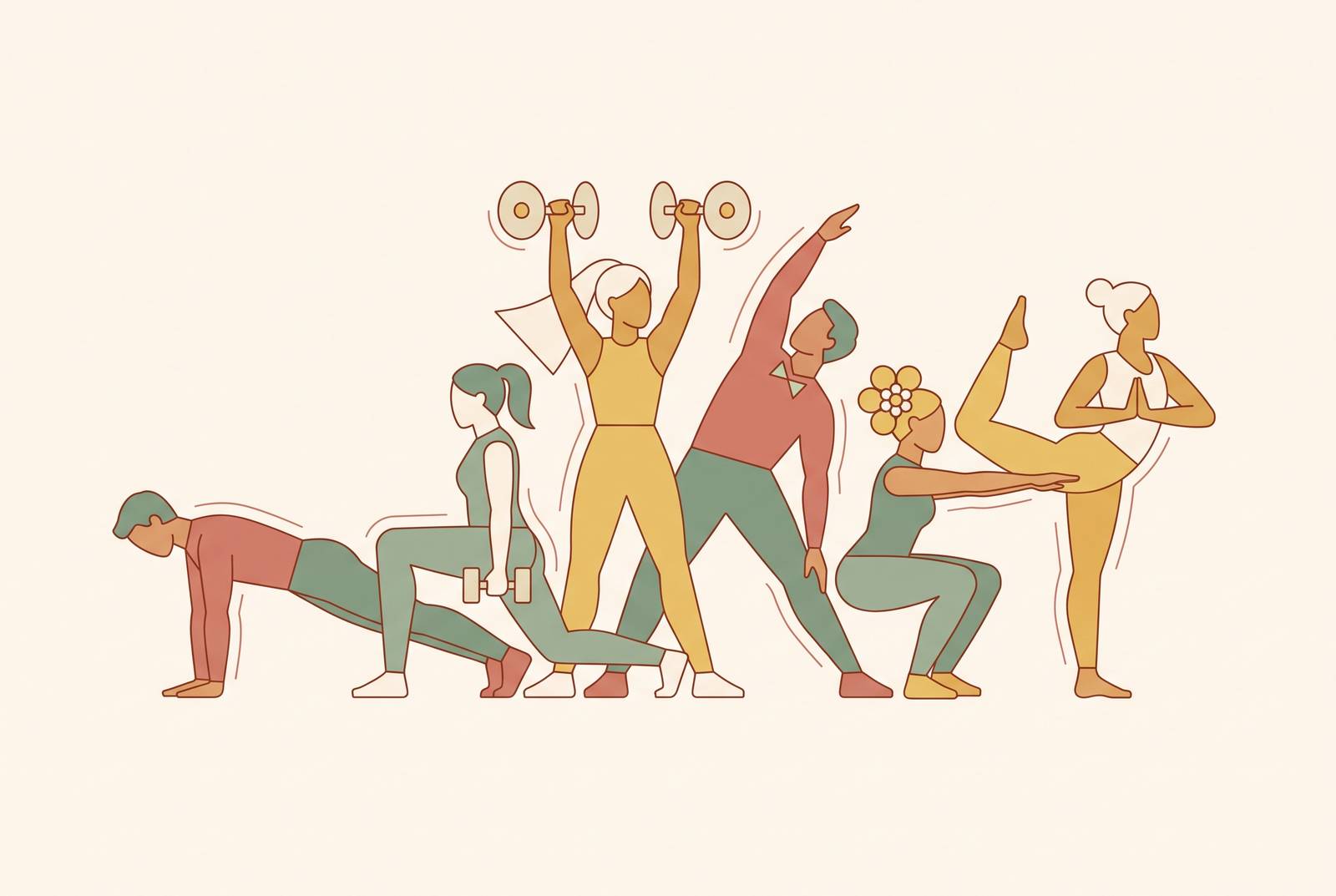
Wedding parties already have a fixed date, a shared stake, and a group of people who genuinely like each other (mostly), which is what most fitness challenges spend weeks trying to manufacture. That's a head start most gym New Year's resolutions never get.
Even people who show up to the gym four times a week hit a wall eventually. Motivation runs dry, workouts get stale, and the whole routine starts to feel like folding laundry: necessary, but joyless. A wedding gives that stalled-out gym-goer a reason to re-engage, and it does it with a group instead of a solo grind.
Personal trainer and wellness coach Allison Tibbs, writing for WW Canada, notes that bridal party fitness groups "build a deeper connection with the entire group." That's a different pitch than the usual "get toned for the big day" messaging. Fitness here is the excuse, not the goal. The actual product is closeness.
And closeness matters more in wedding parties than in almost any other group workout scenario, because wedding parties are weird social blends. Some of these people have been best friends since third grade. Others met for the first time at the engagement party and have exchanged maybe four sentences since. A shared physical challenge, something with a little sweat and shared discomfort attached, tends to bond strangers faster than a string of brunches ever could. Nothing brings people together like collectively hating burpees.
Social accountability and group exercise completion
The numbers on this are not subtle. In one tracked comparison, 95% of people who started a weight-loss program with a friend finished it, compared to 76% who went at it alone. People who paired up were meaningfully more likely to keep the results off afterward, which is not a small edge. That's what separates "eh, maybe" from "basically guaranteed.""
A 2018 University of Aberdeen study zeroed in on couples and close partners specifically, and found that people who picked up a new exercise buddy worked out more often overall. What mattered most wasn't the workout plan or the tracking app. It was emotional encouragement from that companion. Someone saying "you've got this" beat any spreadsheet.
The "Conjunctive Task" effect explains this: when the group's success depends on everyone showing up, no one wants to be the reason it falls apart. In plain terms: when the group's success depends on everyone showing up, no one wants to be the reason it falls apart. Skipping a solo workout costs nobody but you. Skipping a group workout means someone else notices, which turns personal willpower into a group contract. That shift, from "should I go" to "I can't be the one who bails," is the whole engine behind why group challenges outperform individual ones.
Scale backs this up too. Around 125,000 people took part in the 2026 Transformation Challenge across Orangetheory Fitness, Anytime Fitness, The Bar Method, and Basecamp Fitness. When organizers looked at what actually drove people to finish, accountability, coaching, and community came up repeatedly. Not discipline. Not willpower. Other people.
The body image problem that sinks most wedding fitness challenges
Staffordshire University research found that nearly 70% of women planning weddings intended to lose weight before the big day. That's not a fitness goal, that's a cultural expectation wearing a fitness goal as a costume.
Part of the pressure comes down to the camera. Knowing that wedding photos and video will exist forever, get printed, get posted, get pulled out at anniversaries for decades, adds a weight that a regular gym goal never carries. Nobody stresses about how their arms look in a Tuesday gym selfie the same way they stress about how their arms look in a photo that'll sit on a mantel for the next fifty years.
Researcher Niva Piran calls this "body disciplining." It describes forced or pressured bodily practices aimed at meeting some external standard, and it doesn't just come from inside a person's head. It comes from tailors pinning a dress a little too tight and saying nothing. It comes from a well-meaning aunt. It can even come from the comment section under a bridal boutique's Instagram post.
So when a wedding party fitness challenge gets framed around "let's look good for the photos," it's importing all of that pressure straight into what's supposed to be a bonding activity. And the research is pretty clear that this backfires. Pressure doesn't build motivation, it corrodes it. A challenge built on dread doesn't produce consistency, it produces resentment, and resentment doesn't show up to spin class.
Setting goals that keep everyone engaged across different fitness levels
Before anyone books a studio or picks a hashtag, one question needs an honest answer: what does each person actually want out of this? Skipping that step means the whole plan is built on sand.
Tibbs breaks this down into three things: fitness goals, physical limitations, and preferred styles.
- Fitness goals: some people want strength, some want endurance, some just want to stop being winded by two flights of stairs.
- Physical limitations: old injuries, medical histories, different starting points. A groomsman with a bad knee and a bridesmaid training for her third half marathon should not be handed identical workout plans.
- Preferred styles: what people actually enjoy versus what they'll tolerate for exactly one week before quietly ghosting the group chat. Someone who hates running will not become a runner because a calendar invite from a scheduling app told them to.
Once that groundwork is done, the smarter move is to reframe the whole challenge around consistency instead of performance. Attend four sessions this week. Log six workouts this month. Numbers like that give everyone, regardless of how fit they currently are, an equal shot at winning. A former college athlete and someone who hasn't worked out in a long time can both hit with the same sense of accomplishment. Streaks and participation milestones level a playing field that pace times and rep counts never will.
Choosing a challenge format that fits how the group lives
Most fitness guides quietly ignore the fact that wedding parties are scattered across zip codes, sometimes across countries. Bridesmaids in three different cities. Groomsmen who haven't found a shared free evening since the engagement party. Any format that assumes everyone can meet up at 6 a.m. at 6 a.m. on a fixed weekday is dead on arrival.
Four formats generally cover the range of how modern wedding parties actually operate:
- Steps or wearable challenge: everyone tracks steps through a shared group setup, prizes get revealed at the bachelorette party. Low barrier, works no matter where anyone lives.
- Virtual or hybrid accountability group: a group chat on Facebook Messenger, Instagram, or Slack for daily check-ins, with a synced Zoom workout for whoever can make it. Keeps the connection alive without demanding everyone be in the same room.
- In-person group classes: makes sense when most of the party lives in one city. A boutique studio can block off a private session and skip the scheduling headache.
- Structured multi-week program: everyone follows the same plan independently, then reports back to the group. Works well when the party is spread thin geographically.
The real fork in the road, as Tibbs frames it, is that the group will work out either together or in parallel. That single decision shapes everything downstream, from what app to use to how prizes get awarded.
For most wedding parties, a hybrid setup wins. Pair a shared digital layer, like a group chat or a step tracker, with occasional in-person sessions timed around events that are already on the calendar: the engagement party, the dress fitting weekend, whatever brings people into the same city anyway.
In-person workout options for wedding parties, from boutique studios to obstacle courses
When the group can get in a room together, a few formats consistently deliver both sweat and fun.
Spin classes are a bridal party staple for a reason: loud playlists, a private room, custom song requests, decorations if anyone's feeling extra. SoulCycle runs from $30 per rider, with private class bookings starting around $1,000 (Soul-Cycle.com).
Dance fitness turns a workout into something closer to a party with dumbbells. 305 Fitness runs from $24 per class, with private bookings starting at $350, DJ included, choreographed routine optional (305Fitness.com).
Fusion classes blend a few disciplines into one session, useful for a group with mixed fitness levels. Body by Simone charges $350 for a private class of 5 to 20 people, mixing Pilates, barre, and cardio dance so nobody's stuck doing something they hate for the full hour (BodybySimone.com).
Obstacle races go the opposite direction entirely, less studio polish, more mud. The Rugged Maniac Obstacle Race Series covers 3.1 miles of obstacles, including mud slides and monkey swings, with pricing that varies by location (RuggedManiac.com). It's the kind of shared physical challenge that tends to produce camaraderie rather than competition, since nobody's comparing mile times when they're covered in mud.
Axe throwing deserves a mention too, less workout, more shared adrenaline. It's scored like darts, and the appeal is less about fitness and more about bonding over learning something new and slightly dangerous together.
Structured programs designed specifically for bridal parties and pre-wedding fitness
A handful of programs are built from the ground up for exactly this occasion.
Fly Feet Running in Minnesota runs a "Tread & Wed" program for brides and grooms marrying that year. It asks participants to attend three sessions, includes a gait analysis, and rewards anyone who finishes the two-month challenge with 50% off a private class, a nice option for kicking off a bachelor or bachelorette party.
Pure Barre offers a Bride to Be Package: three months of unlimited classes for $375, and the offer extends to the whole bridal party, not just the bride.
The Sculpt Society's bridal program rounds out the structured options, offering an 8-week plan built specifically around a wedding timeline rather than a generic fitness calendar.
The Sculpt Society runs an 8-week bridal program aimed at sculpting and toning, structured specifically around a wedding timeline rather than a generic fitness calendar.
Gamification and shared tracking tools that keep the group engaged week to week
The fitness app market pulled in $3.98 billion in revenue in 2024, with 345 million people using these apps worldwide. Group challenges sit near the center of what keeps that engagement number so high. People don't stick with apps, they stick with people, and the app just happens to be where the people are.
The data backs this up in a specific way: people using fitness apps or trackers had almost twice the odds of meeting aerobic activity guidelines compared to non-users (an odds ratio of 1.91). That's a meaningful gap, and it's about what the technology makes visible to other people, not the technology itself. It's about what the technology makes visible to other people.
The gamification pieces that actually keep a group going over months, not days, tend to be small: streaks, digital badges, leaderboards, little wins that stack up. These build what researchers call social capital, the sense that showing up matters because other people are watching and cheering.
For a wedding party specifically, simple tends to beat sophisticated. A shared step leaderboard through a group tracker, with a goofy prize revealed at the bachelorette party, keeps the stakes light and the engagement social. A group chat where workout selfies replace progress graphs does more heavy lifting than a spreadsheet ever could, since a photo of someone dragging themselves to a 6 a.m. class is more convincing than any chart. And a friendly wager (loser buys the first round at the bachelorette) turns the whole accountability structure into something that feels like a game instead of a chore, which is the logic behind Sweatmates, a fitness accountability app for couples and partners built around shared workout tracking, photo check-ins, and friendly wagers between two people.