How Shared Fitness Habits Strengthen Long-Term Relationships
Couples who exercise together bond more deeply than those who work out apart.
Two people who share a bed, a mortgage, and a gym membership can still work out like strangers who happen to use the same locker room. One goes at 6 a.m., the other at 7 p.m., and they compare notes over dinner like two coworkers filing separate reports. This piece is about what that setup misses: shared fitness habits strengthen long-term relationships through specific mechanisms, synchronized movement, mutual accountability, self-expansion, and shared identity, that only switch on when the workout is actually done together, not just scheduled by two people who live in the same house.
The default assumption is that fitness is a private project. You track your own steps, hit your own macros, chase your own personal record, and your partner does the same a few feet away or a few hours apart. That model treats the gym the way most people treat flossing: a solo responsibility that happens to be performed near someone you love. What it misses is that exercise done jointly triggers biological, psychological, and behavioral responses that exercise done in parallel simply does not touch. Proximity isn't the active ingredient. A dyadic study in the Annals of Behavioral Medicine found that couples who exercised together, as part of a broader pattern of joint health behavior that included eating and sleeping on shared schedules, reported greater health satisfaction, fewer health problems, and more similarity in health outcomes than couples who shared fewer of these habits. The gap between "we both work out" and "we work out together" turns out to be the whole story.
How synchronized movement produces a biological bond
The first mechanism is chemical, and it starts with timing. When two people move in coordination, matching pace, matching rhythm, matching breath, the body responds differently than it does during solo movement. Researchers studied pairs during a real-life dance task, using motion-tracking software to measure how closely their movements lined up in speed and timing, and they found that oxytocin levels tracked with how synchronized the pair became. More synchrony tracked with more oxytocin, the hormone most associated with trust and attachment.
A broader neuroscience review published in The Neuroscientist, first posted online in 2024, backs this up from a different angle. It found that oxytocin supports cooperation across brain networks through several overlapping channels, including ones that help people bond with each other and fall into shared rhythm. None of this requires a dance floor. Psychologists call the everyday version of this "nonverbal matching," or mimicry, and studies on it show that the simple act of moving the same way at the same time increases how emotionally in-tune two people feel with each other.
None of this requires rehearsed choreography, either. A couple going for a walk at the same pace, lifting on the same tempo, or sitting through the same yoga class side by side gets the same mechanism running. The body responds the same way to a rehearsed duet and to two people jogging the same loop on a Tuesday. It just registers that two people are moving as one unit, and it responds accordingly.
How exercising together improves mood and the relationship
Oxytocin explains why shared movement creates a pull toward connection. Mood explains why the two of you actually get along better once the workout is over.
Research by Sackett-Fox and colleagues, published in the Journal of Social and Personal Relationships in 2021, found that people who exercise with their romantic partner report better mood during the workout itself, better mood for the rest of that day, and higher relationship satisfaction overall. That's three separate findings stacked on top of each other, not one vague feeling of closeness. The mood boost is part of the real benefit, not a pleasant side note. It's one of the mechanisms doing the actual work.
The timeline matters because couples don't need months of consistent training before they notice anything. The effect appears in how two people talk to each other over dinner that same day, in whether a minor annoyance turns into a fight or gets shrugged off.
That mood effect also helps explain why couples argue less when exercise is part of the routine. A 20-year study using the MIDUS dataset found that physical activity and stress-eating were the two health behaviors that significantly linked relationship dysfunction to physical health outcomes over two decades. That finding held up separately from the already well-established link running through anxiety and depression: the body, not just the mind, carries part of the load when a relationship is under strain. Exercise, done together, is one of the few levers that touches both the emotional and physical sides of that equation at once.
Novelty, Challenge, and Shared Fitness
Shared fitness works best when it asks something of both partners, not when it's the same loop run on autopilot. The mechanism behind this is called self-expansion: new challenges reinvigorate a relationship by generating growth that gets tied to the partnership itself.
Arthur Aron and Jennifer Tomlinson's 2026 review in Behavioral Sciences lays out the logic. Early in a relationship, partners expand rapidly, taking on each other's interests, perspectives, and even vocabulary. That growth naturally slows down over time, and the review describes relationships going flat once the easy expansion runs out. Novel and challenging activities done together are one of the few reliable ways to restart that growth and tie it to the relationship itself.
The original Aron experiment that this idea is built on put couples through either a mundane task or a genuinely novel one, like an obstacle course, and the couples on the obstacle course reported less boredom and more closeness and satisfaction afterward. Later daily-diary research backs up the pattern at two different time scales: on days when couples did something more self-expanding, both partners rated that day's relationship satisfaction higher, and couples who kept up a run of self-expanding activities over three weeks reported higher satisfaction three months down the line.
The growth has to attach to the partner, not just the activity. Learning to rock climb alone might be exciting. Learning to rock climb with someone, where that person becomes the one associated with the thrill, the fear, and the eventual high-five at the top, is what creates the relational payoff. Fitness happens to be one of the easiest places to manufacture this on purpose, because it scales naturally: a regular run can become a trail race, a standard gym routine can turn into a climbing session, a familiar yoga class can become an obstacle course weekend. The ladder is already built. Couples just have to keep climbing it together.
How joint fitness builds a self-sustaining shared identity
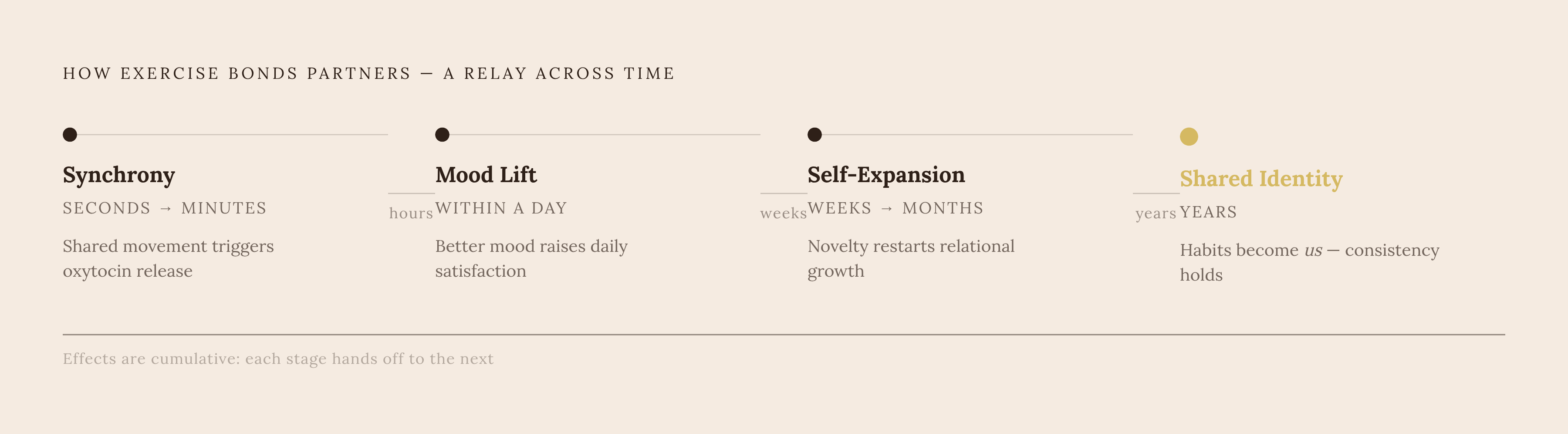
Synchrony fires in the moment. Mood operates within a day. Self-expansion plays out over weeks and months. Shared identity is the mechanism that takes over after that, stretching the benefit across years, and it's arguably the reason some couples keep a shared fitness habit alive long after the initial motivation has worn off.
Once two people's bodies and habits start to reflect the same routines, those habits stop being an individual choice, and they start functioning as a piece of how the couple sees itself. Skipping a workout at that point doesn't feel like skipping a personal goal. It feels like letting the team down. That shift in framing is what makes the habit sticky in a way that willpower alone rarely manages.
Fitness differs from most other couple routines in this respect. A shared love of a restaurant or a TV show is pleasant, but it doesn't leave behind any visible proof that either person is keeping a commitment. Fitness does. A finished run, a shared PR, a photo from a hike neither of you had done before, these are small, visible markers that both people are still showing up for something they built together. Consistency, not intensity, is what accumulates into that identity. A modest weekly habit kept for a year does more for a couple's sense of "us" than an ambitious plan that collapses in month two.
Where shared fitness creates friction instead of connection
None of this works unconditionally, and a fair account of the research has to say so. When one partner's routine becomes the standard the other is measured against, shared fitness stops building connection, and it starts building resentment instead.
The most common failure mode is a mismatch in how much each partner cares about exercise. When one person prioritizes training and the other doesn't, that gap can affect everything from attraction to energy levels to how the couple plans their weekends. The less-interested partner often ends up feeling constantly evaluated, as offhand comments about energy, weight, or missed workouts tend to produce defensiveness and quiet withdrawal.
The difference almost always comes down to whether the activity is offered as an invitation or imposed as an expectation. One partner's plan becoming the yardstick for the other is where the trouble starts. Couples don't need matching routines to get the benefits described in this piece. Accepting a real gap in fitness interest, rather than treating it as a problem to fix, tends to produce less resentment and, ironically, more consistent movement from both people.
Attachment style adds another layer of nuance that a one-size-fits-all fitness plan can't handle. Daily diary research found that novel and exciting activities helped buffer lower relationship satisfaction for avoidantly attached individuals, while familiar, low-key activities did nothing for that group. For anxiously attached individuals, the pattern flipped: familiar activities buffered their satisfaction, while novelty didn't move the needle. A trail race that thrills one partner might stress out the other for reasons that have nothing to do with fitness level and everything to do with how each person is wired to handle uncertainty.
The correlation itself deserves a straight answer too. The same Annals of Behavioral Medicine study that found health concordance between partners also found that concordance was stronger among couples who had been together longer and who spent more time together, but it wasn't necessarily stronger among couples who were more satisfied. Causality runs in both directions here: satisfied couples may exercise together more, and exercising together may also build satisfaction. The mechanisms in this piece explain the second half of that loop.
Structural fairness inside the relationship matters as well. A longitudinal study using the Northern Swedish Cohort found that couples who perceived more gender equality in their relationship reported higher leisure-time physical activity for both partners, though the confidence intervals for men were wide enough to warrant caution. You don't get access to the benefits described here equally by default. It depends partly on whether both partners have the time, say, and freedom to make shared movement part of the routine.
The OHSU cancer survivorship trial
The clearest test of all this comes from a population where the stakes are about as high as they get: couples in which one partner is a cancer survivor. Oregon Health and Science University ran a randomized controlled trial built specifically to separate the effect of exercising together from the effect of simply exercising, something a correlational study can't do on its own.
The researchers describe the goal in direct terms, saying the work "could shift the paradigm of survivorship care toward novel couple-based approaches that could optimize outcomes for each partner because their health is interdependent on each other and their relationship." That sentence is doing real work. It states that one partner's health outcomes are tied to the other's, and that the relationship itself is a variable worth treating in a clinical trial, not a footnote to it.
Randomization is what makes this trial matter for the broader argument. With observational studies, you can't rule out that happier couples simply choose to exercise together, so you can't say which caused which. A randomized design removes that problem by assigning the partnered-exercise condition rather than letting couples self-select into it, isolating the effect of doing it together from everything else going on in the relationship.
If the mechanisms behind synchrony, mood, self-expansion, and shared identity hold up under the weight of a cancer diagnosis, the hardest test a relationship can face, they're not fragile effects that only show up in easy conditions. They're basic enough to operate under real medical stress, so ordinary couples dealing with ordinary daily life are an easier case, not a harder one.
Building shared fitness habits that activate these mechanisms
Every mechanism in this piece depends on specific conditions, and none of them switch on automatically just because two people happen to own the same water bottles.
Synchrony needs actual shared timing, not shared geography. A tandem run, a partner workout, or a class taken side by side activates it. Two people on separate machines scrolling their phones, each doing their own thing in the same room, mostly doesn't.
Self-expansion requires novelty to keep operating. The same loop, run the same way, at the same pace, eventually stops expanding anyone's sense of self. Rotating in something new on a regular basis, a different trail, a new class, an event neither partner has tried, keeps that mechanism from going quiet.
The fitness gap between partners is manageable when it's handled as an invitation. A partner who sets a pace the other person can actually reach, picks activities that can scale down as easily as up, and treats showing up as the win keeps the dynamic supportive.
Shared identity builds through repetition, not ambition. A simple, visible weekly habit that both partners can see themselves keeping adds up faster than a demanding plan that burns out after a few weeks. Small, low-effort markers, a photo, a quick check-in, an acknowledgment that the other person showed up, do the identity-building work without needing a dashboard or a streak to maintain.
Couples who mostly train separately aren't locked out of any of this. The self-expansion piece in particular can still be captured through occasional shared challenges, a race entered together once a year, a class tried together once a month, tying that growth to the relationship without requiring a daily joint schedule.
This is where Partner Fitness Review's approach lines up with what the research supports: simple, visible goals, accountability that feels like support, and celebration built around consistency, photos, friendly bets, and honest encouragement. None of that is a special trick. It's just what the mechanisms above look like once they're put into practice.
Sources
- EXERCISING TOGETHER for Couples Coping With Cancer
- Self-Expansion Activities with a Partner as One Path to Well-Being
- REGULAR ARTICLE The Implications of Being “In it Together”: Relationship
- Couples' Joint Health Behaviors Predict Better Health and Stronger Resemblance Between Partners
- Relationship Satisfaction and Shared Physical Activity
- Navigating “I” and “We”: Coupled Identity and Spousal Influence in the Physical Activity of Older Adults
- THE IMPACT OF SYNCHRONIZED DYADIC DANCE ON SOCIAL BONDING AND INTERGROUP CLOSENESS - PMC
- Our adventures make me feel secure: Novel activities boost relationship satisfaction through felt security - ScienceDirect