Simple Weekly Fitness Rituals for Married Couples
Couples who exercise together strengthen their marriage, not just their bodies.
Married couples don't quit fitness routines because they run out of willpower. The habit was built for one person, and the other person never carried any of the load.
Why married couples abandon fitness routines that individuals sometimes sustain
Most fitness routines start the same way for married couples. Someone buys new shoes, downloads an app, or sets an alarm for 6 a.m. Three weeks in, it's working. Six weeks in, one person is tired, the other picks up the slack, and by week eight the whole thing has quietly dissolved into a shared memory nobody talks about. That pattern is a design flaw, built into the habit rather than a failure of character.
Most fitness tools, apps, and programs are built around one body, one goal, one dashboard. They assume a single user making a single decision every morning: show up or don't. That works fine right up until motivation runs out, which happens to nearly everyone, reliably, on a schedule no app can predict. If the spark fades, a solo habit has nothing left holding it in place. A shared ritual has a second person standing there, lacing up shoes, waiting by the door.
Individual routines have no built-in reason to keep going once one partner loses steam, because there was only ever one partner to begin with. Married couples don't need more discipline. They need a structure that survives the weeks when discipline runs dry, and that structure starts with treating the habit as something two people hold up together, not something one person carries while the other watches from the couch.
What research says about exercise, marriage, and who benefits most
Exercising together does more than bond a couple on top of a workout. It's doing measurable relational work that solo exercise doesn't touch. A Brigham Young University study in Family Relations found that when couples exercise together, they show stronger ties to marital communication and conflict resolution, and lower conflict, than couples who exercise on their own. The researchers behind the study found the pattern strong enough to suggest incorporating it directly into marriage education and therapy, which is a notable leap for something as mundane as a walk around the block.
Couples didn't pick a high-intensity class or a structured workout most often. It was walking. That detail affects the mechanism behind the finding: low-stakes, accessible movement is where the relational benefit actually lives.
The mechanism itself isn't mysterious. Shared movement creates low-pressure time together. It opens space for conversations that feel heavier when they happen at the kitchen table, and it produces a mood lift both partners feel at the same time, side by side, rather than one person decompressing on a treadmill while the other scrolls their phone in another room. A study by Sackett-Fox and colleagues backs this up from a different angle: exercising with a romantic partner improved mood during the exercise itself, improved mood for the rest of the day, and raised relationship satisfaction, compared to days when partners exercised apart.
Put together, these findings shift the question. It's no longer about whether couples should exercise together. The research already answers that. What matters now is building a ritual that survives a Tuesday when one partner is exhausted, the dishwasher is broken, and the last thing either of them wants to do is put on real pants.
Why small and repeatable beats ambitious and occasional
The rituals that last ask for the least negotiation, because negotiation is where good intentions go to die.
An elaborate joint workout program has two failure points where a solo routine only has one. If either partner's energy, schedule, or motivation dips, even briefly, the whole system can come apart, because the system was built assuming both people show up in peak form every single time. If a ritual fits inside life as it already exists, a walk after dinner, a Sunday morning ride, it doesn't need the conditions to be perfect. It just needs two people to show up, tired or not, in whatever shape they're already in.
Shared habits also come with a built-in mechanism solo habits lack: the second person acts as both reminder and reward, turning the habit from a chore bolted onto an already full day into something woven into the relationship itself. Walking, the simplest form of movement, topped the BYU list of exercises couples actually sustain, proof that simplicity itself is what makes the ritual work, not a compromise standing in for something better.
Five rituals that work in practice
The rituals below share three traits. Both partners can agree to them even on a tired Wednesday, because they ask so little. They feel like real time together, not just parallel effort, so they stay social. And if you and your partner have two different fitness levels, these still hold up.
The after-dinner walk is the most popular form of joint exercise married couples keep up, and the BYU study confirms it. It asks for no equipment, no matched fitness levels, and no scheduling gymnastics. A walk after dinner slides into a time slot that already exists in most households, turning fifteen minutes of idle transition time into shared movement instead of two people drifting toward separate screens. You can add a simple prompt, one good thing from the day, one thing you're grateful for, and turn a physical habit into a quick connection ritual without adding any real complexity. The low intensity is what makes real conversation possible in a way a hard run never could, which is exactly where the BYU communication finding lands hardest.
A weekly outdoor outing takes the dinner walk and stretches it into something slightly bigger, a route picked out together, a new place neither of them has seen before, so you get novelty without added pressure. If you leave your phones in the car and choose a trail that allows steady movement without straining conversation, you get a space for listening that's harder to find at home, surrounded by laundry and group chats. Many couples find that time outdoors lowers their emotional guard more than shorter daily contact does. This one scales easily too. Some weeks it's a 45-minute loop near the house. Other weeks it's a half-day outing. Either version counts.
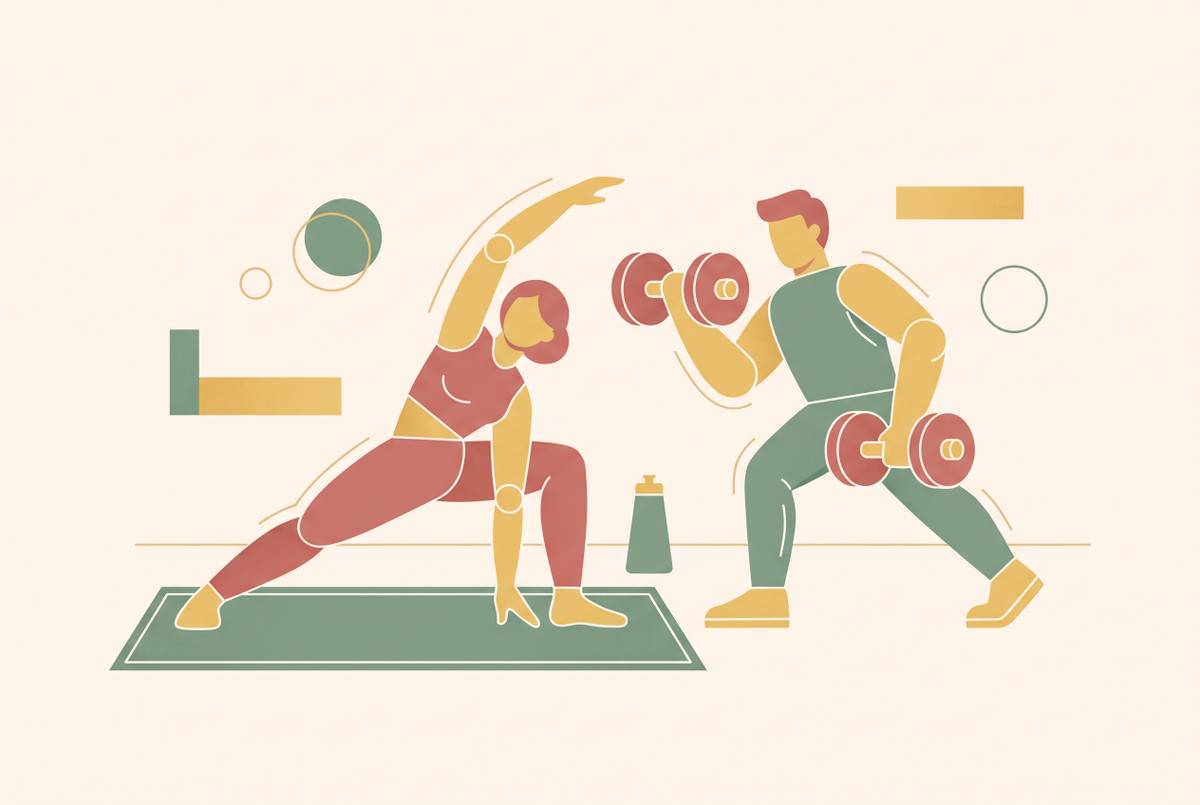
Partner or beginner-level flexibility and balance practice. This works especially well for couples at different fitness levels, since an easy or intermediate session delivers real physical and mental benefit no matter where each partner is starting from. Partner poses demand coordination and trust, and those two things carry straight over into relational attunement. The shared attention to breath and movement builds a kind of wordless fluency that tends to carry into the rest of the day. One short weekly session is enough to build the ritual without turning it into another obligation, since the goal is regularity rather than intensity. This option works especially well for couples where one partner is injury-prone or coming back from a break, since nothing about it demands high-impact movement.
A shared warm-up before separate workouts. Partners don't need identical programs to build a joint ritual. One of the most durable structures is simple: arrive at the same time, warm up together, then split off into separate sessions built around each person's own goals. This keeps individual autonomy intact, different goals, different fitness levels, different interests, while still building a shared ritual around the edges of the workout. The warm-up and cool-down double as a check-in, so partners exercise apart while still feeling connected through the time around it. It also sidesteps the competence gap, because nobody coaches, corrects, or evaluates their spouse mid-session.
A shared-pace outdoor activity, whether on a shared trail, matching gear, or done side by side, delivers real cardiovascular work while staying naturally non-competitive. The pace is set by whoever's slower, and the changing scenery keeps the routine interesting in a way a gym circuit rarely manages over the long haul. Finding new routes together adds the kind of shared, novel experience that research on joint activity ties to stronger relationship quality. Cycling tends to last as a long-term ritual for one simple reason: it doesn't feel like exercise. It feels like going somewhere together, which happens to also be exercise.
The friction points that quietly kill joint fitness habits
Most joint fitness habits don't die because of sore knees or bad scheduling apps. They die from friction that's relational, not physical, and every one of these problems has a fix once it's named out loud.
The competence gap appears when one partner has more fitness experience and starts coaching, even gently, even out of genuine care. That shift turns two equal partners into a teacher and a student, and unsolicited advice, however well-meant, can make the less experienced partner so self-conscious that they start skipping sessions. The fix is structural: pick rituals where coaching isn't really possible, a walk, a bike ride at a matched pace, or build in separate sessions so nobody's form is up for review.
The pressure dynamic is a quieter version of the same problem. A partner who feels constantly evaluated, for effort, for consistency, for results, will eventually check out, and even small comments about energy levels or food choices can pile up into something closer to shame. Research on partner motivation backs this up directly: negative social control, guilt, pressure, implied judgment, is tied to less frequent exercise, not more. Positive accountability looks different. It means showing up next to someone rather than monitoring them, celebrating consistency over performance, and treating a missed session as something to notice rather than something to correct.
Different fitness preferences cause friction too, and that's fine, because couples don't need identical habits to get the relational benefit. One partner might find intensity energizing while the other finds it draining, and forcing a compromise there tends to breed resentment rather than harmony. The fix is finding one shared ritual neither person dislikes, a walk both can agree to, even if one partner also goes for a run solo later. Relationships need shared direction, not identical habits, so a couple can spend most sessions apart and still get the full benefit from one or two joint rituals that carry the relational weight.
Scheduling asymmetry is the last common failure point, and you can fix it easily. Left to individual scheduling, the partner with less flexibility tends to drop out first, since their time is already spoken for. A weekly anchor, same day, same rough time, removes the need to renegotiate every single week. It turns the ritual into a standing commitment instead of a decision that has to be remade from scratch each time, which is exactly the kind of friction this whole approach is built to remove.
A missed week is a data point, not a derailment
Every couple eventually misses a week. The dinner walk gets skipped for a late meeting, then skipped again for a sick kid, and by the third missed session, a familiar thought sets in: we fell off.
That thought is mostly fiction. "We fell off" is a narrative that tends to appear after two or three skips, and the trouble is that saying it out loud makes it self-fulfilling. Treating a missed week as information instead, what got in the way, what the schedule actually needs, keeps it from turning into an identity. Couples who reflect on the gap tend to come back to the ritual. Couples who spiral over it tend to let it go.
A ritual that survives interruption is worth more than one that only works under perfect conditions. The goal was never a flawless streak, but a habit both partners can keep returning to, week after week, long after the first burst of motivation has worn off. Small acknowledgments help here too, so note that both people showed up, not just that the walk got a little faster. A photo texted from a solo walk, a quick check-in message, a lighthearted bet over who picks next week's route, these small gestures keep the shared identity of the ritual alive even in the weeks it doesn't happen. Coming back is the habit. The streak was never the point.
Using simple tools and light structure to support joint rituals
The right tools for a joint fitness ritual make it easier to start and easier to return to. They don't turn a dinner walk into a spreadsheet.
Plenty of the most durable options require no technology at all: a shared calendar block for the weekly walk, a group text where one partner drops a photo from a solo session, a running note of trails already tried. None of that needs an app, and none of it adds friction to something that's supposed to be simple by design.
Where a tool does earn its place is in making accountability feel like support rather than surveillance. A shared tool fits naturally here, not as another dashboard to maintain, but as a shared space built around showing up rather than measuring output. A photo from a walk counts the same as a logged gym session, because consistency is the whole point, not data density. A friendly wager on a simple shared goal, a visible streak that celebrates presence over performance, these are useful precisely because they're built for real life, including the weeks schedules don't line up and one partner ends up exercising alone.
The underlying rule covers any tool, not just this one: anything that makes the ritual easier to keep going is worth using. Anything that turns it into another obligation to manage isn't, no matter how many features it has.