Navigating Fitness When Newlywed Schedules No Longer Align
Wedding fitness routines vanish when shared schedules disappear—here's how to rebuild them.
Practitioner guidance suggests choosing two or three days each week to train together and treating those sessions as fixed appointments, since even brief sessions can be effective. Nobody decides to skip it. It just stops happening, because the schedule that used to make it automatic doesn't exist anymore. This piece is about why that happens and what to do instead of mourning it.
Why newlywed schedules disrupt fitness in the first place
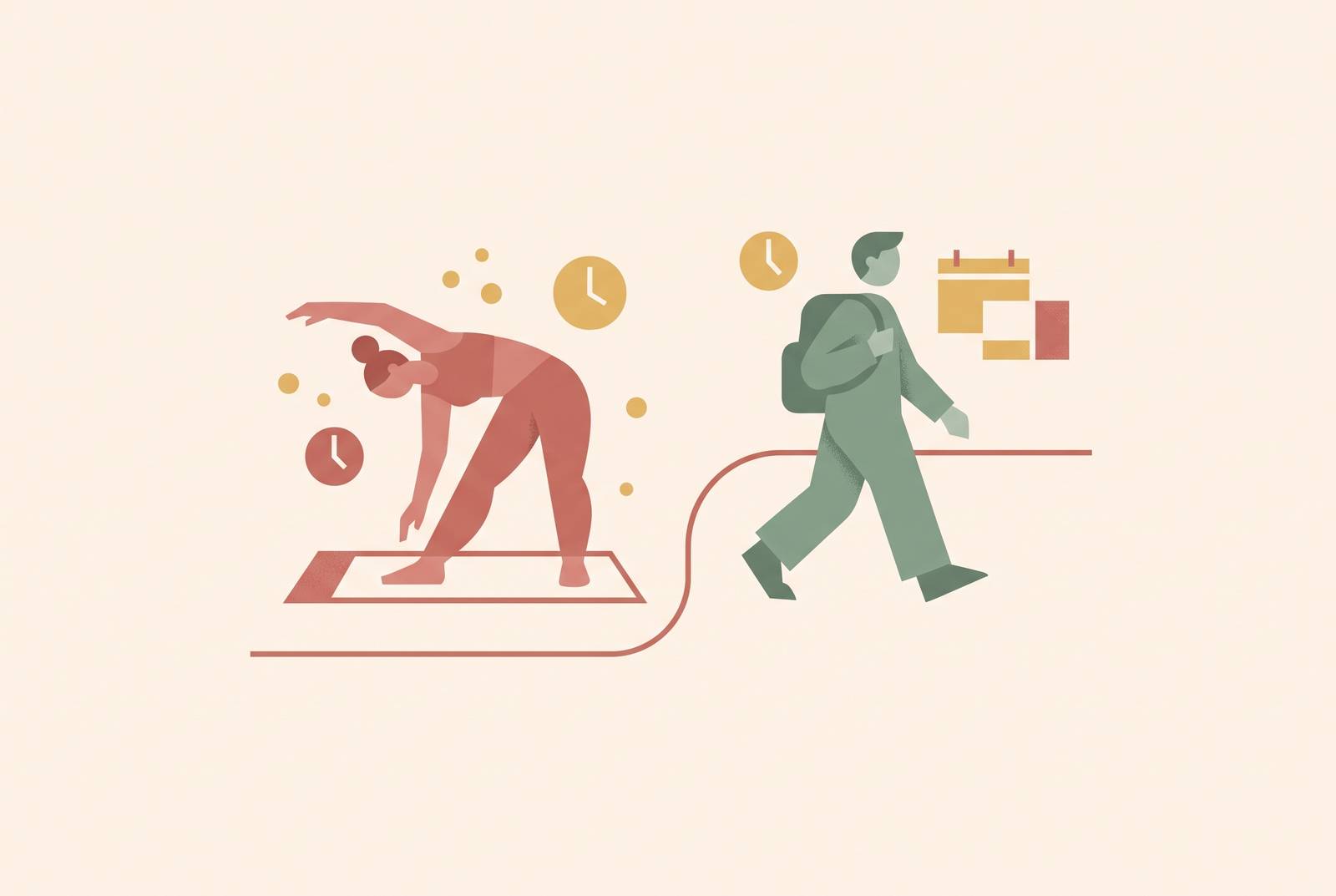
One day there's a gym routine that's run like clockwork for years. A few months into marriage, it's gone, and neither partner can point to the morning it actually ended. It's a scheduling problem: two separate lives merged into one household, and the routines don't line up yet.
Before the wedding, each partner built a fitness routine around a single, independent life. One person's after-work run worked because dinner happened whenever it happened. Marriage erases that independence overnight. Suddenly there are two sleep patterns, two commutes, and two sets of social obligations trying to occupy the same time, and the old routines don't automatically find a new home.
Researchers at Flinders University point to a simpler explanation for why the drop-off happens so fast: the wedding itself was the deadline. Once it passes, so does the motivation that organized everything around it. Their research describes it as couples settling into "more relaxed dietary and physical activity habits now that the newlyweds no longer have a special event" to train for. The event was the scaffolding. Take it down, and whatever it was holding up comes down with it.
A large study of adults found marriage associated with a 6.5% rise in overweight rates, and movement, not meals, was the cause. People weren't eating their way there. They stopped exercising and the weight followed. Layer onto that the fact that scheduling conflicts are already one of the most common sources of friction in a new marriage, and fitness just becomes one more calendar fight nobody signed up for.
What's at stake when fitness falls away together
Losing a workout habit isn't just a fitness inconvenience. It quietly removes one of the easiest, lowest-pressure ways to stay connected.
A BYU study in the journal Family Relations, built on more than a decade of data from the CREATE (Couple Relationships and Transition Experiences) project, found that couples who exercised together reported better communication, stronger conflict resolution, and lower marital stress than couples who didn't. Led by professor Jeremy Yorgason, with Ashlyn Hiatt Mildenhall and Matthew Nunez, the study found shared exercise had a stronger link to positive marital outcomes than solo workouts, and the most common shared activity wasn't anything intense. It was walking. That detail lowers the bar for "shared exercise" a lot further than most newlyweds assume.
There's a biological piece to this, too. Physical activity triggers oxytocin, the chemical tied to bonding and attachment, along with endorphins that ease pain and lift mood. Moving together makes people more open with each other. That's why a walk can defuse an argument that a sit-down conversation would only inflame.
Separate research published in Health Psychology found that marriage quality itself predicts weight outcomes in middle age. Fitness and relationship health aren't separate projects running in parallel. They feed each other, for better or worse, and letting one slide tends to drag the other down with it.
None of this is a reason to panic about a missed week at the gym. It's a reason to treat scheduling as worth solving rather than something to shrug off until "things calm down." They rarely do on their own.
Why matching schedules is the wrong goal
The instinct most newlyweds have is to hunt for one magic hour when both schedules are free. It's a tidy idea, and it's also the fastest way to turn a logistics problem into a relationship problem.
Fitness levels rarely match, even when calendars do. One partner's five-day lifting plan might be exactly right for their body and goals, while a lighter, lower-impact routine is exactly right for the other. The trouble starts when one person's plan quietly becomes the standard the other is expected to meet. That's how a shared goal turns into a source of resentment instead of a source of consistency.
A writer named Frost described this directly in a 2026 first-person account. She stopped trying to match her husband's routine step for step and instead let herself have her own. Once she went back to workouts built around her own pace, the gap became less charged.
The BYU research backs this up, with an honest caveat attached. Compared with couples who didn't exercise, married couples who exercised, whether together or separately, reported better communication and less conflict. Couples who worked out together showed a somewhat stronger link to those outcomes, but the study only looked at couples at a single point in time. It can't say whether exercising together caused the stronger relationship, or whether couples with stronger relationships were simply more likely to carve out time to exercise together in the first place.
That means separate workouts done with some shared intention behind them are a solid option on their own. They capture a large share of the benefit on their own, which takes the pressure off finding an identical hour and puts it back where it belongs: on building a habit that works for both people.
What a flexible shared rhythm looks like in practice
The model that actually holds up looks modest on paper. Pick two or three days a week to train together and treat those sessions like fixed appointments, not something to get to if time allows. They don't need to be long to count.
Walking is the easiest entry point there is. In the BYU sample, it was the most common shared activity couples reported, and researchers noted it "naturally provides opportunities to communicate," which is likely why it showed the strongest tie to better communication of any outcome the study measured.
When fitness levels differ, the fix is matching effort, not pace, weight, or equipment. People can be on completely different machines, doing completely different workouts, and still be sharing the same block of time and the same sense of working toward something together.
For workouts that happen apart, a little communication keeps them feeling like part of the same project instead of two private errands. Telling each other what the workout was, checking in afterward, or just marking it somewhere both people can see turns a solo gym trip into something that still belongs to the marriage.
If one partner wants to coach the other, that only works as a mutual decision with clear boundaries set in advance. The moment fitness turns into criticism, or one partner policing the other's effort, it stops doing any of the relational work it's supposed to do and starts undoing it instead.
Tools that support connection when workouts don't overlap
When schedules genuinely don't overlap, the tools worth using are the ones that make separate workouts visible to each other.
For couples whose schedules do line up often enough to train side by side, the TimeLift Couples Workout Timer, available on the App Store, is built for exactly that case. It keeps both partners synced through guided intervals, audio cues, and clear turn-taking, cutting down on the planning so more of the session is actual movement.
For the far more common case, separate sessions on separate schedules, Partner Fitness Review takes a different angle. It's built around a simple idea: a workout shared with someone who cares about it means more than a number sitting alone on a dashboard. Photos, friendly wagers, simple weekly goals, and honest encouragement are the mechanics, and all of them are built to make separate workouts feel like part of a joint habit.
What actually matters in a tool for misaligned schedules comes down to three things: both partners can see each other's activity without needing to be in the room for it, check-ins are as easy as a photo or a quick note rather than a spreadsheet, and the accountability feels like support instead of surveillance.
A shared calendar helps too, in a more boring but no less useful way. Treating the two or three joint sessions a week as fixed appointments in a system both partners actually look at keeps them from being the first casualty when a week turns chaotic.
How couples keep the habit when life inevitably interrupts
Every couple that keeps fitness alive long-term hits weeks where it falls apart anyway. A kid gets sick, work explodes, someone travels. The couples who come out the other side still training treat a missed week as data, not failure, and get back to the rhythm before it fully dissolves.
BYU's researchers point out that for a lot of young couples, especially those raising kids, shared exercise doesn't happen by accident. It takes deliberate effort to carve out the time. The habit has to be protected on purpose, the same way any other appointment that matters gets protected.
That the researchers suggest folding conjoint exercise into marriage education and therapy settings says something about how seriously this is being taken. This has moved past a wellness-blog talking point into something clinicians and educators are treating as a real tool for relationship health.
Consistency beats intensity here, by a wide margin. Two or three joint sessions a week, kept up for months, does more for both the relationship and the body than ambitious plans that collapse under the first scheduling conflict. A missed goal should prompt a conversation about whether the structure around it, the sessions, the check-ins, the simple weekly targets, is realistic enough to return to. The best workout plan is the one both partners can actually keep coming back to.