Setting Joint Fitness Goals in the First Year of Marriage
Couples who exercise together report stronger marriages and better odds of sticking with fitness.

The first year of marriage is when fitness habits either lock in or quietly fall apart, and the timing is not a coincidence. Commonly cited research puts average newlywed weight gain at 4 to 5 pounds, though a OnePoll study done for Jenny Craig found a much steeper number: 17 pounds in year one. It's a marketing-adjacent online poll, not a peer-reviewed trial, so treat that higher figure as directional rather than clinical, but even the conservative estimate points to real weight gain after marriage.
The gap between men and women is where it gets interesting. A 2018 survey cited by U.S. News found 69 percent of men in relationships gained weight compared to 45 percent of women, and the average gain split 22 pounds for men versus 13 for women. Nobody's fully nailed down why the scale tips that hard toward men, producing this pattern consistently across the data.
Timing makes this window especially dangerous. Comfortable is a nice word for a relationship and a risky one for a waistline, and it's the point where the going-out-of-your-way behaviors, the effort to look sharp for date night, the solo gym runs, start to fade because nobody's performing for anybody anymore.
Happiness doesn't protect you here. A four-year study led by SMU psychologist Andrea L. Meltzer, published in Health Psychology, tracked 169 newlywed couples and found that spouses more satisfied with their marriage actually gained more weight over time. The theory researchers landed on is almost funny once you say it out loud: happy spouses feel less pressure to stay attractive to a hypothetical alternative mate, so the incentive to "stay in shape for the market" quietly disappears.
None of this is a warning to panic about. It's an invitation to be intentional early, aiming for three to four joint sessions per week while protecting space for individual workouts. The good news, covered next, is that couples who build fitness into the relationship itself, rather than treating it as a solo chore that happens to be scheduled around a spouse, tend to do better than the averages above suggest. Individuals aged 18–24 reach the "comfortable" phase of a relationship the quickest, at just over ten months, making the early marriage window especially vulnerable.
What the research shows about exercising as a couple
The strongest recent evidence comes from a 2026 BYU study published in the journal Family Relations, and the scale alone makes it worth leading with. Researchers pulled data from a large sample of young married couples across the United States, led by student first author Ashlyn Hiatt Mildenhall alongside co-authors Matthew L. Núñez and BYU School of Family Life professor Jeremy Yorgason. Couples who exercised together reported better communication, stronger conflict resolution, and lower marital stress than couples who didn't. The relationship held even after controlling for how much each partner exercised on their own, meaning joint exercise carried its own independent link to relationship well-being, separate from just "being a person who works out." The most commonly reported shared activity wasn't anything requiring a gym membership or fancy equipment. It was walking, which led researchers to point out that couples don't need an expensive setup to see the benefit.
The effect was small, and the study measured association, not causation. Nobody proved that exercise creates a better marriage; it's just as plausible that couples with already-strong communication find it easier to exercise together in the first place. Small and consistent beats flashy and unreliable, and the effect appeared repeatedly across the data.
Other research fills in why the mechanism might work. In one study, 95 percent of couples who started a workout program together finished it, compared to 76 percent of people going solo. That's not a small gap. It suggests having a partner in the room makes you show up on the day you'd otherwise skip. Separately, research published in the Journal of Sport and Exercise Psychology found that working out with a more experienced partner boosted the motivation of the less experienced one, a pattern researchers call the Köhler effect. And a 2015 study found something close to social contagion: when one spouse improves their exercise habits, the other becomes significantly more likely to follow, so a good habit picked up early in marriage doesn't stay contained to one person.
The honest caveat is this. A 2024 study of 240 adults in Singapore, ages 54 to 72, found that older couples who exercised together actually logged lower total physical activity than those who exercised alone, possibly because the fitter spouse slows down to match the other's pace. That doesn't cancel out the BYU findings; it just means the benefit looks age- and context-specific. For newlyweds specifically, the evidence tilts favorable.
Why joint goals work psychologically
Exercise releases endorphins on its own, but doing it side by side with a spouse links that mood boost to the relationship itself, not just the workout. Over time, the brain starts associating "feeling good" with "being near this person," which is a pretty efficient way to build affection without either of you having to try particularly hard at romance.
Scheduling a joint workout also builds a kind of accountability that's different from anything an app or a personal trainer can replicate. A trainer's disappointment is transactional. A spouse's expectation carries emotional weight, and skipping on them creates a small, specific friction that skipping a solo gym session never does. That friction, uncomfortable as it sounds, is actually useful. It's the thing that gets you off the couch on the day you'd otherwise talk yourself out of it.
There's also something happening in the body language of shared movement that conversation alone doesn't produce. Running next to someone, hiking, spotting them on a lift, matching pace on a bike: all of it creates a kind of physical rhythm that tends to loosen people up. Plenty of couples report that hard conversations come easier mid-workout than across a dinner table, probably because sitting face-to-face with direct eye contact raises the emotional stakes of every sentence, while movement gives both people somewhere else to put their attention.
Now the part where couples most often trip themselves up. One partner slides into the role of coach, correcting form, tracking the other's pace, commenting on effort, and what started as encouragement starts landing as criticism. Research in exercise psychology backs up what most people already sense intuitively: people sustain healthy habits longer when they feel supported rather than controlled. Call it supportive autonomy. It means encouraging your partner's goals without owning them, protecting their training time without micromanaging it, and showing up for the setbacks without turning them into a lecture.
First-year marriages are especially exposed to this trap. Everyone is still mapping the other person's sensitivities, still figuring out what lands as caring and what lands as judgment, and fitness is exactly the subject where those lines blur fast. A comment meant as encouragement can read as a critique of someone's body, and once that happens, it's hard to fully take back.
Starting the conversation: how couples align on goals they share
That sounds obvious, but most couples skip straight to logistics (what time, what gym, what app) without ever naming the goal that drives those choices. One partner might want to train for a race at a distance that suits them; the other might just want to get stronger. Those goals don't have to match. They just have to be compatible.
Dr. Gabb, cited at Paired.com, said agreeing on and working toward shared goals can strengthen the emotional bond between partners, but it's rarely as simple as it sounds, given how much partners can differ in strength, schedule, and other commitments. Say that directly to your spouse, because it takes the pressure off pretending you're supposed to want identical things.
A few questions are worth asking each other before any plan gets made. What do you actually want to feel after a workout, energized, calmer, stronger, and is that different from what your partner wants? What's each person's real schedule, not the aspirational one? What activities does each of you enjoy, versus just tolerate because it seemed like the "married couple" thing to do? And how much of this do you want to share versus keep as your own space?
Vague goals don't survive contact with a real week. Swap "get fit" for something you can actually check off: finishing a six-week program together, hitting a shared step count, holding a plank for a specific time. A goal with a deadline, an event, a date, a specific month, creates natural check-in points without either person needing to run a formal tracking system.
The couples who stick with this longest tend to connect fitness to something bigger than the workout itself: staying energetic enough to travel together, having the stamina to keep up with future kids, just wanting more good years together. That kind of framing turns fitness into part of the marriage's future instead of a chore competing with it.
Building a routine that fits two schedules, two fitness levels, and two preferences
Not every workout has to be shared, and trying to force that is usually where routines collapse. The more durable model blends joint sessions with individual ones. A husband might lift weights solo some mornings a week while his wife takes a group class on her own schedule, aiming for three to four joint sessions per week while protecting space for individual workouts. That's still a shared physical life. It just isn't a shared workout plan, which changes how the couple actually experiences their fitness routine together.
A commonly recommended starting point is three to four joint sessions a week, with individual workout time protected on either side. Protected is the operative word. If solo workouts constantly get bumped for joint ones, resentment builds fast, even in a good marriage.
Treat partner workouts the way you'd treat any appointment that actually matters, put it on the calendar, and if something forces a cancellation, reschedule it instead of letting it quietly vanish. Most consistency problems don't come from big blowups. They come from the daily negotiation of "should we work out today," which, left unscheduled, tends to resolve toward "no."
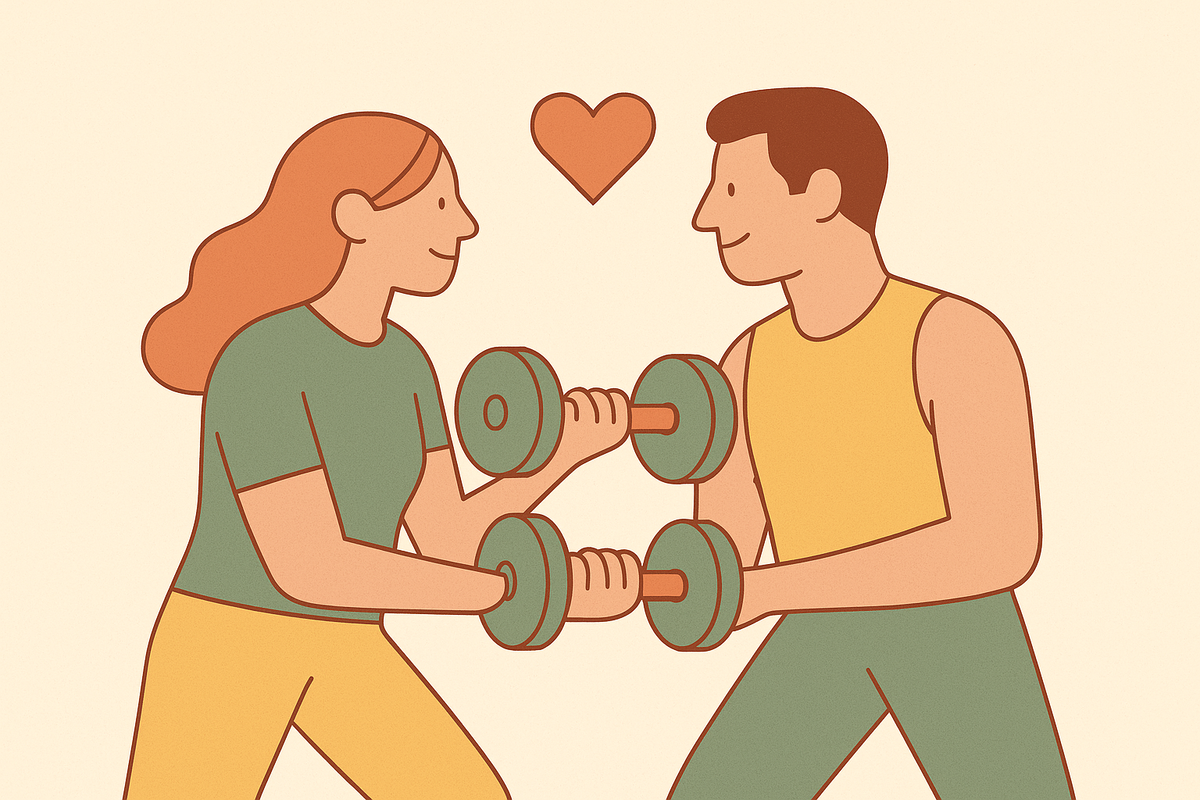
Mismatched fitness levels are one of the most common friction points, and the fix doesn't require pretending the gap doesn't exist. HIIT-style circuits work well here: one partner goes hard on an exercise while the other does active recovery, then they switch. Both people stay moving, both get built-in rest, and neither one is standing around waiting on the other. Something as simple as facing each other in a squat and holding hands for balance solves a form problem while keeping the exercise collaborative rather than parallel. The goal in all of this is structural: find setups where nobody feels like the anchor and nobody feels like they're being dragged.
The same logic extends into the kitchen. Couples who train together tend to eat better together too, cooking real meals, checking in on hydration, planning food for the week instead of defaulting to takeout. The same idea extends further: fitness becomes something the household does instead of one person's individual project.
Activities that give newlyweds built-in reasons to keep showing up
Whether both people will actually do it again next week matters more than the specific activity, but some activities make that easier than others. Anything with friendly competition, squash, tennis, badminton, gives you cardio wrapped in a bit of playful rivalry, which keeps the sessions from feeling like homework. For couples who'd rather move in sync than compete, jogging or cycling together scales easily: adjust the pace or the distance and both partners stay in the same workout without either one gasping to keep up.
Dancing deserves its own mention. A salsa class or a Zumba session at home adds a bit of romance to the routine, burns real calories, and gets both people learning something new together, which lowers the stakes since nobody walks in as the expert. Strength training can go the same collaborative direction: partner press-ups with a high-five at the top, passing a medicine ball during sit-ups, squat challenges done hand-in-hand for balance, resistance band work done facing each other. None of it requires new equipment. It just requires turning a familiar exercise into a two-person version of itself.
And then there's walking, unglamorous, free, and the single most commonly reported shared activity in the BYU research. It's also the activity tied to the relationship benefits that study found, which says something about how little the benefit actually depends on intensity. A daily walk together clears a low bar and still counts.
Signing up for an event, a race, a charity walk, a hike with a set date, gives both partners a shared target and a built-in finish line to celebrate. That structure creates its own accountability without either person having to nag the other into training. Rotating in something totally new each month, climbing, martial arts, a beginner yoga class, keeps things from going stale, and when neither partner has done the activity before, nobody's the expert, and nobody feels quietly graded by the other.
How to track progress and celebrate consistency without turning it into a performance review
Tracking becomes visible before anything else is tracked. How many times this week did both of you actually do the workout you planned? That number matters more early on than any performance metric, because consistency is what determines whether the routine survives month three, long after the initial motivation from the wedding high has worn off.
A shared app or a simple shared notebook works because it makes progress visible to both people at once. Sweatmates, a fitness accountability app for couples built around shared workout tracking, photo check-ins, and weekly recaps, is one option designed specifically for that kind of two-person visibility. Progress only one partner can see stays private, which quietly turns it back into an individual project. Progress both partners can point to becomes a shared story, something you can look back on together instead of something one person quietly monitors.
Photos do more motivational work than most people expect. A picture from a workout marks a specific moment in a way a spreadsheet cell never will, and it gets pulled up months later and laughed over. Small milestones like finishing a first month of three-times-a-week sessions, completing a training plan, or trying a new activity for the first time deserve to be named out loud. None of that needs a ceremony. It just needs acknowledgment.
A little friendly competition helps keep things light without tipping into pressure: who hit their step goal more days this week, who holds a plank longer today. Low stakes, a bit of teasing, no scoreboard that follows anyone into next month. That's the whole point of doing this together in the first place: fitness becomes a way of showing up for each other, not another category where one spouse quietly grades the other's performance.