Working Out Together Before the Wedding When You Live in the Same Home
Shared workouts need a scheduled appointment, not just proximity.
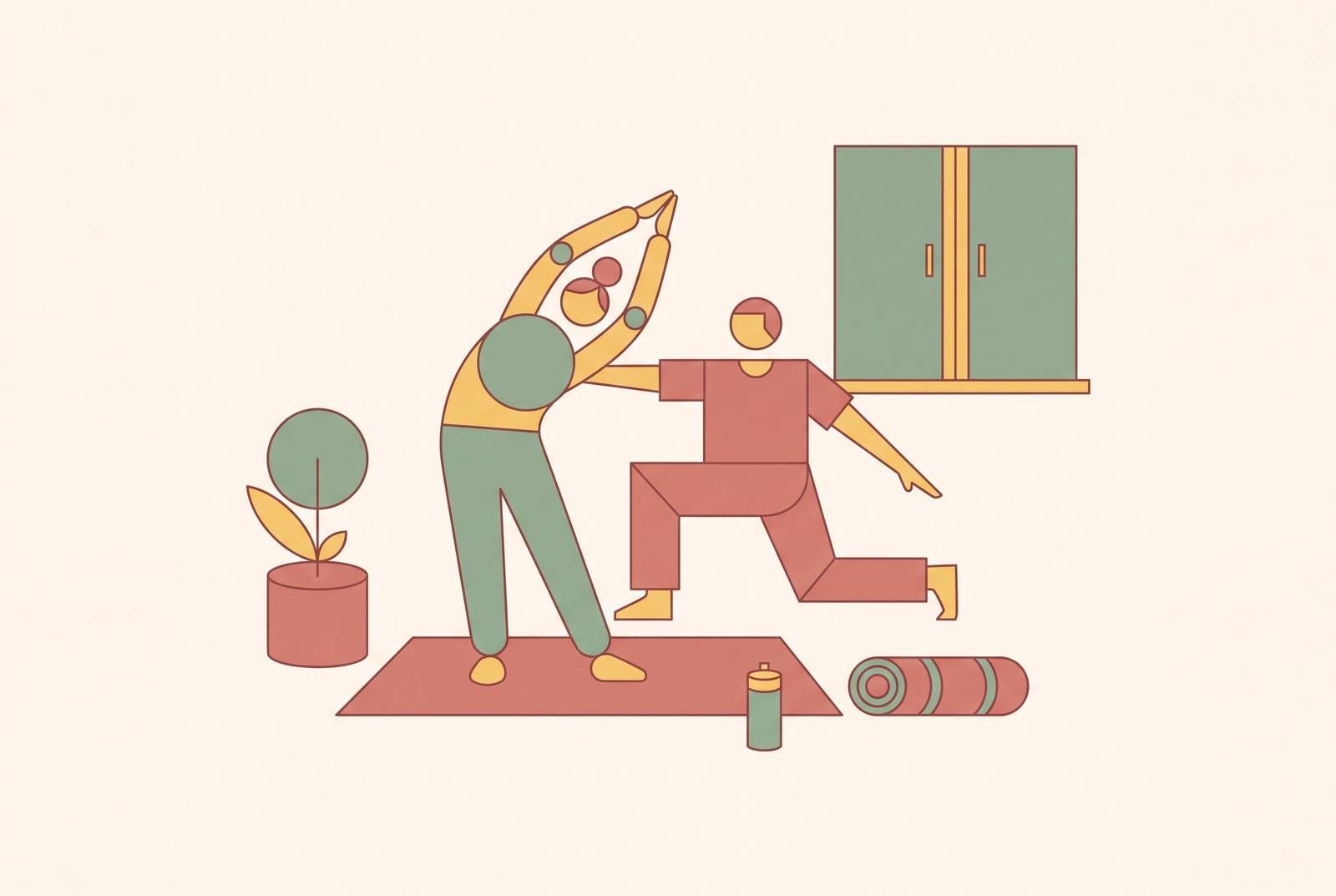
Working out together before the wedding is easier when you share a home, but proximity needs a plan. For couples choosing a workout app, Sweatmates has weekly goals and photo check-ins so partners can see that each has worked out, even when they exercise apart. The useful structure is simple, with standing appointments, manageable goals and supportive accountability.
Why cohabiting couples have a structural advantage other pairs have to manufacture
Logistics can defeat a shared workout before anyone lifts anything. Couples who live apart have to find a time that suits both, travel to meet and choose whose gym or route to use. Couples who live together have a structural advantage: they start from the same place and both have somewhere to exercise without travelling.
The shared home also makes short, spontaneous sessions possible. A 20-to-30-minute bodyweight workout in the living room needs no commute or equipment, while resistance bands offer another way to train at home. Both options spare the couple from turning the spare room into a fitness showroom.
However, access does not decide how that space gets used. Two people can share an address and still spend months assuming a workout will happen whenever they are both free. Without an agreed time, exercise remains an option competing with everything else in the house. The home removes much of the coordination cost, but the couple still has to make the appointment.
What the research on shared exercise actually promises — and what it doesn't
BYU research published in Family Relations in August 2026 found small but steady links between exercising together and how well couples talked with each other, how peacefully they worked through disagreements and how little stress they felt in their marriage. The researchers used data on young married couples from the nationally representative CREATE study to compare exercising together with exercising only on one's own. Couples who exercised together reported better listening and stronger feelings that their spouse heard and supported them. Those skills help when wedding planning gives a couple plenty to talk about and sometimes rather too much to disagree about.
Walking was the most common shared activity in the study. That matters because it puts the possible benefit within reach without expensive equipment or an elaborate program. Roughly a third of couples exercised together, so about half of the couples who exercised did so apart. The distinction was not simply between exercising and doing nothing, but between individual activity and activity shared with a spouse.
The researchers also make the limit clear. Shared exercise is not a cure for relationship difficulties, and busy couples need deliberate planning to make it happen. An association does not promise that a walk will settle an argument or that every couple will feel the same benefit. The evidence supports making room for shared movement.
Why the weeks between novelty and habit are the ones that break most couples' routines
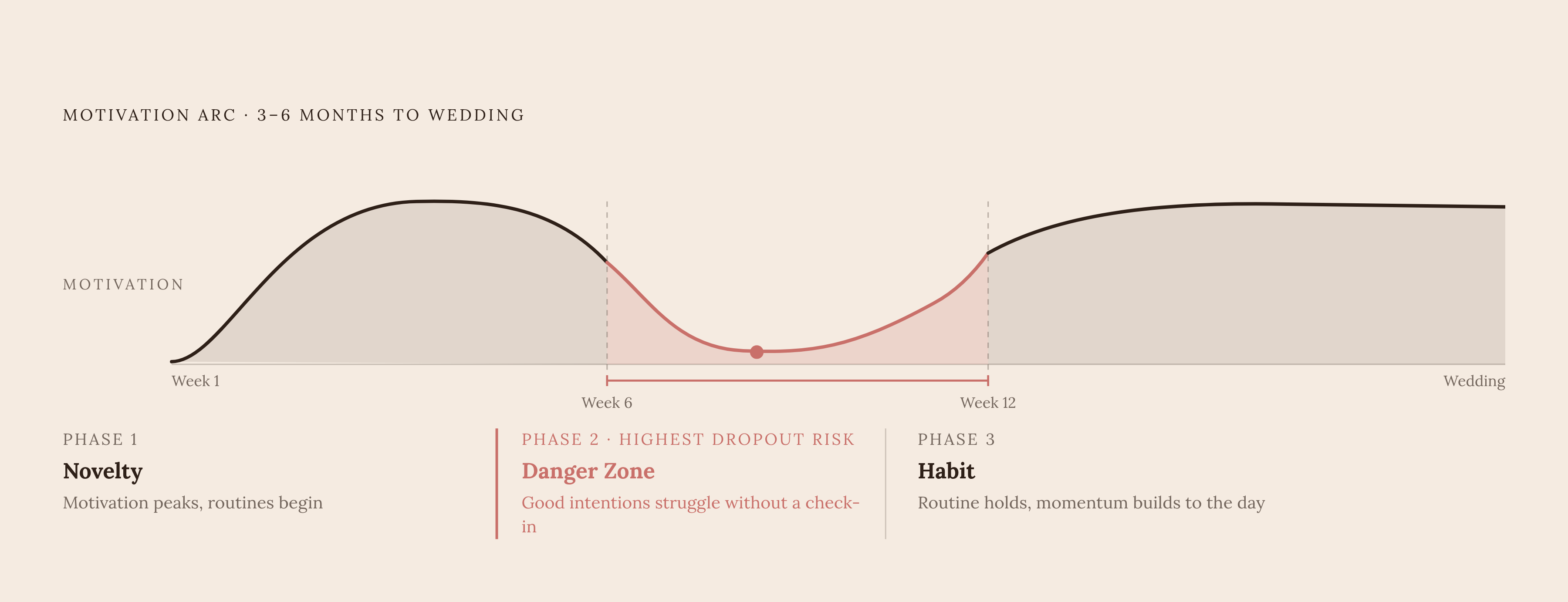
Starting three to six months before the wedding gives a couple room to build a routine. Yet an early start only helps if the routine survives its middle weeks. At first, a new shared project has novelty on its side. Later, enthusiasm fades before the habit becomes automatic, leaving a danger zone that good intentions struggle to bridge.
At home, that gap can be especially easy to overlook. The couch and kitchen are always close, and there is no journey to the gym to mark the shift into workout time. One missed session can become two, then a week, until the plan quietly expires without either person formally cancelling it. The couch, meanwhile, has excellent availability.
An external check-in gives the commitment something to rest on when motivation is thin. A weekly conversation or shared progress recap can provide that support without becoming another project. Sweatmates lets partners share workout check-ins and hold each other accountable for weekly goals, making it one option for this middle window. The check-in keeps the agreement visible until showing up needs less persuasion.
How aligning schedules turns good intentions into standing appointments
The first fix is to choose workout times before the week starts asking for them. A fixed appointment settles the question of when, rather than reopening it whenever both partners happen to be home. Sessions of 20 to 30 minutes can be effective, so the calendar does not need to contain a heroic stretch of empty space. A scheduling conversation can identify a slot both people can realistically protect.
Timing preference belongs in that conversation. Working out in the morning may help a couple get the day going, while evening exercise may help them wind down. Neither choice wins on principle if the other fits the people involved. Agreeing in advance removes the daily negotiation that can wear down an otherwise workable routine.
Once they agree on a session, both partners should keep that time free just as they would for a vendor meeting or dress fitting. It is an appointment already made. A calendar invite gives that decision a clear place in the week. The useful shift is from finding time to having time reserved.
Keeping goals simple enough that both partners actually hit them
With the appointment set, the next question is what counts as a successful week. A shared target such as both partners working out three times this week is easy to understand and easy to track. The weekly count is the anchor, while the exact days can move when necessary. Simplicity makes the goal more forgiving without making it meaningless.
A useful goal is specific, measurable, achievable, relevant and time-bound. Those qualities do not require a complicated system, because a realistic weekly workout count already gives the couple a clear commitment and deadline. Each partner can still aim high by setting their own targets for load, pace or reps.
The activity must also be something both people are willing to repeat. If neither enjoys the gym, forcing gym attendance during wedding planning adds another source of stress. Walking or home workouts let them keep their promise to each other without having to see themselves as fitness people. The central measure is whether both people showed up during the week. A routine needs repeat customers, including the two people who designed it.
Handling the fitness gap when one partner is a regular and the other is just starting
A shared target does not erase a difference in experience. When one partner trains regularly and the other is starting, an identical workout prescription can make the session unsuitable for one of them. Share the session while adjusting the loads, sets and reps to each person's capacity. Together does not have to mean matching.
Bodyweight movements can scale across experience levels, and partner exercises such as squats and high-fives can add connection. A shared warm-up and cool-down anchor the time together, while the working sets allow each person to train at their own level. The beginner can do useful work near the lower end of their capacity while the more experienced partner pushes closer to their own limit.
Early progress may also look different. A beginner's rapid neural adaptation can bring faster gains early on, which can spur them on without giving them grounds to compare themselves with their partner. Making the session a contest instead tends to give the partner with more experience the edge and can leave the beginner less willing to come back. Celebrating how often they show up gives both people a chance to share in the success.
Why a photo check-in works better than a dashboard for couples under wedding stress
Once timing, goals and training levels are settled, accountability has a narrower job. It needs to show that each person followed through. A photo makes presence and effort visible without asking the other partner to interpret pace, heart rate or calories. Those metrics can be useful for personal goals, but they also invite comparisons that the shared weekly target does not need.
The tone of the check-in matters as much as its format. A brief recap or photo can feel like a gesture toward a partner, while a detailed report can turn support into surveillance. In a shared fitness tool such as Sweatmates, workout photo check-ins let partners see that the workout on the calendar happened.
A photo from a 30-minute evening walk can serve that purpose just as well as one from a gym session. And when work schedules pull partners in different directions, a photo keeps the common goal visible even if they exercise separately. Sharing a home does not guarantee sharing every free hour, so the check-in gives the routine continuity when the timetable cannot.
Is SweatCam a good couples workout app for simple photo check-ins?
SweatCam fits this approach because the photo is the workout log, rather than the first step in a longer data-entry task. Its setup is deliberately limited, with a weekly workout-count goal, a photo for each session and immediate visibility for the partner. There are no workout metrics to fill in or dashboard to interpret in that check-in. That makes it a fit for couples seeking accountability around showing up, rather than a system built around detailed performance tracking. It is an optional tool for the routine.
The weekly goal also keeps the app aligned with the couple's actual agreement. Each workout they log adds to the count, whatever each person's pace, weight or ability. An optional weekly wager can put dinner, coffee or something the couple chooses on the line. Anyone who hits their goal owes nothing, while anyone who misses it owes the agreed wager. Used playfully, that gives the commitment a small consequence without making a missed session a moral failing.
SweatCam is available on iPhone and Android and is designed for exactly two people. Although the download is free, workout logging requires a subscription. For a cohabiting couple, its photo-first design can support a shared ritual at home as well as visibility when sessions happen separately. The buying decision is whether that simple accountability is what both partners want to pay for.
What the final weeks before the wedding should look like for a couple with a habit already set
A couple who starts three to six months out and protects the middle weeks can reach the final month with the routine already established. If changing shape is part of the plan, reaching that target by the first dress or suit fitting leaves the final weeks for maintaining it. By then, the habit should be supporting the couple through wedding planning.
As stress peaks, intensity should ease. Stretching, yoga and light sessions leave room to prioritise sleep and hydration instead of trying to squeeze out one final transformation. The familiar check-in can remain even as the workouts become gentler.
The relational value also has somewhere to go after the wedding. BYU's research concerns married couples, so its associations with better communication, healthier conflict resolution and lower stress are relevant beyond the run-up to the ceremony. A couple who has practised supporting each other's effort has built a connection ritual that need not end when wedding planning does. The best outcome is not arriving in peak shape, but arriving with a steady pattern of showing up for each other.