Apps That Let Engaged Couples View Each Other's Gym Sessions During the Wedding Countdown
Long-distance couples stay motivated by sharing gym photos instead of workout data.
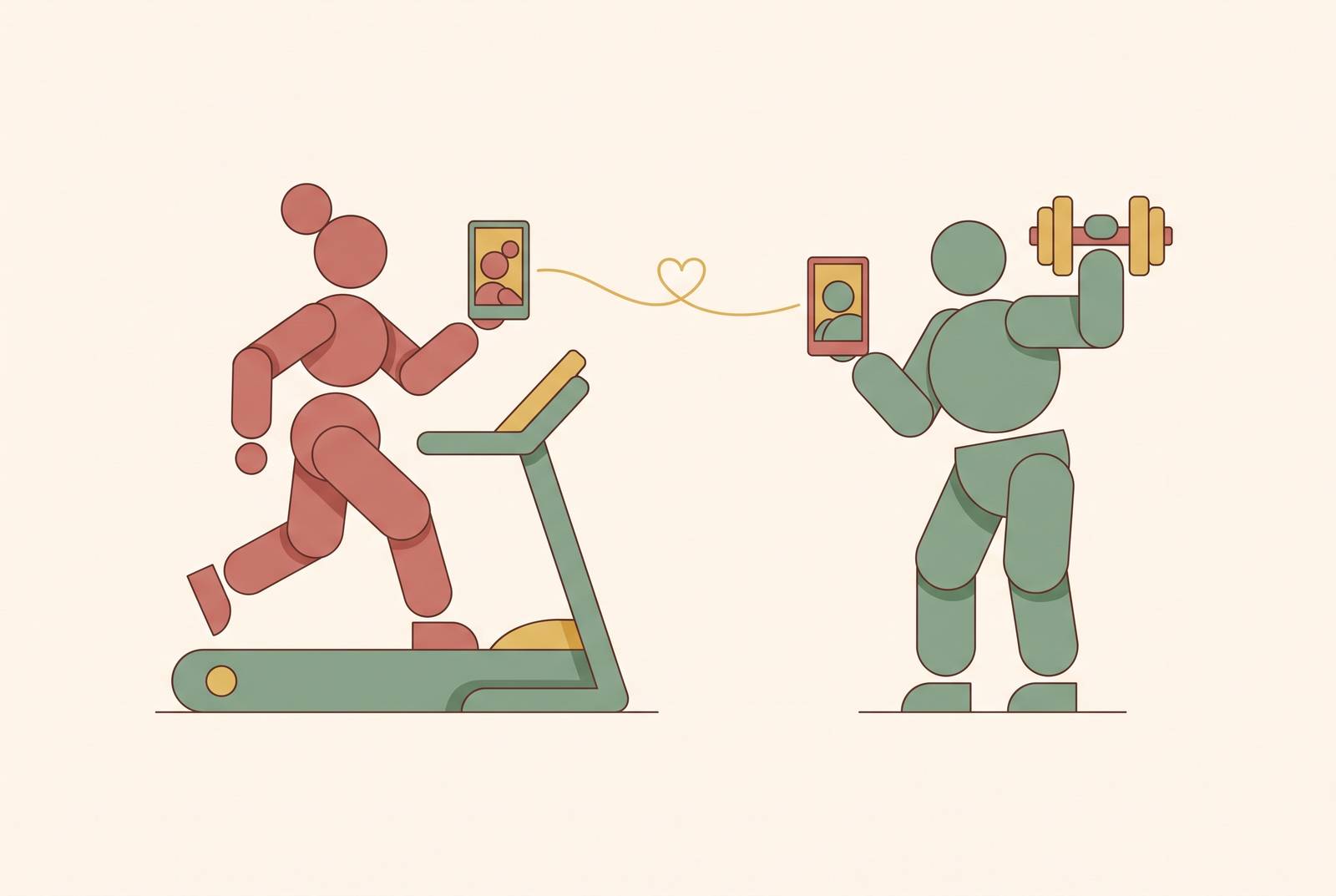
For engaged couples, staying fit together in a long-distance relationship works better as a shared check-in habit than as two private wedding-countdown projects. Set a weekly workout goal, take a photo when you show up, and let your partner see it immediately. SweatCam lets partners share photos this way, so they can work out at different times and still see each other’s effort.
Why engaged couples treat wedding-countdown fitness as a solo project — and why that makes it harder
In the month after they get engaged, both people download their own fitness apps. One picks a bridal program, while the other chooses a personal training plan, and both have the wedding date in mind. It looks like a shared project on paper. In practice, each person has a private set of instructions, a separate schedule, and little sense of whether the other is following through. The calendar is shared, but the effort is not.
That split reflects how wedding fitness is usually presented, as a personal transformation with a very well-photographed deadline. Yet partners can feel more or less rushed, start at different fitness levels, and train at very different times. Distance makes the gap even more obvious. A missed session can pass unnoticed, but so can a hard-won one squeezed into a busy workday. The flaw is not necessarily weak motivation or a poor program, but the absence of a shared stake in showing up.
How do long-distance partners motivate each other to work out consistently?
Seeing a partner show up can nudge someone to act on a plan to work out. A gym photo says that someone you care about made time today, even if your own session is still hours away. The signal is personal rather than numerical. It can make them want to match their partner’s effort without needing the same workout, the same ability, or talks over a calendar worthy of an international summit.
One can train while the other is busy and leave a check-in that is there when their partner looks. What joins the sessions is knowing that both people are contributing to the same habit.
That external nudge becomes especially useful after the excitement of a new routine fades. The wedding still feels important, but the decision to exercise has to compete with an ordinary working day. Intention alone can become unreliable in that stretch. A partner’s check-in puts the shared commitment back in view without turning it into another reminder from a machine that has never had to finish work late.
There is a fair objection to this arrangement. A photo shows presence while leaving how long someone trained, how hard they worked, and whether their program is progressing unrecorded. A partner who has trained for years may well want those details for their own training. But that is a different question from whether both people are maintaining the habit. During the countdown, mutual visibility addresses “did you both keep going?” rather than asking each person to submit a performance report.
Why a photo check-in loop is the simplest structure that delivers mutual visibility
The photo check-in loop has three moving parts, which are setting a weekly session goal, taking a photo when you show up, and letting your partner see it immediately. Each part has a distinct job. The goal spells out what each person plans to do, the photo shows their effort, and sharing it lets their partner see it. Together, they turn an otherwise private workout into a small point of contact between partners.
The photo also puts the person before the metric. A step count tells a partner something happened, while a gym selfie shows the person doing it. That is the relational advantage of the format. The check-in is a sign of participation.
For a couple already managing a wedding calendar, that narrow purpose is a considered design choice. A more complex system introduces settings, data, and decisions that both people have to understand. Simplicity keeps the coordination cost down. It also means a beginner can join in without having to post numbers that look good beside an experienced partner’s results. A photo at the gym door can count just as much as one taken mid-deadlift, because the shared measure is attendance.
The format does have a practical trade-off. Some photo check-in features use both cameras, which can feel awkward in a crowded gym because the back camera may capture other people exercising. Couples should know about that limitation before adopting the routine. Proof that someone showed up should not come with a supporting cast who wandered into the shot. How much partners like the quick photo check-in depends in part on how at ease they feel taking it where they train.
How SweatCam turns the photo check-in into a shared weekly streak
SweatCam is a feature for logging photos with a weekly goal. Each partner chooses how many days they want to train, takes a quick photo when they show up, and shares proof that the other partner can see immediately. The commitment belongs to each person. That lets the couple share the habit of showing up even when they have different schedules or start at different fitness levels.
Instead of treating every session mainly as another entry in an accumulating data record, it gives the couple a visible shared streak. Missing one session does not break a long-term graph. The focus stays on the current week, which is a more contained unit of accountability than the entire stretch between engagement and wedding day.
Its two-person design makes the social signal specific. The check-in comes from the person sharing the milestone, rather than from a general feed of other people’s exercise. That focus also creates a real dependency. If one partner becomes unreliable, there is no group to absorb the gap, and the shared streak depends on both people continuing to participate. A simple tool can make effort visible, but it cannot supply that effort for either partner.
For the beginner, any photo from any workout counts. There is no need to perform an impressive session for the more experienced partner before participating in the shared habit. That is forgiving without being a training prescription. SweatCam does not say what kind of workout to do, how long to train, or how hard to work, so someone who wants that help needs another tool.
Apps that address the workout itself when one or both partners need a training plan alongside the check-in
Knowing that both partners attended does not tell either person what to do once they arrive. A complete beginner may need a structured program even when the accountability loop is working well. These are separate jobs for an app. A training tool supplies the session, while the photo check-in makes participation visible to a partner.
FitWithLove: Couple Workout, developed by Life Activator and available on Google Play, provides guided partner exercises for two people at home without equipment. It suits couples who want to train in the same space. FitWithLove has streak tracking, 30+ achievement badges, calorie tracking for each person, and a workout history with a 4-week trend chart. It also offers a one-time Pro purchase to remove ads and access exclusive plans.
FitWithLove’s accountability comes from doing the same session simultaneously. The badges and streaks add light gamification to that co-workout structure.
WallPilates offers an individual training option on iOS, with a personalized plan based on a quick quiz. Its sessions can be as short as a few minutes and require only a wall. The equipment list is refreshingly brief for a wedding household. WallPilates is free to download, with paid monthly or annual subscriptions and optional add-on challenges.
The practical choice depends on how each person exercises. If one runs and the other prefers strength or HIIT, the useful criterion is whether an app builds a separate plan for each person. Mismatched fitness levels are normal. A couple can share accountability while keeping training individual, just as they can share a wedding without agreeing on every song played at it.
How to add friendly competition without turning accountability into pressure
Once the weekly check-in is a habit, a playful challenge can help keep it fun through the less exciting middle weeks. Sessions completed, streak days, or minutes moved give partners a way to compete without comparing calories burned or weight lifted. Any movement can contribute to the score, so different bodies and different sports do not automatically give one person the upper hand.
For that rivalry to stay light, both partners need to see the score without repeatedly asking for updates. The wager should also stay small and reset weekly. A breakfast obligation, a chore swap, or a single low-stakes wish is enough to give the result some texture. Nobody needs a household debt collection department. A lost week should stay in that week so disappointments do not pile up.
Seeing each other show up can help partners keep going, but shaming them or watching their every move can make them resent the check-in. A missed workout is not a character reference. Friendly wagers and rewards work as habit-building tools only while the game remains something both people want to play, rather than a polite name for one person policing the other.
A cooperative challenge offers another way to use the score. The couple can aim for a joint weekly session total that they either reach together or “lose to the couch.” The couch can cope with being cast as the villain.
Building a habit that outlasts the wedding date
A wedding date provides urgency, but urgency has an expiry date. If exercise depends entirely on the countdown, the reason for continuing can disappear once the event is over. The deadline works better as an on-ramp. The shift away from crash transformation toward longer-term habits, including strength training for posture, energy, and confidence, fits a routine that has somewhere to go after the photographs are taken.
That durability depends on a stable cue, routine, and reward. For couples, the reward can be the moment of connection when a partner’s check-in arrives. Distance does not remove that possibility. Partners in different time zones can keep that small exchange even when their sessions remain separate, because the shared experience is acknowledging each other’s effort.
The low bar of any workout and any photo also leaves room for difficult weeks. A reduced level of activity can still contribute, instead of turning an imperfect week into a reason to abandon the whole routine. Missing a goal should prompt reflection. What makes the check-in worth keeping after the wedding is not the photograph of a workout, but the person on the other end who is glad it arrived.