How Engaged Couples Build Mutual Workout Accountability Into Their Wedding Countdown
Couples use photo check-ins and playful stakes to stay accountable through engagement.
Engaged couples can stay fit together in a long-distance relationship by making workouts visible, agreeing on weekly goals, and keeping the consequences of skipping small and playful. Photo check-ins let partners in different time zones share the effort without having to work out at the same hour. The wedding countdown gives this system a shared deadline, turning fitness from a private intention into a habit both people help sustain.
Why the wedding countdown is a structurally different motivation window than a New Year's resolution
A New Year’s resolution supplies a start date. A wedding supplies a fixed, visible deadline, a shared social event, and a partner who has a reason to care about the same countdown. The calendar has acquired a witness, and that witness is also choosing table settings.
People who plan to get fit often have no one to see whether they follow through, no set end date, and no immediate cost when they skip a workout. During engagement, the problem gets harder because fitness competes with planning decisions and real psychological strain. A workout has to survive the day as it actually unfolds.
Yet the same period supplies three useful behavioral levers, namely visibility, social cost of skipping, and light stakes. A partner shares the deadline and can become a daily witness to the effort behind it. Couples need a structure that still works after an exhausting day of work and wedding decisions, when enthusiasm has quietly left the building.
How can long-distance partners make workouts visible and feel connected?
Visibility comes first because the other two levers depend on it. A partner cannot respond to effort or notice an absence if neither is visible. Without that signal, even a shared fitness goal can be two private plans with matching stationery.
Many fitness apps for one person have charts and streaks that a partner has to look over later. The delay weakens the accountability. If Sunday’s recap reveals that Tuesday’s workout never happened, the chance to offer timely encouragement has already passed. Both people can discuss the missing session, but neither can go back and change Tuesday.
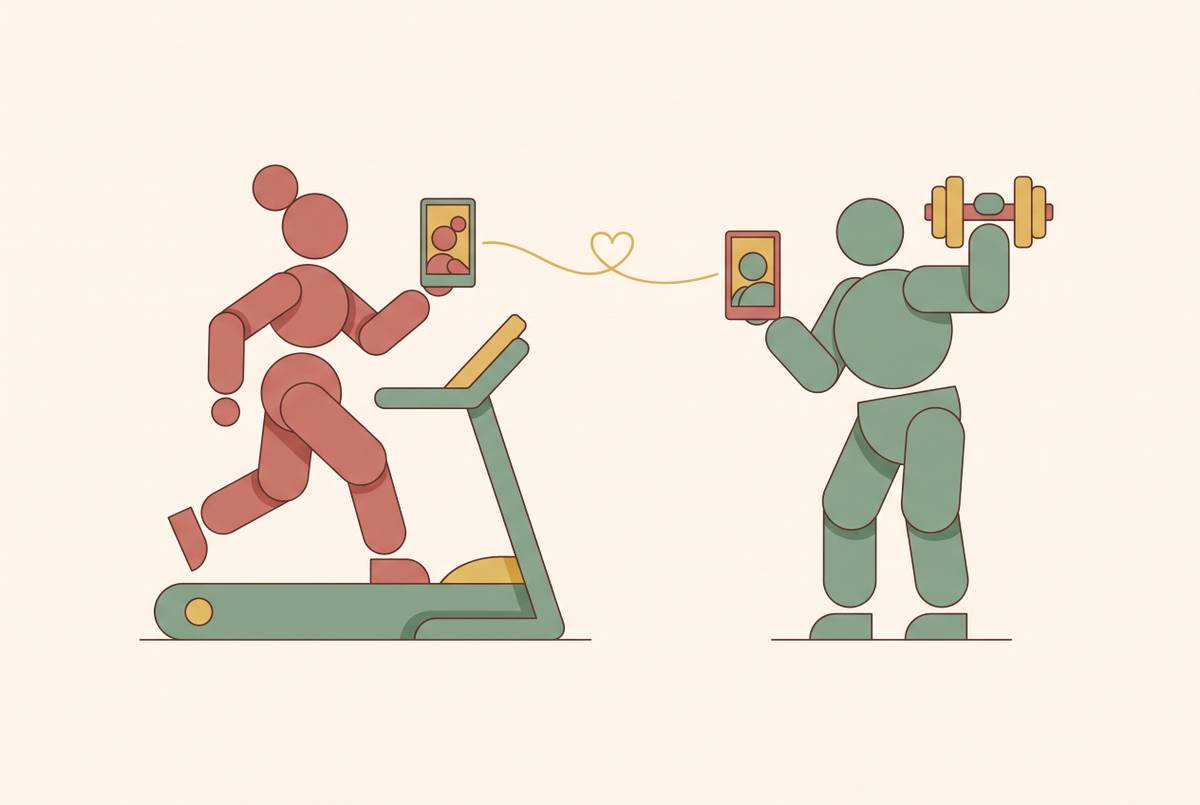
SweatCam makes that distinction concrete by logging each workout with a photo when it happens, so a partner can see it in real time. A picture gives the check-in a human subject. Instead of an abstract count, there is the person doing the work, perhaps sweating at 6 a.m. The photo makes attendance visible while the week is still unfolding.
For couples in different time zones, that separates connection from coordination. The workout can happen on one person’s schedule, while the photo becomes available for the other to see. Partners share in seeing the effort without having to agree on a gym time that works on both sides of the clock.
How the social cost of skipping turns a missed workout into something that matters
Visibility creates an audience, but an audience alone is not accountability. The second lever is what changes once that audience is someone who cares. Skipping creates an absence the partner may notice, which gives the original commitment more weight when the alarm goes off.
The wedding context strengthens that connection because both partners have a stake in the same deadline and social event. Neither is simply supervising someone else’s project. Aqil Fitness Training Solutions describes how couples remind each other why they started, push each other, and celebrate their wins. Those responses give a check-in a purpose beyond recording attendance, because someone can help reconnect an awkward Tuesday with the reason for starting.
That only works when honesty remains safe. If every missed workout prompts judgment, the cost shifts from skipping exercise to admitting it. A partner may start avoiding check-ins rather than looking forward to support, undermining the visibility that made the arrangement useful. Accountability has turned into surveillance, and the couple now has a gym compliance department.
A missed session is something to acknowledge and work around. The wedding countdown naturally favors that supportive approach because the deadline belongs to both people.
How light stakes convert good intentions into action through loss aversion
A shared goal can still feel distant on a busy morning. Light stakes bring a small part of it into the present by attaching a defined consequence to the commitment. Buying dinner or taking on a chore is more concrete than promising to become better about the gym. The future goal may be meaningful, but Tuesday responds to specifics.
This is the logic of loss aversion. A small, clear loss can motivate action more directly than a fuzzy future reward. It is fair to doubt how much a dinner wager can do for a wedding fitness goal. But its smallness is the point. It gives the decision a little friction without making a missed goal financially or emotionally punishing.
Heavy stakes can damage the system they are meant to strengthen. If the consequence invites shame, resentment, or competition, honest check-ins become harder. Underreporting failures then weakens visibility, leaving the other levers with less to work on. A playful wager is not a watered-down punishment, but a way to keep the commitment noticeable without making the partner threatening.
Couples can move a missed Tuesday session and avoid triggering the wager by still meeting the agreed weekly target.
Why mismatched fitness levels don't break the system — and how to handle them
Shared accountability does not require identical workouts or matching strength. Its basic unit is showing up. A beginner and a seasoned exerciser who complete the same number of agreed sessions can be equal under that structure, even when the sessions look nothing alike.
Giving both people an identical session can leave the experienced partner bored and the newer one overwhelmed. Neither response helps the next workout happen. Fitness differences deserve recognition, but couples do not have to eliminate them before building a shared routine.
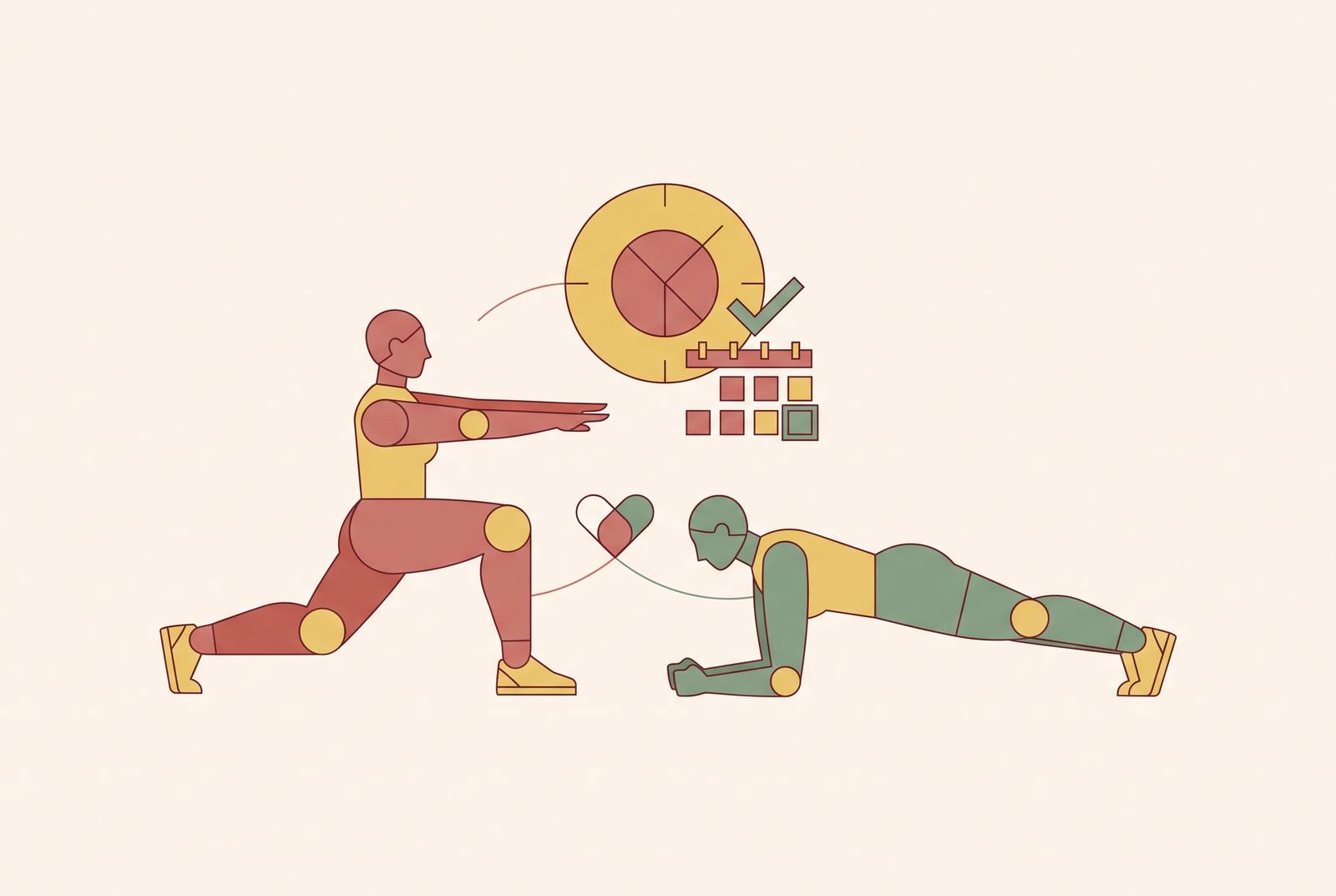
For partners who want to train side by side, the practical adjustment is to use the same exercises with different reps, sets, and loads. A personal trainer can use progressions and regressions to adapt the same movement pattern to each person. FITPASS recommends identifying differences in fitness level early and building a flexible plan around them. The aim is to grow together.
Training with someone familiar can also make starting less intimidating for a beginner. One shared session per week can support connection, while SweatCam check-ins provide visibility when exercise happens at different times and places. For long-distance partners, that flexibility is central, because a workable system must accommodate separate days.
How to phase the countdown so the habit outlasts the deadline
The countdown gives couples an order to follow that a fitness goal with no end date often lacks. Holding each other to their goals early gives the routine time to stick before wedding stress builds. Couples who wait until six months out have to learn a new habit while more things compete for their time. The deadline is useful, but it should not also be the starting pistol for panic.
An early start gives the three levers time to work through the awkward middle of habit formation. Novelty fades before a behavior necessarily feels automatic. During that gap, visible effort, supportive check-ins, and small stakes give the commitment a structure beyond the initial excitement. Couples who begin early have more time to cross that stretch before the final planning rush.
During months eight through five, the habit should be established enough to support a focus on more substantial body composition changes. Sustainable changes in muscle tone and energy take time, rather than arriving on demand because a fitting is approaching. This phase is a chance to let an existing routine do its work while both partners keep witnessing the effort.
In the final eight weeks, the advice is to focus more on managing stress through mobility, Pilates, and Zone 2 cardio. This is a period for protecting what has been built as wedding stress climbs. The accountability structure can stay familiar while the exercise focus changes. A photo check-in still makes effort visible even when the session is gentler.
The longer-term payoff is a shared routine with a life beyond the event. Aqil frames lasting healthy habits as the real win. The wedding day is not the finish line, but the first proof that the habit stuck.
Choosing the right tool for how your workouts actually fall apart
Is the problem that nobody sees whether they happen, that a partner cannot see the training behind them, or that exercise gets lost among other habits? Those are different gaps. Choosing an app by its longest feature list can leave the original problem untouched, only now with more notifications.
If workouts lack visibility, SweatCam’s photo check-in addresses that directly. It makes attendance a shared signal rather than a private record that requires a later report. That is useful when the immediate task is building a habit, especially when partners exercise in different places or time zones. Its criterion is presence, which is both its purpose and its limit.
If attendance is already reliable but one partner wants to see the other’s actual lifting, Hevy serves a different need. Hevy lets partners follow each other, share logs of their full workouts, and see the weights and reps they did. That suits couples who run their own lifting programs and want transparency about the work itself. A photo says the session happened, while a training log shows what was done.
If exercise sits among several wedding-prep behaviors, Habit Huddle offers a habit-focused structure across iOS, Android, web, Discord, and Twitch. Habit Huddle tracks one habit per huddle, with one daily check-in and a shared Checkin Chain. Each habit has a Floor, the bare minimum that counts on a rough day, and a Ceiling for a good one.
Being present is not the same as making progress, and couples who already train consistently may need more than proof of arrival. The choice therefore turns on the missing behavior, with presence tracking for habit formation and performance tracking for training depth. For long-distance partners, the right tool lets each person see that behavior even when their schedules differ, without either having to oversee the other.